
The stone marks the ending.
The story begins before it.
Gravestones is a collection of short stories inspired by epitaphs—imagined lives behind the few words left behind.
Stories by Evangeline Bell
Story Number One:
Story Number Two:
Story Number Three:
Story Number Four:
Story Number Five

Sadly Missed
Sheila.
He thought of the twinkle in Sheila’s dark eyes and her wide generous smile.
He saw Sheila dancing in that green silk dress at the university New Year Ball during his final undergraduate year. That’s where Sidney had met her.
She had looked so tall, so elegant: so beautiful. She had swayed to the music like a willow tree in a breeze.
He saw Sidney and Sheila holding hands as they walked barefoot through the shallows. He saw the waves rolling in, breaking and then little fingers of water scuttling up the beach before vanishing into the sand.
Sheila had laughed as she has watched the terns diving for fish. It was an infectious giggle which frequently turned into a snort.
She had been so happy.
And Sidney had been happy.
Then Sheila had told Sidney that she was pregnant.
Sidney had insisted that she have an abortion. They had only just graduated. They had student loans. They had careers to establish. He didn’t want a baby.
Sheila did.
They had argued. Sidney had been adamant and eventually Sheila had acquiesced.
And Dr Jackson, newly qualified and eager to help his friend, had arranged it.
Fell Asleep
Naomi looked down.
She wondered why she was not falling. Instead, she seemed to be hovering high above a scene which reminded her of a hospital drama. The figures moving below her were like small dots in a distant landscape.
She felt weightless.
Was she in space?
She recalled seeing astronauts on board the ISS doing somersaults and she tried to do the same. No: she couldn’t physically move.
Why couldn’t she move?
She tried to look at her own body, only to find that she seemed to have lost it.
No. There it was—far below on the operating table. It looked very frail.
How did it get there? Or, maybe, how had she got here?
She wondered if she would ever find herself inside it again.
Did she even want to go back?
It was nice up here.
Naomi had carried a burden for a very long time. She had grown tired of carrying it and, now, it seemed that the weak body lying on the surgical table was carrying it for her.
Perhaps this was a good time to leave it behind.
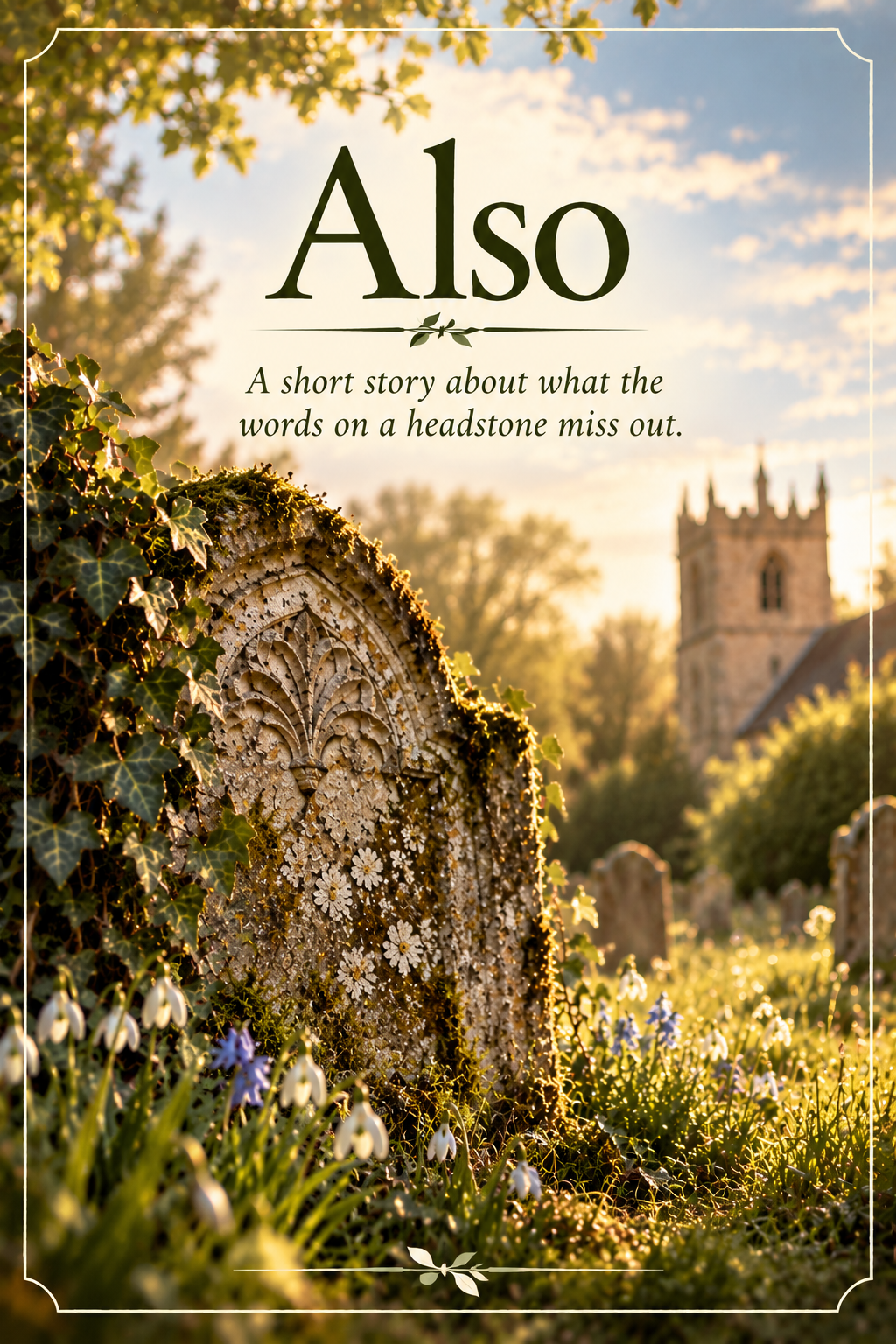
Also
The present day
Joanna frowned. It was a funny little motion, more indicative of disappointment than annoyance. She was with her father and they were staring at a lichen-covered headstone which had, until five minutes ago, been covered with ivy. They’d cut away the vegetation, only to find that most of the inscription was unreadable. A good third of the stone had clearly sunk and any names carved thereon were lost to posterity. At the top of the stone there had been some sort of elaborate pattern but it was mostly eroded away, as were the names of the first generation to be interred in this ancient family plot. The only decipherable name was ‘Matilda’ and that was under a part of the stone which was flaking away but on which the single word ‘Also’ could just about be made out. That was it.
‘Also, Matilda’
Joanna and her father were researching their family tree. They’d been told by the cemetery record office that plot no 57 had belonged to the Selsdon family and that they could have a look at it. It had taken some searching to find it, all overgrown with ivy and hidden in an area of long grass, nettles and tangled columbine which ran over everything. Once they were sure they’d found the correct stone, they’d cleared away the ivy, hoping to find a list of names and dates which would provide new leads. It was disappointing.
‘After all that work’, said Joanna, ‘all we’ve got is an “Also”.’
They sat on a broken old park bench, which had a small brass plaque commemorating the memory of an Arthur Davis half screwed to the top of the back of the bench, and looked at their newly cleared headstone.
‘Fancy being an “Also”, said Joanna’s father. “Would you like to be an “Also”, Joanna?’
‘I would not.’
‘Your whole life - and all you got was four letters … “Also.” It doesn’t tell you much, does it?’
‘No.’
The thought nagged at Joanna. Who was Matilda? What kind of life had she led? Why had she ended up being an “Also” on a Selsdon family gravestone? She decided that she would do her utmost to find out.
Aged 98
Elsie Grainger looked terribly small and terribly frail. Her white hair was so thin that you could see a pinkish, blue-veined scalp clearly showing. Usually, she wore a hat to cover her head and to help keep her warm. Her face was so wrinkled that it was hard to believe that she had ever been a young girl who played hopscotch and thrust bluebells, picked in the woods, into a jam jar. Her skin was perished and she was so very very thin.
Elsie sat in a deep armchair near a window. The chair was large and she was so small that visitors could be forgiven for thinking that there was no-one there. Sometimes Elsie felt that they were right: her life was coming to an end simply because she was fading away. One day, she thought, she’d just not be here anymore. No-one would miss her. No-one would even realise that she’d gone.
It was so very sad. Elsie’s beloved husband, Dennis, had died over 30 years ago. Their son, Benjamin, had died last year. That had been such a shock to her. She had never imagined that Ben might die before she did. When they took her to see him in the hospital, she had barely recognised him but she knew him by his scent. Despite his illness, despite the abundance of drugs they’d pumped into him, Elsie could still detect the odour of her baby boy. She’d sat with him as he’d passed away … and was still amazed that her own frail heart had kept on beating after it had been thus ripped from her body. But it did.
Ben had been her last link to a living family. She had grandchildren, even great-grandchildren, she believed, but Ben’s marriage had failed and his children had gone to live with their mother. They’d barely seen Elsie after the divorce and, most likely, had forgotten that she existed or believed her to have already died. It left her alone and terribly vulnerable.
Elsie looked out of the window. It was a dull day in early spring. From her chair she could see a robin hopping about on a patch of grass. In one corner, a few daffodils bobbed their heads about as a thin drizzle made the outside world damp and grey.
The greyness of the day meant that Elsie saw her own reflection in the window. She saw a young woman wearing a dress which aped the ‘new look’. The full polka dot skirt and tightly cinched waist, emphasised by a wide black belt, gave her a shapely figure. Her bright patent leather stiletto court shoes were accompanied by a matching handbag. Her fair hair framed her face in soft sculptured waves. Elsie smiled; she recalled how hard it was trying to replicate the style of Lauren Bacall. This was the outfit she had been wearing the day she met Dennis. Was it really so long ago?

Artist
Celia had always been told that she was no good at anything. She certainly felt that way. She had found it hard to learn to read, hard to write and struggled with her numbers. She had a poor memory and often irritated people because they had to tell her things over and over before she’d understand or remember them. She was always the last to be chosen for a team in sports. No one wanted to be her friend. She was easily bullied.
Poor lonely Celia. Her mother worried about her. Her father ignored her. Her teachers gave up on her.
Celia could not have explained any of this - but she knew. She felt it. Inside, she was a tiny, frightened kitten who blinked uncomprehendingly into the light and sensed herself to be unwanted and vulnerable. So Celia did not speak. She hid herself inside herself and dreaded being forced to leave her room and meet people. People, she thought, were unkind.
But God had given Celia a special gift. And, one day, he gave her the chance to find it.
It was the Christmas season. Celia was with her mother in a shopping mall where a craft market was taking place. She was as mesmerised by the flickering illuminated decorations as she was disorientated by the crowds. Attracted by the colours. Celia was drawn to an area where people were using vibrant acrylic paints to paint pictures and decorate ceramics. She stood looking over the barrier for a while when one of those running the event spotted her. A kindly looking elderly lady came over to Celia and asked if she’d like to have a go. Celia shied like a startled horse but the lady’s warm smile and kind eyes invited trust and Celia allowed herself to be led to a low table where there were pots of coloured paints, various brushes and large sheets of paper. She had no idea what to do with them. But the nice lady showed her how to make marks with the brushes on the paper. Celia tried to use the brushes but found that she preferred to dip her fingers in the paints and make her own marks on the paper. She was fascinated by them. She liked the silky feel of the paint. She liked the way it dripped in thick blobs. She found that she could make fine trails by moving her fingers and big splodges by pressing the heel of her hand. She liked the way the colours could be merged. Celia ‘ooed’ when she saw the impact of white as it turned a brilliant red into a strawberry pink.