

04 How to make learning easy: the power of multiple processing
Learning shouldn’t be hard. Of course, everyone comes across something they find difficult at some point and there will always be those who struggle. But, for the vast majority of students, the process of learning things should not be hard because human beings are learning machines. We’re built to learn.
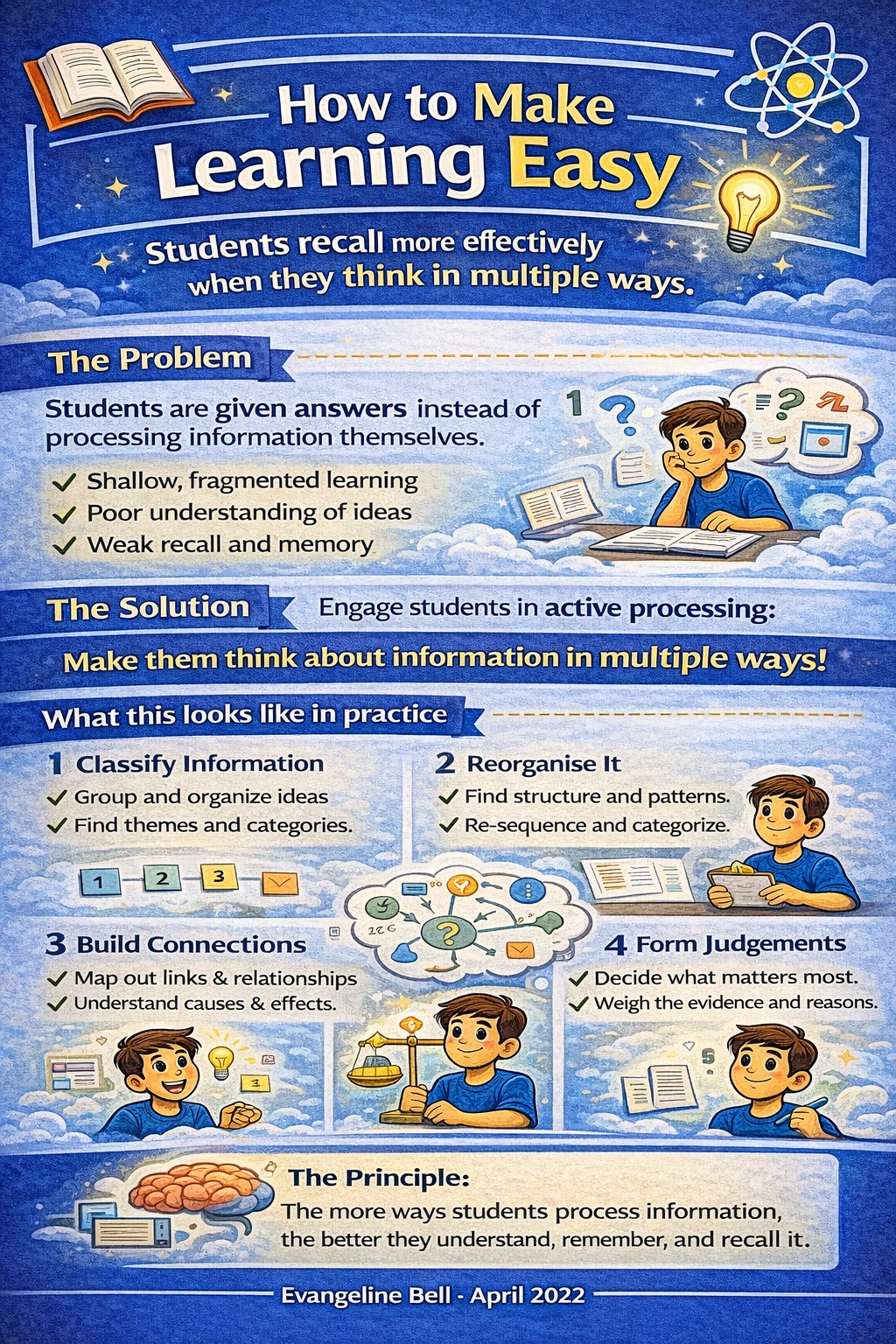
Processing
First, let us remind ourselves of what we mean by ‘processing’. These are the activities which teachers give students to do in order that they can make sense of new information. Ideally, students should be able to fit this new information into established patterns of meaning. In addition, I have argued in a previous blog that students should be encouraged to engage in a process of active memorisation and recall and then compose their understanding into a piece of written prose in order to make sure that they understand what they are supposed to have learned, to lay down complete memories and to ensure that they can retrieve their memories when called upon to do so. I have also argued that learning should be holistic and not fragmentary. It may be that we ‘chunk’ or ‘slice’ learning into digestible pieces – but it is equally important that we make the students themselves, and not the teacher, synthesise this back into a whole before leaving the learning and moving on to something else.
The purpose of this blog is to argue that strategies which involve multiple layers of processing are more effective in securing learning than singular strategies.
Back to an old idea – ‘thinking skills’
Several decades ago, there was a fashion for teaching via ‘thinking skills’. In Somerset, the Local Authority put a lot of resources into developing a ‘thinking skills’ programme – a curriculum based on teaching students how to look for various forms of abstract patterns and how to apply this to real-world subjects. Research establishments focused intensely on pedagogies which were intended to be transferable from one discipline to another. Schools experimented with ‘learning to learn’ or ‘learning brilliance’ or ‘learning excellence’ programmes. Essentially, all of these were aiming to teach students the power of metacognition and to encourage them to take independent responsibility for the way they learned. Unfortunately, these programmes were insufficiently successful in that it was hard to draw a direct line between them and examination outcomes. Teachers did not like teaching them and they dissolved into a sequence of fairly pointless tasks.
However, like many initiatives in education, there was a core of good sense at the root. Those of us who are successful at academic study – and all teachers are, by definition – are generally very good not only at identifying patterns for ourselves but at taking in information by listening, by reading and by doing. This might be because we have taught ourselves to be so. It might be because we are naturally good at it. It does not matter why; the simple fact is that we can do it. We are the exceptions, however. Many students are not naturally good at these things. They need to be taught. The problem with the ‘thinking skills’ programmes was that these skills are not best taught as a discrete subject. They are best taught via substantive content. However, this does not mean that the very idea of ‘thinking skills’ has no merit. It absolutely does. It is just that these skills need to be learned in practice, rather than in theory.
How to put ‘thinking skills’ into practice
One teaching method which illustrates how to put ‘thinking skills’ – or what I would prefer to call ‘active processing’ into practice is a method known as ‘inductive learning’. It is not the purpose of this blog to give a detailed explanation of how the inductive method works and how it might be applied to different contexts. What I want to do is to demonstrate how I applied this method to my subject, History – and then draw a more universal conclusion.
A core concept in History is that of causality. At GCSE level, most questions are either evidence-based questions or are some incarnation of a question related to causality: why something happened in the past. I could, of course, have taught an answer to this question which would have essentially amounted to the transfer of knowledge and understanding from the teacher to the students. That would have required the students to listen to the teacher and internalise the teacher’s answer to the question. I didn’t do this. Instead, I posed the question as a problem to be solved. I gave the students an assortment of events, all of which did contribute to causing the outcome. I asked them to classify them thematically. I then asked them to classify them chronologically (that means into ‘long term’ and ‘short term’). I then asked them to form chains of causal connections. And, then, to form a judgement about the relative importance of events. At this point, I asked the students to give their complete understanding of the topic and convey that to me in writing, usually in the form of a formal essay.
The ‘inductive’ part of this sequence is the multiple layers of classification and the alternative ways of forming a conclusion – causal connections, judgement etc. All of this entails intense thinking by the student. The teacher is absolutely not ‘giving’ the student the answer to the question. The student is having to work it out for themselves. At the end of this process, the student a) has a much better understanding of the topic than they would have if they were just being asked to ‘lift’ an answer from the teacher, and b) is able to remember – and to recall – the topic more effectively. Moreover, because I asked the student to go through a sequence of thinking activities and because those thinking activities were related to our patterns of reasoning in History, the students were not only learning about the topic more effectively, they were also learning those patterns of reasoning which are all-important and would assist them in laying down memory for examination purposes.
The inductive method (and similar methods) can be applied to many contexts and it is not always about causality. The basic principle is that a problem is posed. The student is given an assortment of data. The student is asked to classify that data in a number of different ways before coming up with their own solution to the problem. The key idea is that the student is required to engage in multiple layers of processing information. This makes learning more effective.
A down-side to this concept of multiple processing is that teachers and students cannot move rapidly through a scheme. It takes time and teachers have to be constantly aware of how the students are thinking. This entails a lot of in-class assessment and in-class interaction between teacher and student. When teaching like this, teachers must be constantly on the move, talking to students, questioning students, asking student to explain their thinking. If teachers do not do this, students may go off in a completely erroneous direction. They may make conceptual errors or absurd connections. However, when done well, the quality of learning is significantly improved. However, in order to teach like this, we have to manage our time super-efficiently. This means that the old idea of every minute of every lesson counting really does hold true. We, as teachers, have to justify every single element of our lessons because we want the students to spend as much time as possible actively processing, memorising, recalling or writing.
Conclusion
Learning should not be hard.
If we have constructed a curriculum plan based around the core patterns of meaning within our subject discipline, if we have made memory and recall an intrinsic part of the learning process, if we have structured our learning programme so that it is systematic and ensured that students are required to learn holistically and if we have used writing effectively to ensure that students consolidate and articulate their learning, then we are on the road to successful outcomes.
The purpose of this blog is to focus on the processing part of learning – that which we ask students to do in order to make sense of new input. The argument being presented here is that students will be better able to make sense of new information if they are asked to process information in multiple ways: to look at the same information through different lenses or from different angles. They are also likely to retain more and be more able to recall more when we turn our attention to the recalling part of the process.