


Welcome to the Verbatim Blog - a space dedicated to expert proofreading and editorial insight. Here you’ll find practical writing guidance, academic tips, publishing advice and reflections on language, clarity and style. You will also find examples of my own writing - which will give you an idea of my versatility. New posts are added regularly and written by Evangeline Bell, Intermediate Member CIEP and PTC-trained proofreader.
Introducing ‘Gravestones - a collection of short stories’

Introducing ‘Gravestones’ - a collection of short stories based on the inscriptions found on headstones in the cemetery next to my home.
The idea came to me in early 2025 as I was walking my old dog around the cemetery. Bless him! Poor Tommy was almost 19 years old, deaf, blind and very arthritic. He still loved a walk, but he could only just manage a short one in the cemetery. Gone were the days when we’d happily walk for 5 or 6 km - and then some. As he pottered around on the end of a lead, sniffing at the headstones, I read the inscriptions.
Many headstones contain stereotypical inscriptions, as if chosen from a list of suitable epitaphs. There are many ‘Treasured Memories’ and ‘Passed Away’s- and they don’t tell you very much about the human being who is interred there. There are names and dates, and that’s pretty much it. Others are more cryptic and you think that, underneath those words, there is a real story to tell. One stone carries the words ‘A Truly Proud Man’. Another simply says ‘Artist’. In one grave, for instance, there are two 34 year olds who died on a single day, leaving three children behind - the headstone tells us that much. It screams ‘car accident’, but we cannot know that for sure. And, as I wandered among the rows of headstones, I spotted the same surname a couple of rows beyond and it took only a moment to see that these were the grandparents of the children left behind on that tragic day. The grandparents who had almost certainly erected the first headstone in the names of the three bereaved children and, most likely, were the ones who ended up raising them. But … I am inferring, for none of this is overtly inscribed on the stones in front of me.
Then there are those which plainly reveal a tragedy. There is one which has three infants who were born and died on a single day. Clearly, triplets who did not survive - and I imagine the poor mother interring her three stillborn children in this, now ancient, plot of land. There are military graves. Some are the recognisable white stones which fill every wartime cemetery in France and have clearly been erected by the MoD. But there are others, often relating to those who fell during The Great War. Their names are inscribed on family stones. Yet, when I investigated, their remains are not actually in this cemetery. They are interred in one of those memorials in France - probably in a plot without a specific name, an ‘unknown’ soldier. But they were anything but an ‘unknown’ to the grieving family left behind who, being unable to visit France, chose to inscribe a memorial on their own family stone. Often, these inscriptions include the military citations or the battles in which their loved one died - young men, often not out of their teens. The story here is as much that of a family, a community and a nation experiencing both a private and a collective trauma.
But, behind every inscription, fulsome or brief, there is a story. One grave bears the name of a man I once knew. He died by suicide - but the headstone does not record that, just his name, dates and that he was a much loved husband, father and grandfather.
It struck me so forcibly that each name was once a real person with a real life.
The other thing which is surprising about these graves is how short some lives actually are. You expect to see the graves of people who died in their 70s, 80s and 90s, but there are an awful lot of people whose lives came to an end in their 50s and 60s … or even earlier. There are children, teenagers, and young men and women. Every one of them would have had their hopes and dreams, just like we do.
‘Gravestones’ isn’t an attempt to tell the stories of real people. Rather, it is a collection of fictional stories intended to remind readers that every inscription is only the last word on a life which was far more complex than any short epitaph can convey. My favourite illustration of this is the word ‘Also’. How many family graves have added the word ‘Also’ to the end of a long inscription, and followed it by just a single name? A whole life reduced to ‘Also’?
Thus, one of my stories is called ‘Also’ and it attempts to reconstruct a life which deserved more than to be reduced to one word on a headstone.
My stories may be fictional and there is no intention to suggest that any one of my stories is based on the real life of an individual. I have imagined all the scenes and details in each one. But, together, I hope that they convey a rich tapestry of life in many forms and invite the reader to reflect on what it is that really matters in life - because life is all too short.
Please find extracts from ‘Gravestones’ on the Instagram account @gravestonesstories or on the Gravestones section of this website.
For all your proofreading and editing needs, contact Verbatim.
Precision. Clarity. Verbatim.
05 How to make learning easy: Recording and Revising
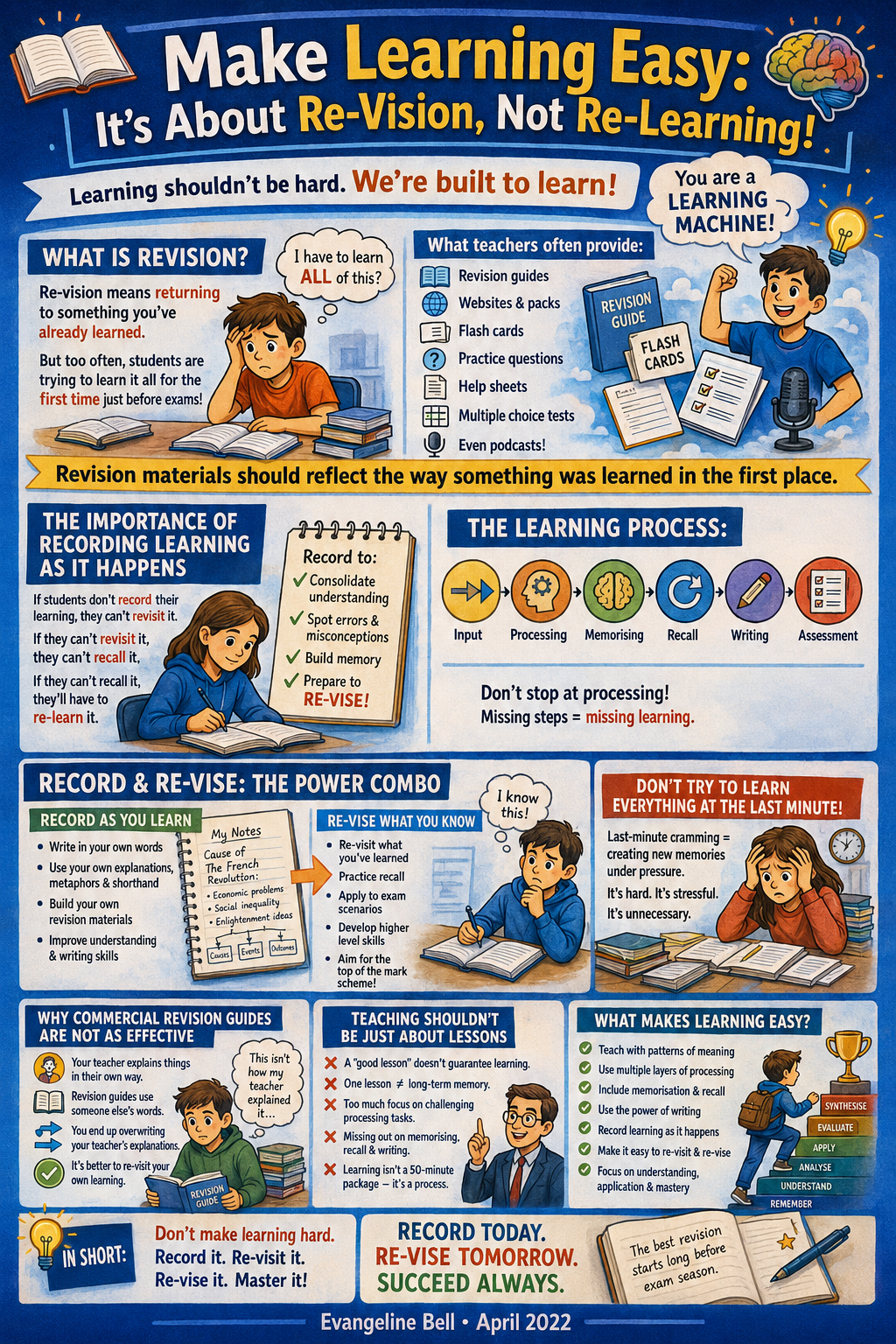
Learning shouldn’t be hard. Of course, everyone comes across something they find difficult at some point and there will always be those who struggle. But, for the vast majority of students, the process of learning things should not be hard because human beings are learning machines. We’re built to learn.
What is revision?
How many teachers have I seen provide ‘revision’ materials for students? They point students to a published revision guide, a website, a pack of teacher-prepared resources, commercially produced ‘flash cards’ …. etc. They provide practice questions and help sheets. Multiple choice tests on content. Even podcasts!
I want to argue in this paper that ‘re-vision’ implies a returning to something and, yet, too often, what actually happens in the lead up to examinations is that students are attempting to learn everything for the first time, as if they’d never really learned it in the first place. I also want to argue that, to make it easy for students to ‘re-vise’, revision materials need to reflect the way something was learned in the first place.
The importance of recording learning as it happens
Many years ago, a colleague asked me a question: why is it that I can teach ‘good’ lessons and, yet, the students don’t get good results? What he meant by ‘good’ lessons were lessons which had been graded ‘good’ by observers, using the then criteria used by OFSTED. The answer is that, too often, OFSTED spend their time looking at what teachers are doing and insufficient time looking at what learners are learning. A more important issue is that the concept of the ‘lesson’ leads to a poor way of engendering learning.
Let us consider what we mean by a ‘lesson’. For over 20 years, the ‘lesson’ has been the key focus in teacher training, inspections, quality assurance and most CPD. Essentially, it means ‘the package of activities which teachers and students engage in during a fixed period of, typically, 50-60 mins’. There are variations on a theme and different opinions about what elements ought to be in these ‘lessons’. Some schools have a very rigid approach. Some are more flexible. However, the basic idea is that it is engagement in these activities which drives learning. There is much talk about making these activities ‘challenging’ – the inference being that the harder students have to think, the more effective the learning will be.
That is partly true. Clearly, it does matter what students do when they are face-to-face with their teacher. Clearly, it matters what teachers do when they are face-to-face with their students. And, as I argued in my paper on processing, there is a kernel of sense in the idea that thinking aids memory. In this series of papers, I have argued that there are, indeed, various elements to the process of learning:
· Input
· Processing
· Memorising
· Recall
· Writing
· Assessment
But, I have been very careful not to use the term ‘lesson’. This is because I believe that the idea of forcing individuals into a position where they have to imbibe information, learn to do something, make conceptual leaps etc within a succession of equally fixed time periods is ludicrous. We all know that different things take different lengths of time to learn. So, a teacher who stands there and tells his/her class that the ‘learning outcome’ for the session is X and expects that this one session is going to achieve that may be well-meaning but is likely to be only ever partly successful, at best. It may be that a critical mass of students understands something during that session that they did not know before. It may be that they are exposed to some new information that they have never seen before. It may be that they have a go at a new skill or think about something in a new way. Yes – there are lots of things done in lessons which are a necessary and valuable step on the road to learning. Indeed, if the curriculum plan is constructed in accordance with the core patterns of meaning inherent in a subject, if teaching is organised and holistic, if multiple layers of processing are required, if the power of writing is harnessed and if the acts of memorisation and recall are an intrinsic part of the teaching and learning process, it is quite likely that the impact of what happens in lessons is very effective.
But the experiences of a single ‘lesson’ alone are hardly likely to engender long-term learning. This is especially true when the default structure of any ‘lesson’ is a sequence of processing tasks. Now – I’m not criticising the concept of processing. Indeed, my last paper was arguing that multiple layers of processing are critically important in engendering long-term learning. I am arguing that teachers have been conditioned to think that EVERY lesson should require learners to engage in a sequence of processing activities and that the more challenging they are, the better. The subject of creating appropriate challenge is a topic for another time. In this paper, I want to argue that teaching which is constructed solely around a sequence of ‘lessons’ consisting of challenging processing activities is misguided. Even if these activities are intrinsically good – and let’s assume that they are – what they are asking the students to do is use their active working memories in the belief that this will transfer information into their long-term memories. As I argued in an earlier paper, there are as many such activities as there are grains of sand BUT they are not all equally effective, and they are not all equally effective for all learners. I argued that there are many times when I’ve felt that something has worked, only to find weeks later that it has not. For this reason, learners require time to consolidate their learning: to reflect on their thinking, to make the relationship between new input and those core patterns of meaning secure - and the act of recording their learning helps to do that. It also helps teachers to spot errors, misconceptions, missing items and erroneous connections and conclusions.
Let us return to my colleague’s question. It is quite possible to teach a sequence of ostensibly ‘good lessons’ without the learners retaining very much at all. This is because the assumption is that it is these challenging processing ‘tasks’ themselves which powers the learning. Now, as I shall show in another paper, this is not true. Processing tasks are necessary in teaching and learning, as is appropriate challenge, but no matter how effective the immediate in-class experience appears to be for learners, it is inevitable that they are going to go away and that much of what they temporarily learned in that session is forgotten in the hurly burly of daily life. This is absolutely true if the process of learning is merely a sequence of input, processing and assessment and without the elements of memorising, recalling and writing. If the end point of a course is an examination, and if that examination contains a significant written element, then, there is going to come a point where the learner has to re-visit prior learning and revise it.
For this reason, it is important that learners record their learning as it occurs. When they need to revise, they need to re-visit what they have already learned. Re-visit! The general idea is that, thanks to the well-designed processing activities and, if done well, the embedded elements of memorisation and recall, they have already stored the critical mass of the required learning in their long-term memories. Re-vision is all about practising recall and bringing what has already been learned back into the working memory. It is about applying learning to potential examination scenarios, honing techniques and pushing on to the higher levels required in whatever mark scheme is going to be used, usually by synthesising various elements of learning into a whole. What they do not need is to be put into the position where they are being asked to learn the entirety of a course within the few weeks prior to an exam. What we are doing to students under these circumstances is asking them to create new memories in a very short period of time. And, quite frankly, this is exactly what many teachers actually do! This is to make learning a lot harder than it need be.
I cannot count the number of occasions when I hear teachers talking about giving students ‘revision materials’ – and so many of them are summaries of what the student should have already learned. Why? The answer to this question is that the students have basically not learned it. Why? They were not required to record their learning as it happened and, so, did not consolidate that which they did understand at the time their first encountered it. Why? The answer to this question is that teachers were more obsessed by structuring a sequence of activities which met the criteria for a ‘good lesson’ – typically a sequence of challenging processing activities - than they were about ensuring that the students were in a good position to revisit their learning at a later stage. They also did not include memorisation, recall and writing in their teaching and learning cycle. They just assumed that input, processing and assessment alone would engender learning.
Commercially produced revision materials are not as effective as recording learning as it happens
If a student engages in a course of learning – for those of us in secondary education, this largely refers to our GCSE, A Level and Btec courses – the way they learn something matters. If I – as the teacher – explain something, I use my own choice of vocabulary. I use my own metaphors as illustrators. I use my own short-hand aids to memory. I explain important concepts the way I understand them. What I am hoping is that the student will end up seeing whatever it is in the same way that I do. After all, I’m the expert. But, if the student does not make an ongoing record of their learning – the way they’ve understood these things – and, at the end of the course goes and buys a revision guide, it is highly unlikely that the person who wrote the revision guide used exactly the same explanations as I did when I taught them originally. Under these circumstances, the student is, effectively, choosing to listen to an instructor who was not the person who originally taught them. They are attempting to overwrite whatever it is that they can recall from their own teacher with that written down in the revision guide.
Now – I’m not saying that students cannot learn from revision guides or ‘knowledge organisers’. Of course they can. Indeed, you might choose to make such a resource the default resource for your course and, if you do, then it will double as the default revision resource as well. Moreover, I’ve contributed to the production of a commercial revision guide and, when I was 16 myself, used one to pass my Chemistry exam. Indeed, it is having had to do that which tells me that attempting to learn an entire course from scratch between February and June of Year 11 is a foolish idea – and much less effective than being in a situation where I had an ongoing record of my learning done in the way that I learned it at the time. Why? In effect, I was discarding everything that I had done in Chemistry class in favour of memorising the content of my revision guide. I may point out that it worked and I got a very good grade in Chemistry. But it did mean that pretty much the entirety of the 2 years I had spent in Chemistry class were a waste of time. And I could not have done that for every one of my courses simultaneously.
Recording and revising
My contention is that one way of interpreting the sequence of elements in the learning process which is listed above in this paper and, again, in my paper on ‘memory, organisation and recall’, is to make recording an embedded part of classroom practice. What I mean by that is that students should be required to write in prose – in clear, accurate and well-constructed written English – their total, complete and holistic understanding of what they have learned. We might call this the ongoing construction of their own revision materials. If we do this, not only would it enable the learner to consolidate their understanding of what they’ve learned by having to compose a piece of text to explain it, it would also give them the opportunity to practice their writing skills and give them materials to revise from which match the way they learned whatever it is at the time they learned it. This would, in turn, mean that when students come to re-vise, they are actually revisiting prior learning and not trying to learn everything from scratch in the weeks leading up to an exam.
Under these circumstances, a commercially produced revision guide or a ‘knowledge organiser’ may become a supplement during revision. But, too often, it is the only source of material for revision because students have not made an on-going record of their learning as they learned. This is to make learning unnecessarily hard for the student.
Conclusion
The core theme of these papers is that learning should be easy. Yet, too often, teachers make it overly difficult. In this paper, I have argued that the nature of revision means that students should be ‘re-visiting’ things which they have already learned. They should not be trying to learn an entire course in the weeks leading up to an examination.
I am arguing that on top of all the other things I’ve talked about in this series – patterns of meaning, memory, metacognition, systematic teaching, holistic learning, multiple processing, writing – requiring students to record their learning as they learn is an important aid to making learning easy. Not only should students be using a process of recording to consolidate their understanding as they encounter learning for the first time, not only should teachers be using this as a diagnostic tool to evaluate the quality of that learning, but students should be producing materials which will enable them to re-visit their learning in the way that they originally learned it. The memories laid down at that time should be located, retrieved and re-worked in preparation for an examination. Moreover, instead of spending time creating new memories, students preparing for examination should be spending that time practising application and developing advanced skills which will enable them to reach the higher levels of whatever scheme of assessment is being used in the exam.
Finally, I have also argued that a core reason why teachers make learning overly hard is because of the default position that teaching is all about the construction of a ‘lesson’. It isn’t and it shouldn’t be. It should be about finding every possible route to making it easy for students to understand, memorise, recall and apply.
If you publish books or educational materials,Verbatim is here to help, not just with proofreading but with professional expertise.
Precision. Clarity. Verbatim.
Blackpool Rock
Blackpool Rock
Disclaimer
‘Blackpool Rock’ is a work of fiction and satire. The characters, organisations, institutions, policies, events, and dialogues portrayed in this story are products of the author’s imagination. Any resemblance to actual persons, living or dead, schools, trusts, employers, educational institutions, policies, practices, or real events is entirely coincidental and unintended. No character is intended to represent any specific individual, and no organisation is intended to represent any real institution.
This story is based on the author’s observations during her teaching career but it is ntended as a satirical commentary on organisational culture, not a realistic portrayal of an actual school, The characters are intended to be broad archetypes: the pompous principal, the ambitious young careerust, the cynical veteran, the subject specialist, the union rep and the complaint colleague.. They are educational stereotype, not portraits of real people.
Part One: The Principal
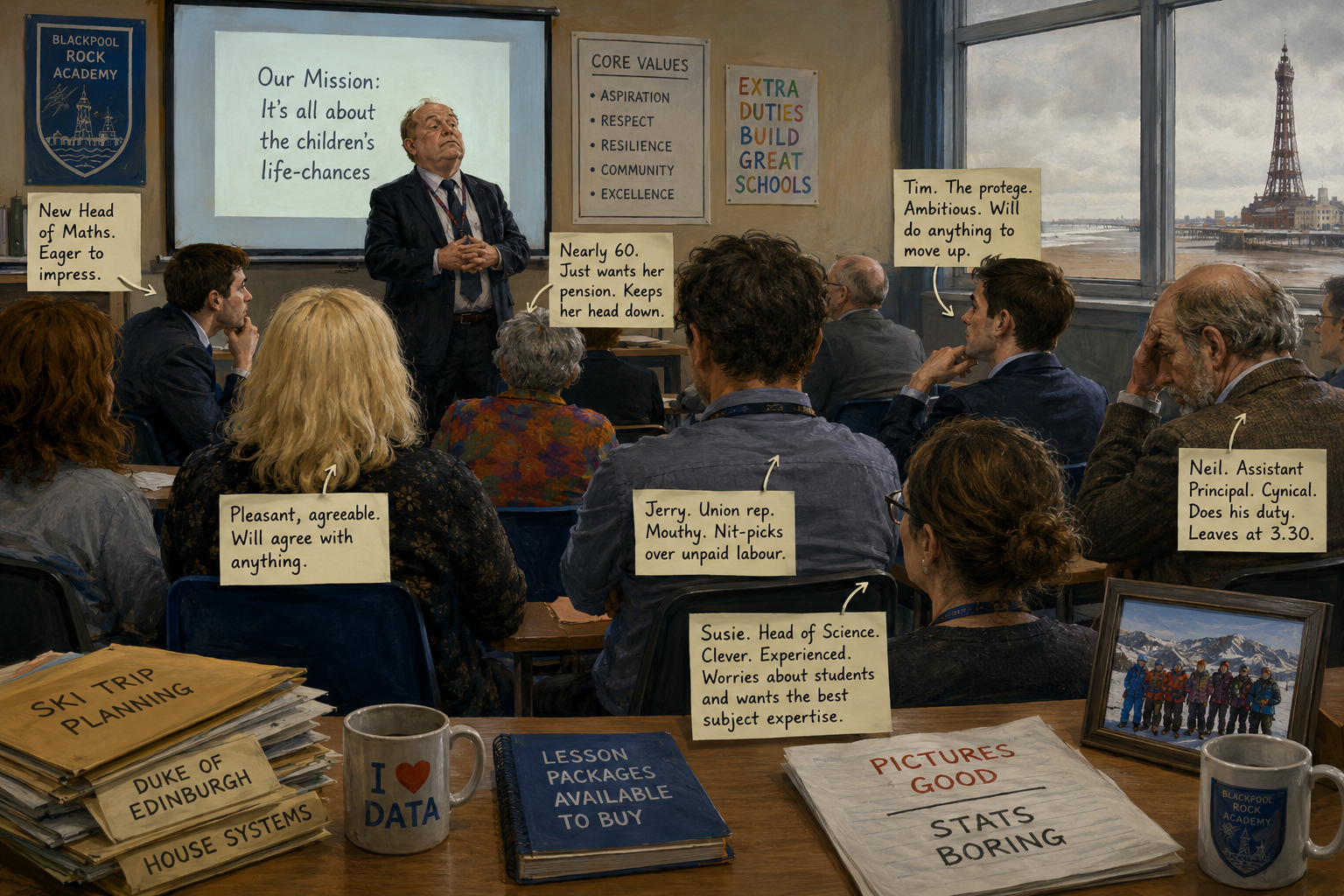
‘We must always keep the thought that it’s all about the children’s life-chances at the front of our minds,’ he said pompously. The Principal was a short man in his early forties. His slightly greying head wobbled ostentatiously on his narrow shoulders as he stood before the assembled staff on the first day of term.
He looked over the sea of faces as he gave them the obligatory start-of-term lecture. Over to the right was the Maths dept: the new Head of Dept was leaning forwards attentively. He was soaking up every word, determined to prove himself in his new post. On the front row was a plump woman with bleach-blond hair. Pleasant-faced and smiley, she too, was an easy convert. Whatever she thought, she’d toe the party line and nod along. If he said that the best way to learn was to dress the children in swimming trunks and make them do somersaults during registration, she’d agree - and say she was sure she’d heard it somewhere before. There was an older woman in a brightly-coloured top at the back. She looked sceptically at him but he knew that she was just a time-server. In her early 60s, she was just waiting for the right moment to secure her pension. She might see right through him - but she was no real trouble at all. She’d keep her mouth shut and just sit tight.
In the mid-centre sat Jerry. Hmm! More of a problem. He was the union rep. A mouthy bastard who nit-picked over every bit of unpaid labour. Didn’t he know that teaching was not a job, but a vocation? They were supposed to put in unpaid hours; it was all about the children’s life-chances after all. But … the staff needed to think that their views counted and giving Jerry an hour of his time once a month was a small price to pay to secure general compliance. School trips needed organising and the budget wouldn’t run to paid revision classes.
Over there, near the wastepaper basket, sat Tim. Ah! The protégé. Tim was only in his second year but it wouldn’t be long before he would be ensconced on SLT. He had the right stuff in him: a proper little toady, but bags of energy and a shiny-eyed expression. Tim would start the applause in the appropriate pauses. His hand would shoot into the air during questions and he could be relied on to serve a softball which really just required a self-congratulatory validation. It could be batted back across the net with a flourish which made an empty banality look like a stunning backhand volley. Now, that’s the kind of person SLT needed.
Not like that balding and grizzled Assistant Principal propping up the corner over there. True: Neil had probably been a Tim in an earlier life. But, somehow, inertia had got a grip and his career had stalled. Now in his early 50s, the glee-eyed expression had been replaced by a dull cynicism. He was a solid performer in the classroom … but utterly uninterested. He did his duty but, unless he was on the rota for late night detentions, he left the premises at 3.30 on the dot. There was no point in asking Neil to run next year’s skiing trip during the Easter holidays. He’d give a flat refusal and there was no way to morally blackmail him into it; he’d abandoned any hope of further promotion years ago. No: Tim would probably do it, though.
And … who cared if Tim’s experience was small and his short record unremarkable. He knew all the right things to say and better to have a few photos of half a dozen kids in woolly hats, smiling on the slopes and eating apres-ski pizza than worry about a few grades here and there. Susie, the Head of Science, could be blamed for Tim’s inadequacies, anyway - and social media preferred pretty pictures to hard stats.
Susie was a worrier. Clever, experienced and unambitious, Susie wanted the children to succeed in the sciences. A chemist herself, she worried that she had not got a graduate physicist to teach the A Level Physics course and develop the physics side of the curriculum. The Principal’s lip curled. He’d appointed Tim, a biologist, instead of the physicist Susie had wanted because Tim’s performance on the day of the interview had showed what outstanding potential he had. Susie had ranted about subject expertise and how that mattered for the students. But the Principal knew better. Susie was one of those stick-in-the-mud middle leaders who was obsessed by their exam outcomes and could never see the bigger picture. It took visionary leaders - like himself - to see that ski trips and Duke of Edinburgh schemes and House systems - and people who would do extra duties on rainy November days - were more important than subject experts. Lesson packages could be bought in. Anyone could teach physics as long as the resources were good enough: it was all about ‘delivery’.
Tim had been appointed. Susie continued to moan about the lack of a physicist in the department. But the Principal, looking across his staff, knew that he’d made the right choice as Tim started the clapping. The Head of Maths joined in. The bleach-blond head nodded. The brightly-coloured woman smiled knowingly. Jerry, the union rep pursed his lips and folded his arms. And Neil’s face remained impassive.
Part Two: Neil
‘And how do you intend to ensure that these students achieve their target grade?’ Neil asked Susie.
He already knew the answer she would give. He’d been asking Susie this question three times a year for the last 15 years. How many variations on a theme could anyone give to the same question asked so many times? So, Neil didn’t really bother listening to Susie’s answers; there was no point. He tapped irritably on his keyboard.
In his mind, Neil could see slabs of coloured sugar candy. They were being carefully arranged to form a pattern: white and purple. It was a strange irregular pattern and Neil could not quite work it out. Eventually, the pattern was wrapped in a tube of pinkish candy. The whole thing was like a fat piece of pink piping about 18 inches in diameter. Neil suddenly jerked and shook himself …
At some stage, Susie would raise that thorny issue of physics. It was obvious from the mock results that the students were weakest on the Physics paper. Of course they were, no-one in the department really understood physics. They were awash with biologists and a few chemists but too many of the youngsters didn’t even have that credibility. That terrified looking newbie, for instance, had a third class degree in Environmental Science. What the fuck did she know about physics, even at GCSE level, let alone A Level? But - there was no point in pursuing that route. Barely anyone with a degree in physics would come into teaching these days. Neil thought about his own degree in French. Hell: if he were graduating today, he wouldn’t come near teaching, either. There were far better livings to be made outside the classroom than in it. And you could have a life, too. His lip curled: the general public thought teaching was all short days and long holidays. How wrong they were!
‘Here it comes,’ he thought as he saw Susie’s lips distantly form the word ‘physics.’ Neil sighed. It was a big heavy sigh which began in his belly and moved through him like a low-frequency wave. He exhaled. It didn’t matter that Susie was right: the Principal didn’t think it mattered. He’d bought a verified physics package from a reputable source. Now it was Susie’s job to make sure it worked. And it was Neil’s job to put her under pressure about how she was going to make it work - even if they both knew that it wouldn’t work. Neil had a pro-forma to fill in.
Susie passed her timetable of booster classes over to Neil. ‘Good - at least it’s something we can say we’re doing,’ he thought, although why anyone believed that ‘more’ of the same thing would make any difference was beyond him. After 4 1/2 years in which the children had had some 5-6 hours of Science lessons per week, it made no logical sense whatsoever to think that half a dozen more would make much difference. Neil did a bit of mental arithmetic: that was around 1000 lessons. A few booster classes were nothing more than a drop in the ocean. The real problem was that the children needed a teacher who genuinely understood the subject and that couldn’t be cured by more time with the assortment of well-meaning non-experts which made up the Science Department. But the Principal would be pleased: all these teachers working overtime for no pay. It proved that they were putting the students first and taking his thrice-yearly lecture about life-chances seriously. Dedication: that was it. Commitment.
‘Why have you got that NQT - I mean ECT - doing three evenings a week?’
‘She volunteered. And you know none of the older staff will do it.’
‘You’re doing a couple?’
‘Yes. I’ve got no choice, really. I can’t ask others to do it and then not do it myself, can I?’
A pained expression subtly crossed Susie’s face. Neil spotted it. It meant that after five hours straight in the classroom, Susie was committing herself to an extra hour two nights a week for the next five months. She’d go home more than usually exhausted - and it would be her own children, as well as her long-suffering husband, who would pay the price. Although she’d never told him, Neil knew that this would put a strain on her marriage. Susie’s husband was not a teacher. He didn’t understand this expectation that his wife work extra hours for no extra pay. If he worked overtime, he got paid for it. Neil knew that it had caused rows before.
‘What about Tim?’ said Neil. ‘Why isn’t he on the rota?’
Susie pressed her lips together. Her eyes met Neil’s. ‘Do you want the truth?’
Neil was not sure that he did. He could rather guess the reason but he felt obliged to let Susie have her say. ‘Go on …’
‘He’ll do more harm than good. He doesn’t know what he’s talking about. I’ll get complaints if I let him do it. And - the physics grades might actually go down. Would you want your child taught physics by Tim?’
Neil sighed again. The honest answer was ‘no’. If his son were facing a GCSE Physics paper and Tim were his teacher, Neil would have paid for a private tutor. It was all about life-chances.
Part Three: Susie
Susie looked at the woman in the brightly-coloured top. The woman looked back. They both turned and looked at Tim.
Tim was teaching.
At least that was what he called it. It was very strange. He was saying the right things. He had the right resources. His lesson was peppered with all the right techniques. But, somehow, the children sat there looking bemused. It was as if his words came out of his mouth and just dropped onto the floor. They didn’t seem to be reaching the children at all. One girl was brushing her hair and covertly looking into a mirror hidden beneath the desk. Another was texting on her phone. And two boys in the back row were quietly playing ‘noughts and crosses’ on a scrap of paper.
‘So - what can I do with him?’ asked Susie? She’d asked her experienced colleague to come and see the problem for herself. ‘The Principal thinks he’s the “bee’s knees”.’
‘I know. I’ve heard him raving.’
‘But I daren’t give him a class that matters.’
Neither of them needed to explain: top sets had to pass. Parents of top set children expected top grades. Parents of top set children expected their children to have the option of doing Science A Levels. There’d be hell to pay if they couldn’t. It was all about life-chances. As for the poor souls in Set 6 …. it was better not to discuss them.
‘You’d better find a way of hiding him. Lots of KS3, bottom sets and BTEC. And if there’s anything ‘out of subject’ give him that.’
‘I’m going to struggle to do that. Neil came to see me yesterday. He’s complaining that he never gets any decent classes. And the Principal wants him front and centre. He says that he’s sure he can teach the A Level Physics course.’
‘Oh my goodness! No!’
‘I’m told that he just needs to be given the chance to show us all what he can do.’ Susie rolled her eyes.
The shoulders in the brightly-coloured top shrugged. Her lip curled. ‘The Principal wants to be able to promote him. He’s got to be seen to be pulling his weight in the classroom - and that means premium classes.’
Part Four: Tim
The Principal looked shrewdly at Neil. ‘I’m asking Tim to join SLT as an ‘associate’ member. It’ll be good for us to get some new blood into the team and it’ll give Tim an opportunity to get some developmental experience.’
Neil’s face was expressionless. The pink candy tube swung before his eyes, like a pendulum. It stretched and elongated. ‘What are you going to ask him to do?’
‘Teaching and learning’ said the Principal, with a touch of impatience in his voice.
Surely that was obvious. Tim was a brilliant teacher. He’d given an absolutely fantastic presentation to the SLT last week. Tim had demonstrated how it was possible to meet the needs of children with a wide variety of learning difficulties simply by structuring the lesson according to DARVO principles: Devise, Adapt, Revisit, Vary, Optimise. It was mind-blowing! Tim’s energy had echoed round the room. The Principal had been bowled over by it and had, almost instantly, decided that this new acronym would be the school’s strategic approach to improving classroom practice for the next planning cycle. He had, in the same instant, decided that Tim was THE man for the job.
‘You’ll have to open the post up to other applicants.’ said Neil. Jerry won’t like it if you just appoint Tim without a fair and transparent process.’
The Principal grunted. Fuck Jerry! There’d BE a fair and transparent process - and then Tim would get the job. He’d put the Head of Maths and Mrs nodding-blond on the panel, along with himself and Neil. That’d give him whatever outcome he wanted - and whatever Jerry thought, there’d be nothing he could do about it. He could go and jump off a cliff!
Neil watched these thoughts float through the Principal’s mind. Yes - Tim would get the job. No-one would be surprised about it and the Principal would announce that his performance on the day had been absolutely outstanding and that he was going to be a real asset to the senior team. He was, without doubt, the best person for the job. The appointment process never failed to sort the sheep from the goats. After all, these were the processes through which he’d risen to be Principal. You should always trust the process.
Neil imagined the expression on Susie’s face. He saw her lip curl at being told that her curriculum must now be re-shaped to fit the new DARVO model. He heard her mechanically telling him in their next data meeting that the students would now be able to achieve their targets because her teachers were going to adopt DARVO as directed by the new school policy. He saw himself silently typing it all into his pro-forma.
Of course, there was still that small problem of no physics specialist …
But Tim said that DARVO would overcome that hurdle. And the Principal enthusiastically agreed. The Head of Maths had already conscientiously added DARVO to all his departmental slides. Mrs bleach-blond could be overheard saying that she’d once read about DARVO in the TES - and it was just fabulous. Neil thought of his own son and thanked God that he’d already left school.
The candy pendulum continued to swing. It was mesmerising. What had begun as thick slabs of coloured sugar had stretched into a narrow agile strand. Neil absently wondered how far it could stretch before it finally just snapped. The oddly positioned purple blocks revealed themselves to be tiny letters. They made a word run through the whole pipe: ‘life-chances’.
Part Five: Blackpool Rock
Tim stood in front of the whole staff. He could barely believe it. He’d only been teaching for two years and here he was, giving a presentation to the likes of Susie, and that older woman he didn’t really know in the brightly-coloured top sitting on the back row, on the subject of DARVO.
Tim talked in fluent buzzwords for the next 30 mins. It flowed over the audience like a mist. The Principal smiled a self-satisfied smile: ‘This’, he thought, ‘was real leadership. It was really all about the life-chances of the children. And Tim was exactly the man to ensure that his own leadership skills were noticed in the right circles. He’d be an Executive Head in no time.’ The Head of Maths leaned forwards eagerly. The blond woman at the front beamed and nodded vigorously. Susie stared, almost disbelievingly. The brightly-coloured woman raised her eyebrows. Her lip curled; how many Tims had she seen in her time?
She glanced obliquely at Neil: he had been a Tim once. His dark brown eyes had gleamed with pride and religious fervour as he’d given his first whole-staff presentation as a member of SLT. What was it? That’s right: HEY U! High-Expectations for You: Unlock your Potential. She recalled that speech: ‘It was all about the ‘life-chances of the children’, Neil had boomed, almost hopping with excitement. The then Principal had clapped with approval. A different Head of Maths had leaned forwards, anxious to catch every one of Neil’s profound words and a very young woman with bleach-blond hair had whispered to her neighbour that ‘HEY U!’ was exactly like what she’d learned on her PGCE course. It was motivational and all her classes had been properly fired up by it.
Neil’s smile had been broad. His dark hair carefully combed. He had happily waved a candy cane towards his audience, using it to illustrate his argument that teaching wasn’t so much a job as a vocation. ‘We must do everything we can to ensure that these children have the best life-chances,’ he’d said. ‘As the letters run through this stick of Blackpool rock, so our commitment and our values run through our lives and work.’ That same year he’d pioneered the first ever booster class programme - and taken a Y9 trip to France.
A greyer balding Neil now stood impassively propping up the corner as Tim overflowed with a righteous zeal. He looked over to where Susie was sitting surrounded by her department. There was not one physicist to be seen. The latest data set continued to show that the students were lagging behind in physics and that this was likely to drag overall Science grades down. The A Level Physics projections were dire. Poor Oliver was just one more 18 year old unlikely to be going to university to study engineering next September. Neither the booster classes nor DARVO had narrowed the gap but that hadn’t stopped Tim from citing his A Level Physics class as an example of DARVO in practice. Neil yawned.
As Tim’s voice faded, it was the Principal who led the applause. He was so very pleased with his new appointment: Tim was the voice of the future. One day, he, too, would be a Principal: there was no doubt about that. Tim was the ally he needed: in a year or two he’d replace that has-been, Neil. Neil would be quietly shoved to one side to spend his remaining years grinding out mediocre GCSE grades in French and Tim would become the ‘go-to’ guy on all things teaching and learning.
Neil’s fingers squirmed in his jacket pocket. They’d found an old candy cane lodged in the seam. He pulled it out. It was slimy and sticky and covered in blue fluff. This made it appear kind of mouldy. In places the pink coating had worn away and the half-exposed letters protruded unevenly and were rough to the touch. They appeared to be distorted by the exposure. Instead of being viewed from a sharp. clean-cut end, they appeared erratically and longitudinally. Neil squinted. This lettering had once illustrated the importance of ‘life-chances.’
As he listened to the distant sound of clapping and saw a blond head bobbing about somewhere over yonder, it looked to Neil awfully as if ‘chances’ had somehow curdled into ‘charade.’
Neil suddenly felt his phone vibrate. There was a text: ‘HEY U!’ He glanced round to find the woman in the brightly-coloured top giving him a covert wink. Neil’s emotionless face cracked. Lines creased up around his eyes. His lip uncurled and, somewhere behind the habitually blank facade, there lurked the shadow of a smile.
For all your proofreading and editing needs, contact Verbatim.
Precision. Clarity. Verbatim.
Just lift his tail up!

Chapter One: The Joke
May’s eyes widened in alarm. She looked sceptical. And everyone laughed …
‘He can’t kick if you pick his tail up.’
That’s what the vet had said as Caesar, a big chestnut gelding, who was being treated for a tendon injury, picked his hind leg up and showed every sign of kicking out. May, her assistant, was having none of it. She stepped sideways and pulled a face at the vet.
I laughed with the others and said to the vet,
‘If you’re so confident about that, you stand behind him and pick his tail up.’
She didn’t.
It had become a standing joke. ‘I don’t know why I’m paying for a sedation. You said all you needed to do was hold his tail up - and he wouldn’t be able to kick.’ Everyone laughed…
… and the sedative injection went in. Not one of us really believed it was worth the risk of getting kicked by a horse’s hind leg. None of us were prepared to put the vet’s assurance to the test .. including the vet.
Chapter Two: The Contest
It felt like an Olympic final. The three competitors stood, poised, muscles tensed and ready to spring into action, waiting for the starting pistol.
In one corner stood a plastic bucket containing the vaguely pink liquid which told of diluted hibiscrub and distantly smelled of disinfectant. In another, a roll of ruffled up cotton wool. Its dishevelled state indicated the hasty way it had been torn into lumps. Each competitor gripped a hank of soaked cotton wool.
In the centre stood Caesar. His head drooping, his eyes half closed and his front feet slightly splayed: the sedative was working.
Almost …..
The crowd gasped. The lights seemed to dim. ‘It’s coming,’ yelled May. And, sure enough, a pink plug began to emerge from Caesar’s sheath. We dived, hands outstretched like slip-fielders in a cricket match, our wet cotton wool dripping into the shavings.
We missed. ‘Oh no! It’s gone.’ It was a false start. And, as the vet’s fingertips missed the target by millimetres, the right hind leg lifted ominously.
We resumed our starting positions: the vet, May … and me. Three middle-aged women clustered around Caesar’s hind quarters, ready to move when the signal was given. The crowd howled with laughter as, for the second time, that elusive pole began to emerge - and we were off!
Damn! Another false start. No sooner had it begun to poke out, than it suddenly retreated, leaving the runners flailing at empty space with their cotton wool bats. The right leg lifted again, and the vet stepped swiftly backwards.
We were supposed to be cleaning Caesar’s willy. He did not like anyone touching it. As soon as a hand even came close, his back leg would shoot up in warning. ‘You come any closer’. It said, ‘and I reserve the right to defend myself.’ Even under heavy sedation, it seemed, those autonomic defences remained on high alert. I knew that feeling only too well.
We stood fixated. The frustrated tension now began to mount. As soon as there was even a hint that the penis might be about to make an appearance, our anticipation reached a crescendo. It was like waiting for the main act to arrive on stage. We would pounce, only to see it vanish before our eyes.
We’d gathered a delighted audience. People began to laugh at the absurdity. It was as if we were watching a magic show and the magician was about to make the big reveal: the rabbit he’d conjured out of thin air was about to emerge from under his red silk handkerchief. Spectators began shouting encouragement. Someone began taking bets on which of us would win the coveted honour of victory over this stubborn and shy willy.
Throughout, Caesar was happily oblivious to the spectacle. He did not see the growing anxiety on the vet’s face, every time he lifted his right hind leg in her direction. He did not see how the cotton wool began to disintegrate into shreds and dripped disgustingly from our hands. He did not sense the rising tension or realise how much he was taunting us with this ‘in-out’ strategy. It became less like a sprint and more like a game of ‘whack-a-mole’.
Then, suddenly, his willy dropped to its full length: a fleshy protuberance unrolling from a dark tube and oozing from its sheath. All three of us pounced! I got there first. I grabbed hold and swiped my shredded cotton wool over the surface, removing thick chunks of grime in the process. Whooping with a joy that was far in excess of the accomplishment, I lifted my manky trophy aloft in triumph! I was standing on the podium and punching the air in glee.
The crowd hollered their approval. Trumpets were blown. Fireworks flared and ticker-tape fluttered. A banner unfurled across the doorway announcing my victory. A crown descended on my head. I was the champion: the winner of the inaugural gold medal for competitive willy-cleaning. The vet, and May, bowed in obeisance, acknowledging their defeat.
Caesar snored.
Even then, and still under heavy sedation, his back leg rose, threateningly - but the vet was closer to it than I … so I didn’t hesitate. ‘Just lift his tail up’, I said ‘you’ll be OK.’
Chapter Three: Change is good
Later, Caesar and I were alone. He was contentedly munching his hay while I polished my medal. The crowds had gone. The vet had been paid. The job was done.
It had been an ordeal and, despite being the kind of rare entertainment which all the spectators had agreed had definitely been worth the price of admission, it was one I did not fancy repeating any time soon. There had to be a better way. I decided that I would apply myself to solving the problem of cleaning Caesar’s willy.
It was, I pondered, analogous to life. No matter how horrible an experience had been, there had to be a better way. The future was not determined by the past. I needed to win Caesar’s trust: to convince him that I was no threat. I needed him to realise that my touch, wherever it landed, indicated safety, comfort and healing. I needed to alter his mindset, just as I needed to alter my own.
Life had not been good to me. I’d been too risk-averse: too afraid to take a chance and scared to trust. Like Caesar, I’d been on high-alert, defensive and ever-ready to lash out if anyone came too close. I desperately needed to change my life. Watching Caesar happily grazing, I realised that change shouldn’t be seen as terrifying. The future needn’t be as bleak as the past.
Maybe I should make a slight alteration to the old proverb:
‘Where there’s a willy, there’s a way.’ I laughed…. and that felt good.
Not every piece of writing has to be deeply serious.
Choose Verbatim for all your proofreading and editing needs.
Precision. Clarity. Verbatim.
The Dentist

Time snoozed: the minutes queued, stranded in the tedium of waiting for a door to open. They pushed into each other and merged so that there was no way to know how many there were or had ever been. Anna blinked upwards into the existential light which glared down upon her. It did not blink back.
She was lying with her head slightly lower than her feet and her mouth wide open as a high-pitched and unrelenting electric scream told her that the dentist was at work, drilling into the roots of that big molar which had cracked and broken as she had eaten a croissant one morning.
A fucking croissant! How absurd. It ought to have been toffee or peanut brittle or something tough. Instead, it had been a soft, flaky, buttery croissant. How could something so inconsequential have broken a whole tooth?
Be honest!
The unblinking electric light continued its unrelenting interrogation. It forced her to confess to herself that it had not been the croissant. That tooth had been decaying for years. More than one dentist had filled it and repaired it but, with every patch, its resilience had weakened. Then, one day, it had cracked and broken and tiny bits of tooth wall had shattered into her mouth. They had felt like miniature swords, slicing into the jelly of her cheek and piercing her tongue, making it swollen and sore. It had impeded her speech, making her swallow words which ought to have been said aloud. The croissant was not the cause.
The only way to save the tooth had been to destroy it and replace it with a new one. This dentist had been blunt about that: root canal treatment, followed by a crown.
So here she was. The ivory leather chair felt solidly secure underneath her back. Her ankles neatly crossed on the foot rest. She felt unconcerned: comfortable and relaxed. She was aware of the drill grinding away in her jaw but her nerves were numb. There was no sensation. The most painful part of the whole process had been anticipation: she had felt the sharp prick of the needle before it had begun inserting the anaesthesia into her nerve and she rather anticipated some discomfort to come as the numbness wore off. But, in this esoteric state of timeless suspension, Anna was, at last, at peace.
She gave an involuntary shudder which caused the dentist to momentarily cease his drilling and ask if she were OK. She was - but, for an instant, she had pictured herself playing the title role in the scene of her usual Wednesday afternoon. She saw the handcuffs and the chains. She saw the rack and the thumbscrews. Her head felt like it was about to explode with the pent up pressure caused by an eon of inhabiting an ill-fitting crown. Miscast in the story of her own life, she was tossed about, out of control and flailing, not knowing what she was doing. Her feet kicked wildly, unable to find solid ground.
It was a fleeting moment of panic. She looked up, into the solitary multi-lensed eye of the cyclops - and a blue wave of serenity washed over her.
They’d told her that all she had to do was ‘deliver’ the lesson - and they were only first years. It seemed an unlikely reason to cause her resilience to crumble. It wasn’t. That had been eroding for years - but it was a festering buboe. It leaked putrid black pus. It stank like a leprous ulcer. She feared it as you might fear waking to find yourself buried in your own grave: fighting to breathe as the weight of confinement stole the stale air from your lungs and necrosis anticipated decay. Each second had felt like a new moment of death. Time had snoozed: the minutes had queued, pushing into each other and merging so that there was no way to know how many there were or had ever been. Anna’s desperation had reached a crescendo, her heart thundering against her ribs, her muscles tensed and her brain thrusting out of her skull - until the electric screaming of the bell merged with the screaming in her soul and the opening of the door signalled that it was, for now, over. Anna would run out of the chamber and momentarily gulp mouthfuls of fresh air - before the dread of anticipation would begin its slow and toxic ascent once more.
The dentist continued boring into her jaw. He was meticulous, poking and probing and removing the debris, using the bold white light to peer into the microscopic tunnels he’d created. The only way to save the tooth was to destroy it, he’d said, and use the wreckage as the foundation for a new tooth, a ceramic replacement for the original. It would be strong, he’d said. Under the existential glare of the therapeutic cyclops, Anna knew that he was right: survival necessitated destruction as resurrection necessitated death.
Be honest!
The only way to live was to destroy those things which were broken beyond repair and build new ones in their place. She sank back into the firm embrace of the dentist’s chair. She felt a sense of solace. Here, there was no pain, no terror and no noxious corruption. She could simply let time be and enjoy her peace.
For all your proofreading and editing needs, contact Verbatim.
Precision. Clarity. Verbatim.
Scaramouche and Harlequin

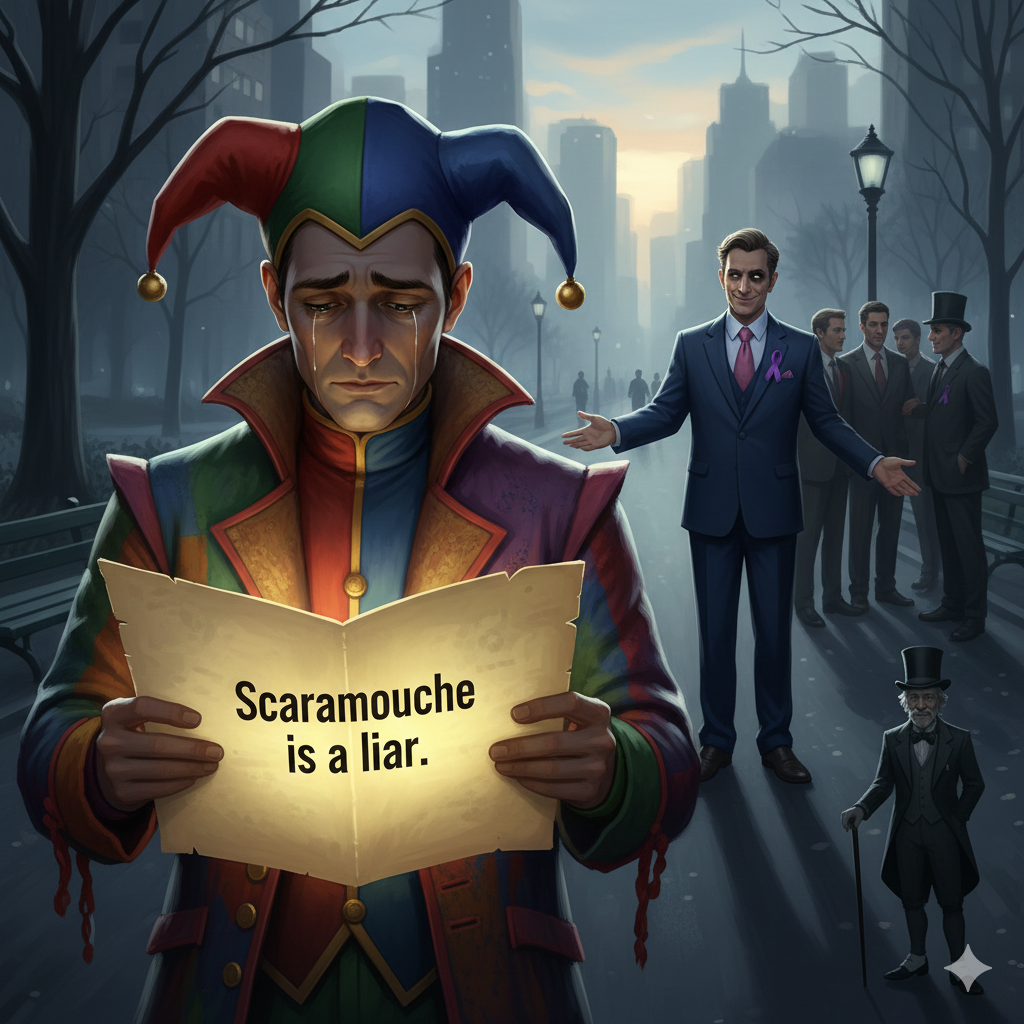
Scaramouche is a liar. He does not look like a liar - but what liar does? Only a really bad liar looks like he would deceive you. Scaramouche wears a smart blue suit, bright white shirt, a dusky pink tie and a kerchief of matching hue pokes out of his top pocket. He is impeccable. On special days he wears an appropriate lapel badge: breast cancer, Holocaust memorial, Remembrance or mental health awareness … whatever. The cause matters not for the cause is to be seen to be sending the right message. Scaramouche smiles a lot: it is a warm smile, inviting confidences, often accompanied by a flash of the eyes suggestive of an intimacy which can never exist. It is easy to be caught in his net, enticed by flattery and unspoken promises. You are sure he would not betray your trust. But Scaramouche is wearing a mask. He likes to play the ‘man of integrity’ but he glances at you obliquely, hiding his soul behind his lashes. You will notice that he says little and listens a lot: the manipulator’s ‘tell’. You think he is in accord with you but … is he? While you are with him you are sure that he agrees with every word you say but, afterwards … you are not quite so certain. Did you ever hear him say, ‘Yes’? No: you did not. You assumed. That’s how Scaramouche likes it. Everyone assumes that he agrees with them when, in fact, we - none of us - know what was playing in his mind. We only discover what he was thinking when he turns his thoughts into deeds. Then, we are shocked because it turns out that Scaramouche is a liar.
Harlequin is naive. He feels things but doesn’t always think them through. Harlequin cries easily, too empathetic to be cynical. He wears his coat of many colours with modesty. It is hand-made, rustic and stitched with the boldness of sincerity. Harlequin would never make it into the lobby of a posh hotel. He would be directed to the charity shelter in a back street instead … and he would go, even if he were supposed to be the honoured guest at dinner for Harlequin would not suppose that he was being despised or mocked. Harlequin admires Scaramouche for Harlequin sees only the glib and shiny exterior of ‘the leader’ Scaramouche is pretending to be. He does not see that Scaramouche is a liar.
One day, Scaramouche and Harlequin walked together down a lonely road: an odd couple. Ah! We forget: Scaramouche is too well-mannered to show open disdain for the likes of Harlequin. His contempt is disguised beneath that mask. Harlequin is overjoyed to have been noticed by a real-life hero, not so much a bronzed Hercules but a 21st century Scarlet Pimpernel.
Scaramouche asks Harlequin how things have been. He is utterly disinterested but it is courteous to ask. Harlequin is flattered into divulging that things have been ‘OK’ - a stunning revelation indeed. Scaramouche nods and compresses his lips, once more forcing the disdain to remain concealed. Taking this for a signal to continue, Harlequin talks. This is how Scaramouche learns of useful secrets. Harlequin asks Scaramouche where he is going. Scaramouche does not reply. He never replies to a direct question: he distracts Harlequin with a question of his own. Harlequin is looking for Merlin for he has heard that Merlin knows the location of a priceless diamond. Now Scaramouche’s ears are pricked: a diamond? Yes - in an old book, Harlequin learned of the existence of this treasure and that the only person who knows of its location is the legendary magician, Merlin. So - he is off to find Merlin.
Scaramouche secretly scoffs; Harlequin is a fool. There are no magicians and no priceless diamonds. The world is run by people like himself: suave players who cynically exploit the naivety of others. It is an exclusive club, an unassailable elite who rise … on the back of their own merit, of course. God forbid that there might be so much as a whiff of institutionalised privilege or the gaming of a system designed by other Scaramouches. After all, what is all that education for but to prepare you to be a great leader? It entitles you to be condescending. For an instant, Scaramouche’s lip almost curled. But Scaramouche has spent a lifetime learning to discipline his features. He restrains himself and presses his lips together.
In the split second that Scaramouche was thinking these thoughts, Harlequin had pulled out an old piece of yellowing parchment. Its very thickness and strange dark text spoke of ancient wisdom. Gothic script with bizarre diagrams and occult symbols. Harlequin began to translate the words and ideas as alien as kindness began to form in Scaramouche’s mind. Yes - there was a diamond. And a desire, more burning than the fires of Hell, more obsessive than addiction, more intoxicating than lust, arose inside him. He absolutely must possess this treasure.
‘Let us join forces and find Merlin together,’ suggested Scaramouche to Harlequin. Harlequin beamed, for he did not see the greed lurking in the eyes which Scaramouche kept behind the veil of his lashes.
The moment the pact was made, an old gentleman suddenly appeared before them. He was dapper in his top hat, tail coat and spats. A trim little beard and a walking cane completed the look: Mr Monopoly himself, no less. ‘Good morning, sirs. And how do you do?’ said the old gentleman. ‘I hear you are looking for Merlin.’ Harlequin blushed but Scaramouche confidently asserted that they were. ‘Ah!’ said Mr Monopoly, ‘… then you must be seeking the diamond.’ ‘You know of this diamond,’ said Scaramouche. ‘I do,’ he replied. ‘It is the greatest of all treasures but, I’m sorry, it cannot be divided. Were you intending to split it between you?’ ‘Two are always better than one,’ said Scaramouche, carefully avoiding a direct answer to the question. ‘Harlequin is my friend.’ Harlequin beamed. Mr Monopoly winked at Harlequin.
‘Then you must play my games,’ said the gentleman. ‘These games will test you to the utmost. They will see if your friendship is strong enough. If it is, perhaps you can find the diamond together. Will you play?’
Scaramouche looked at Harlequin. There he was in his multi-coloured, hand-made garb and smiling peaceably. What an irritating and deplorable sight! But - he was also still clutching that parchment …
Harlequin looked at Scaramouche. Tall, smart, sophisticated. Oh! To be like him.
‘Yes!’ they said, in unison.
Now this is a fairy-tale and that means there must be three. Aladdin and Portia would be disappointed if there were not. A fairy godmother should not short-change her audience and even Macbeth would be disgusted if we fell short at this point in our story. Thus, Scaramouche and Harlequin must chance their fortunes thrice. However, as we sophisticates look on, we are astonished that our protagonists do not see the obvious moral tale being woven by our narrator; that Portia’s suitors did not spot that the real treasure lay inside the lead casket or a mythical king did not immediately realise that salt is more valuable than gold. In this case, it is self-evident that Merlin wishes to teach Scaramouche that the friendship of Harlequin is worth more than the lump of carbon which has inflamed his greedy heart.
But this is a 21st century fairy-tale and it is nearly a century since Walt Disney punctured all the naive charm from Snow White and Cinderella. We expect more from our stories than a twee happy ending where a girl is overwhelmed with joy to have found her Prince. Beauty marries the Beast and the end credits roll with no thought of tomorrow and tomorrow and tomorrow …
So, we will not infuriate our readers with lame puzzles and beige-coloured riddles. We will pick up our narrative at the point where Scaramouche recognises that the friendship of Harlequin is worth more than all the diamonds in the world.
Merlin beamed; his top hat wobbled on his head as he waved his cane in glee. Scaramouche and Harlequin had just broken free from their embrace. Harlequin smiled sweetly as Scaramouche wiped the tears from his eyes. ‘My friend!’ said Scaramouche, his face shining with a pinkish glow, almost, indeed, the same hue as his natty tie and kerchief - and his heart warmed with the unassailable knowledge of complete and utter trust. ‘And, so, you’ve found your diamond…’ said Merlin. ‘My job is done.’ And, with that, he vanished.
Harlequin and Scaramouche walked back along the lonely road, wending their way home. An odd couple, still, but, this time, deep in talk: intimate. They share a joke and spontaneously laugh at the same time: kindred spirits. Harlequin links his arm with Scaramouche and Scaramouche does not flinch; it’s been a long time since Scaramouche walked in step with anyone for the Scaramouches of this world do not truly have friends – they have contacts: they network and none of their acquaintances are indispensable. They are tools in their toolbox. They may lay untouched for years in their contacts list but you never know when a number never yet dialled might suddenly come in handy and become useful. It’s a nice feeling, this feeling of camaraderie, of comradeship, of companionship. Were we to see a feeling rather than sense it, we would be able to see a sunny warmth enveloping these friends, radiating from them, and illuminating the world around them, turning all that is grey and mundane into bright technicolour as they walk the yellow brick road.
But, eventually, they must part, these two, for all roads have an end. In this case, Scaramouche must return to his mansion and Harlequin to his bedsit. They embrace one last time and promise that they will speak shortly. Scaramouche has something he would like to give to Harlequin, benevolence oozing from every pore. Harlequin is overwhelmed and tries to think of some way to reciprocate. What can he possibly give to Scaramouche to match this generosity? Scaramouche smiles, that warm and intimate smile, inviting confidences. His eyes flash. ‘No need. No need at all,’ he says. Harlequin watches Scaramouche as he turns, waves and heads home.
…………………………………………………………………
It is many days later before Harlequin sees Scaramouche again. It is at a distance. Scaramouche is with a group of business associates. He is dressed, as always, in a smart blue suit, bright white shirt, a dusky pink tie and a kerchief of matching hue pokes out of his top pocket. He is quite impeccable. He has a ribbon pinned to his lapel. It is to raise awareness of the dangers of testicular cancer in the young: a worthy cause, indeed. Harlequin, too, looks just as we first saw him in his hand-made, rustic coat of many colours. For a moment, Harlequin watches Scaramouche but Scaramouche is not aware that he is being observed. Scaramouche’s smile is warm and inviting. His eyes flash. He is glancing obliquely to left and right, saying little and listening intently to his companions as he mimes his habitual role as the ‘man of integrity’. His lashes are lowered and there is an asymmetry to his smile. It is clear to Harlequin that Scaramouche has a secret.
Suddenly, Scaramouche looks up. His eyes meet those of Harlequin. For an instant, there is panic. His eyes widen and his cheeks flush for, as soon as he had left Harlequin at the parting of the ways, his sincerity had become a miasma. But this resurrection is only for a fraction of a moment and the others in Scaramouche’s group are not even aware that Scaramouche’s mask has slipped. As his eyes dart back behind those concealing lashes, it is Harlequin whose gaze remains steady. As he stares, Scaramouche’s appearance seems to change before his eyes. The clothes remain as pristine as ever but the man inhabiting them seems to wither. Somehow, he is smaller and more frail. His flesh seems pinched. His smile is frozen. His eyes are black. As he nods his head in apparent agreement with something someone else says, Harlequin can see Scaramouche’s face contort into a smirk. He does not agree but the other thinks that he does. Harlequin shudders; Scaramouche is a liar.
As he turns away, Harlequin sighs. What he has seen does not please him. He takes no satisfaction in learning that Scaramouches do not change their natures. He cries, not so much for the loss of a friend he never truly had but for Scaramouche, who once did. As the tears slip down his cheeks, Harlequin pulls an old piece of yellowing parchment out of his pocket. Its very thickness and strange dark text speaks of ancient wisdom. He unfolds it to find, written in bold arial font, ‘Scaramouche is a liar.’
At that very moment, Harlequin could have sworn on oath that, out of the corner of his eye, an old gentleman, with a trim little beard, in top hat, tails and spats and carrying a walking cane, winked at him.
For all your proofreading and editing needs, contact Verbatim.
Precision. Clarity. Verbatim.
Burnout
Run to stand still,
Said the voice in my head.
It was the only key to a door.
The door was locked fast
But the voice in my head
Kept telling me to run more.
The way to the moon
Is to run till you drop
And virtue is putting yourself last.
But the clock measured time
And it wouldn’t stand still
So I ran till I ran very fast.
The faster I ran
The more I stood still
And space-time was warped in the end.
The voice in my head
Turned into a clown.
It told me I had to pretend.
I pretended too long
And the mask became fixed.
The audience laughed at a fool.
My feet turned the wheel
But the river ran dry
And one day I ran from the school.
I ran through a cloud
And a precipice loomed.
I was over before I knew why.
I hit the ground hard
And my senses were dazed,
But the Levites just walked on by.

AI Generated Image
Verbatim is there to assist with all your proofreading and editing needs - be they whole books, essays, short stories or poems.
Precision. Clarity. Verbatim.
The Problem with ‘due to’
‘Why have you spoiled a really good essay by pooing all over it with “due to”s?’
This was me, being very brutally honest with an A Level student some years ago. I wasn’t being unkind and the student went on to achieve an A* in her A Level History exam. It was, however, a common problem. Many of my students would litter their writing with ‘due to’, and the impact was that it reduced the quality of their writing and, consequently, their grades. Indeed, I have spent many hours crossing out ‘due to’ and replacing it with ‘because’ or ‘as a consequence’.
And it isn’t just students. I’ve proofread whole books where experts in a particular field have also repeatedly used ‘due to’. When this happens, it leaves the reader in the position of having to fill in an explanation for themselves and, in effect, guess what the writer was alluding to and what relationships he or she wanted the reader to understand.
Now, it isn’t that the phrase ‘due to’ should never be used nor that it is intrinsically wrong grammatically. It isn’t. But …. too many writers use it as a form of shorthand to evade explanation, and this is the very last thing that any writer should do. In effect, they are asking the reader (or the examiner) to infer understanding from text which doesn’t explain it.
Take the following example:
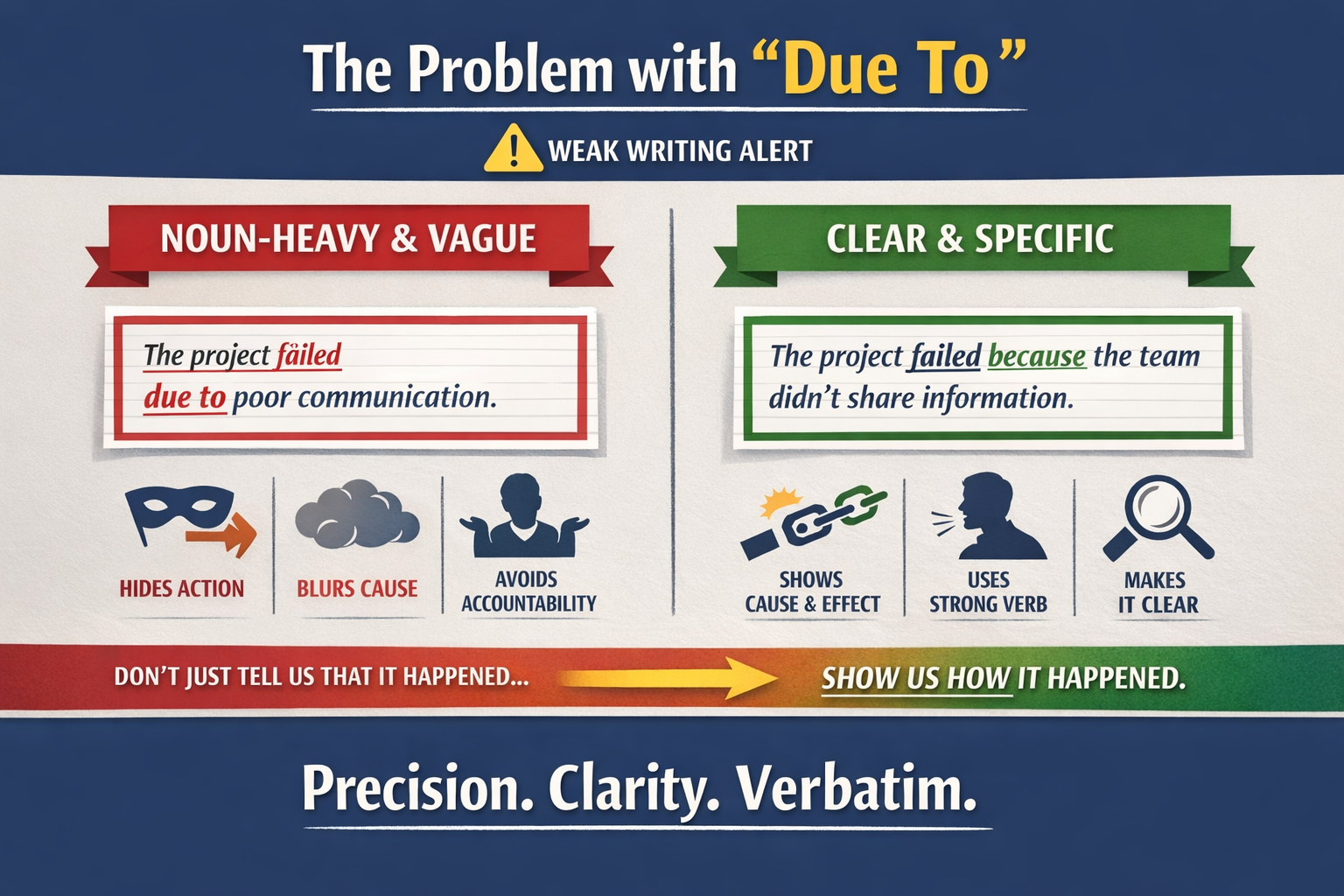
The project failed due to poor communication.
vs
The project failed because the team didn’t share critical information.
The first simply states a reason. The second explains a reason. The grammatical point behind this is that ‘due to’ frequently leads writers to focus on a noun whereas ‘because’ leads writers to focus on a verb. The former is static whereas the latter demonstrates cause and effect.
Here’s a second example:
The delay was due to a signalling fault.
vs
The train was delayed because the signalling system failed.
In both cases, the phrase ‘due to’ is followed by a noun - ‘poor communication’ and ‘signalling fault’, whereas ‘because’ is followed by a verb ‘didn’t share’ and ‘failed’. This habit of deploying ‘due to’ is very much one of those unintended consequences which happen when a school’s literacy policy emphasises ‘keywords’ rather than precision in grammar. The student is subliminally conscious of the need to use the ‘keywords’ (and these are invariably dominated by nouns) so their mind is focused on structuring a sentence based on a noun. ‘Due to’ fits that model precisely. Thus, instead of creating a sentence based around a verb and creating an explanation, the student reaches for the keyword noun and writes: ‘The decrease in reaction rather was due to catalyst degradation.’ rather than ‘The reaction rate decreased because the catalyst’s active sites were blocked by impurities.’
So - a good rule is this: use ‘due to’ when describing a state but avoid it when explaining an action. Above all, do not expect a reader to infer a causal relationship between two phenomena unless the writing makes that relationship clear.
The purpose of writing is to communicate. It is never up to the reader to guess what the writer intended. It is always up to the writer to make their meaning clear to a reader. Clarity should always come before complexity. Punctuation and grammar are tools writers use to convey meaning, so recognising when it is appropriate to use a phrase like ‘due to’ and when it is not is an aid to good writing.
For all your proofreading and editing needs, contact Verbatim. We put clarity at the centre of our work.
Precision. Clarity. Verbatim.
04 How to make learning easy: the power of multiple processing
Learning shouldn’t be hard. Of course, everyone comes across something they find difficult at some point and there will always be those who struggle. But, for the vast majority of students, the process of learning things should not be hard because human beings are learning machines. We’re built to learn.
Processing
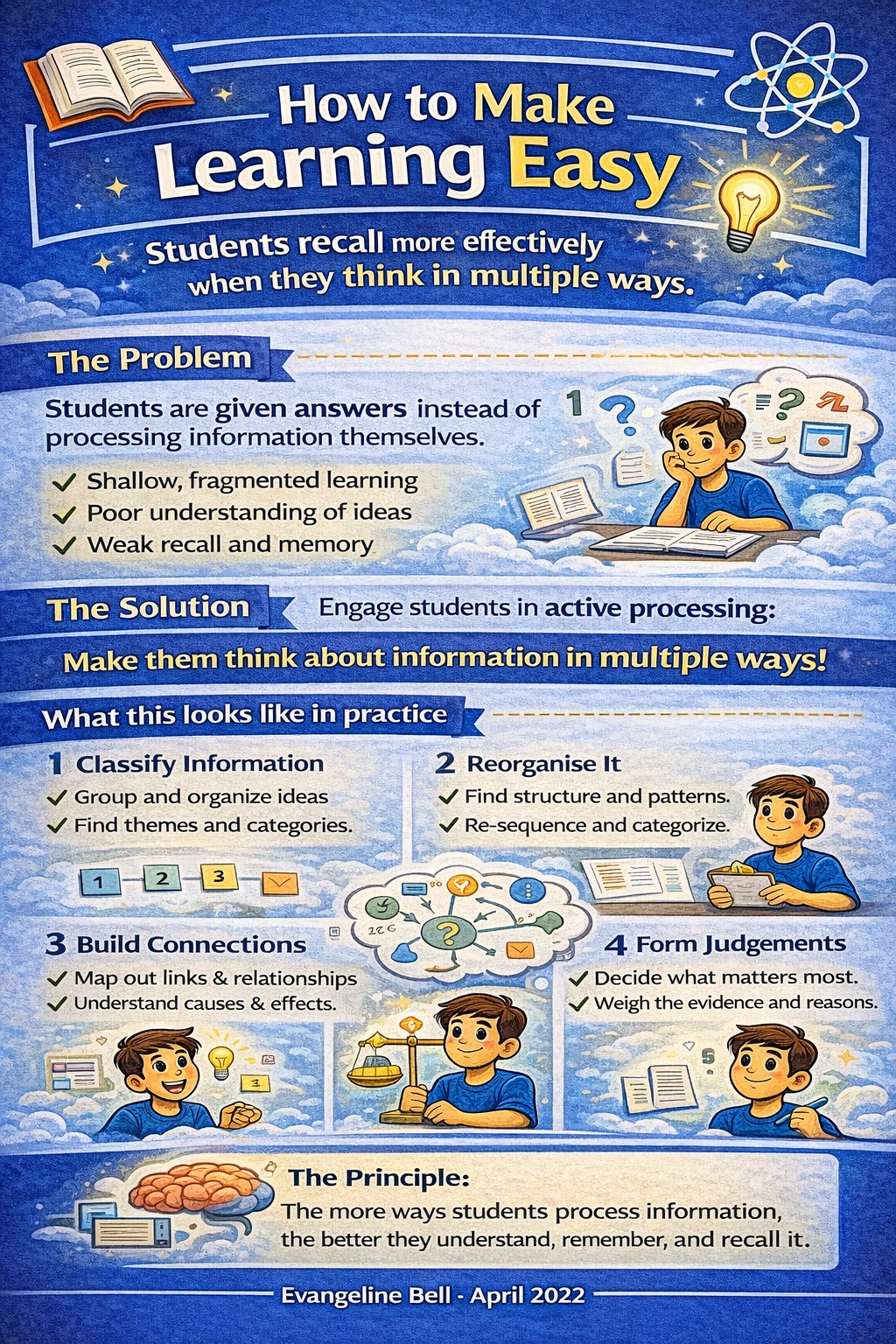
First, let us remind ourselves of what we mean by ‘processing’. These are the activities which teachers give students to do in order that they can make sense of new information. Ideally, students should be able to fit this new information into established patterns of meaning. In addition, I have argued in a previous blog that students should be encouraged to engage in a process of active memorisation and recall and then compose their understanding into a piece of written prose in order to make sure that they understand what they are supposed to have learned, to lay down complete memories and to ensure that they can retrieve their memories when called upon to do so. I have also argued that learning should be holistic and not fragmentary. It may be that we ‘chunk’ or ‘slice’ learning into digestible pieces – but it is equally important that we make the students themselves, and not the teacher, synthesise this back into a whole before leaving the learning and moving on to something else.
The purpose of this blog is to argue that strategies which involve multiple layers of processing are more effective in securing learning than singular strategies.
Back to an old idea – ‘thinking skills’
Several decades ago, there was a fashion for teaching via ‘thinking skills’. In Somerset, the Local Authority put a lot of resources into developing a ‘thinking skills’ programme – a curriculum based on teaching students how to look for various forms of abstract patterns and how to apply this to real-world subjects. Research establishments focused intensely on pedagogies which were intended to be transferable from one discipline to another. Schools experimented with ‘learning to learn’ or ‘learning brilliance’ or ‘learning excellence’ programmes. Essentially, all of these were aiming to teach students the power of metacognition and to encourage them to take independent responsibility for the way they learned. Unfortunately, these programmes were insufficiently successful in that it was hard to draw a direct line between them and examination outcomes. Teachers did not like teaching them and they dissolved into a sequence of fairly pointless tasks.
However, like many initiatives in education, there was a core of good sense at the root. Those of us who are successful at academic study – and all teachers are, by definition – are generally very good not only at identifying patterns for ourselves but at taking in information by listening, by reading and by doing. This might be because we have taught ourselves to be so. It might be because we are naturally good at it. It does not matter why; the simple fact is that we can do it. We are the exceptions, however. Many students are not naturally good at these things. They need to be taught. The problem with the ‘thinking skills’ programmes was that these skills are not best taught as a discrete subject. They are best taught via substantive content. However, this does not mean that the very idea of ‘thinking skills’ has no merit. It absolutely does. It is just that these skills need to be learned in practice, rather than in theory.
How to put ‘thinking skills’ into practice
One teaching method which illustrates how to put ‘thinking skills’ – or what I would prefer to call ‘active processing’ into practice is a method known as ‘inductive learning’. It is not the purpose of this blog to give a detailed explanation of how the inductive method works and how it might be applied to different contexts. What I want to do is to demonstrate how I applied this method to my subject, History – and then draw a more universal conclusion.
A core concept in History is that of causality. At GCSE level, most questions are either evidence-based questions or are some incarnation of a question related to causality: why something happened in the past. I could, of course, have taught an answer to this question which would have essentially amounted to the transfer of knowledge and understanding from the teacher to the students. That would have required the students to listen to the teacher and internalise the teacher’s answer to the question. I didn’t do this. Instead, I posed the question as a problem to be solved. I gave the students an assortment of events, all of which did contribute to causing the outcome. I asked them to classify them thematically. I then asked them to classify them chronologically (that means into ‘long term’ and ‘short term’). I then asked them to form chains of causal connections. And, then, to form a judgement about the relative importance of events. At this point, I asked the students to give their complete understanding of the topic and convey that to me in writing, usually in the form of a formal essay.
The ‘inductive’ part of this sequence is the multiple layers of classification and the alternative ways of forming a conclusion – causal connections, judgement etc. All of this entails intense thinking by the student. The teacher is absolutely not ‘giving’ the student the answer to the question. The student is having to work it out for themselves. At the end of this process, the student a) has a much better understanding of the topic than they would have if they were just being asked to ‘lift’ an answer from the teacher, and b) is able to remember – and to recall – the topic more effectively. Moreover, because I asked the student to go through a sequence of thinking activities and because those thinking activities were related to our patterns of reasoning in History, the students were not only learning about the topic more effectively, they were also learning those patterns of reasoning which are all-important and would assist them in laying down memory for examination purposes.
The inductive method (and similar methods) can be applied to many contexts and it is not always about causality. The basic principle is that a problem is posed. The student is given an assortment of data. The student is asked to classify that data in a number of different ways before coming up with their own solution to the problem. The key idea is that the student is required to engage in multiple layers of processing information. This makes learning more effective.
A down-side to this concept of multiple processing is that teachers and students cannot move rapidly through a scheme. It takes time and teachers have to be constantly aware of how the students are thinking. This entails a lot of in-class assessment and in-class interaction between teacher and student. When teaching like this, teachers must be constantly on the move, talking to students, questioning students, asking student to explain their thinking. If teachers do not do this, students may go off in a completely erroneous direction. They may make conceptual errors or absurd connections. However, when done well, the quality of learning is significantly improved. However, in order to teach like this, we have to manage our time super-efficiently. This means that the old idea of every minute of every lesson counting really does hold true. We, as teachers, have to justify every single element of our lessons because we want the students to spend as much time as possible actively processing, memorising, recalling or writing.
Conclusion
Learning should not be hard.
If we have constructed a curriculum plan based around the core patterns of meaning within our subject discipline, if we have made memory and recall an intrinsic part of the learning process, if we have structured our learning programme so that it is systematic and ensured that students are required to learn holistically and if we have used writing effectively to ensure that students consolidate and articulate their learning, then we are on the road to successful outcomes.
The purpose of this blog is to focus on the processing part of learning – that which we ask students to do in order to make sense of new input. The argument being presented here is that students will be better able to make sense of new information if they are asked to process information in multiple ways: to look at the same information through different lenses or from different angles. They are also likely to retain more and be more able to recall more when we turn our attention to the recalling part of the process.
If you publish books or educational materials,Verbatimis here to help, not just with proofreading but with professional expertise.
Precision. Clarity. Verbatim.
Gaslight

Gaslight
Alice blinked. A flickering pale-yellow light had woken her unexpectedly early. She blinked again but it did not seem as if she could focus on anything. She re-closed her eyes and yawned. She tried to stretch. ‘What time was it?’ she wondered. Too early to get up, surely. She decided to roll over, pull up the duvet, try to go back to sleep and wait for the alarm to ring out before attempting to open her eyes again.
It was then that Alice discovered that the duvet was gone. It had definitely been there when she went to bed. She distinctly recalled snuggling into its soft fleecy folds and breathing in the fresh cotton fragrance of the fabric conditioner. Hmm! How strange. Had she kicked it onto the floor during her sleep?
Alice tried to sit up. She could sort of move her body but she found that she was stuck. Somehow, her bed had got hold of her and if she tried to sit up, it pulled her back down. She tried to lift her right arm. Her arm moved alright but, as she lifted it, something was dragging it back to where it was before. It was as if she were attached to something stretchy. It would move with her so far. Then, reaching the limit of its elasticity, it would suddenly snap back, pulling her with it and forcing her to resume the same posture.
She felt a shudder which did not come from inside. Her environment was, literally, trembling. It was a strange kind of wobbling sensation: a vibration: a tremor. And, in the distance, a sort of subdued ticking.
Ah! The alarm clock was still there, reliably marking time. All was well.
So - where was the duvet, and why couldn’t Alice move?
She reluctantly opened her eyes again. The yellow light was still flickering, like the naked flame of a candle - or, perhaps an old-fashioned gas light. It was that deceptive sort of light which makes you see phantoms in the shadows and creates the illusion of dark fantasies. In one corner of her peripheral vision she spied a dark, but indistinct, shape, occasionally illuminated by the dancing light. It was moving - and it was this motion which was causing her own surroundings to tremble. It was as if she and this other thing in the far distance, were, somehow, connected. As the shape moved, so did Alice’s world. It was as if they were both on a waterbed and any move by one party was instantly sensed by the other: wave touching wave, intersecting, crossing and reflecting. Alice recalled the concept of quantum entanglement and vaguely wondered if she were trapped in some kind of sub-atomic relationship with this dark shadow on the other side of the universe.
Alice tried to lift herself again and, once more, she found that she was stuck.
Tick! Tick! Tick!
She wiggled her fingers and discovered that she could feel some kind of sticky rope underneath her hand. She felt as far as she could in all directions and discovered that she wasn’t in her bed at all. She appeared to be in something more like a hammock. She could now feel that her back was sunken into a rope net. She was sure she wasn’t tied up in rope, but she was stuck to a tacky, gooey and gluey kind of rope netting. She began to feel the strands cutting into her bottom. She could feel the nodes where the warp and weft lines crossed. The cords felt incredibly thin but extremely strong.
Alice did not recall climbing into a hammock of any kind. Where was she?
Tick! … Tick! Tick!
Alice’s heart startled and she let out an involuntary yelp. Her alarm clock kept regular time. Those ticks had suddenly become alarmingly irregular.
The netting began to jerk violently. The dark shape in the distance seemed to be thrashing about. ‘Stop it!’ Alice shouted. ‘Stop it!’
The shape became still. The net seemed to tighten.
‘Is there someone there?’
‘Yes’ replied Alice.
‘Who are you?’ said an unfamiliar male voice.
‘Alice’.
‘I’m Michael’.
‘I’m stuck’ said Alice.
‘So am I’, said Michael.
‘Where are we? Do you know?’
‘No. I just woke up to find myself here. I keep trying to break free, but this thing has got hold of me and I can’t move.’
Tick! Tick! … Tick! … Tick! Tick! Tick!
‘What is that? said Alice.
‘I don’t know’ said Michael, ‘but I’ve been hearing it for a while and it’s getting louder from where I am. It’s giving me a creepy feeling up and down my spine.’
“I thought it was my clock’ said Alice ‘but it isn’t, is it?’
Michael began thrashing about again in a desperate effort to free himself. The net holding Alice jerked and writhed in response. She felt her legs rise above her head, and then her head was thrown forwards until her chin hit her stomach. As her body turned topsy-turvy and her world seesawed about, she heard Michael panting and groaning with the effort. It made her feel totally powerless for no matter how rigidly she tried to hold herself, Michael’s movement just threw her about like a rag doll on a bronking bull. Eventually, he stopped. The net felt suddenly taut.
Through heavy breathing, Michael exploded in frustration: ‘Aargh! No matter what I do, I cannot get free.’
Alice remained silent. She was grateful that her world had stopped heaving for a moment. It had been making her feel sick. She tried to remember what she had been doing before she found herself stuck in this bizarre situation.
She suddenly remembered a cold and toneless female voice. It had been talking about her - Alice. But the person being described was nothing like Alice. It was as if it were describing a fake Alice, using her name but describing characteristics which were not remotely like her. Alice, it said, had become a problem and she needed to be ‘taken care of’. The voice was chillingly cold.
‘Michael’ said Alice. ‘What’s the last thing you remember before being here?’
Michael said nothing for a while. Then he said, ‘I remember voices. Someone was talking about me. But … it wasn’t me they were really talking about.’
He was silent again and then said, in a very small and scared voice. ‘Someone said they going to eat me alive.’
‘Click! Click! Click! …. Click! Click! …. Click!’
The sound in the distance was definitely louder now and, to Alice, it sounded less like a tick and more like a distinct clicking, irregular and ominous.
‘Do you know who it was?’ asked Alice.
‘No. … Wait … Yeees.’ said Michael, slowly. ‘It was a colleague who wants my job. He’s been trying to get me fired for the last two years. He was plotting to make up a lie about me and get me into trouble with my boss.’
‘And then you found yourself here, tangled up in this sticky netting?’ said Alice.
‘That’s right. He was inventing a story that I’d stolen a company computer.’
‘Did you?’
‘Of course not.’ Michael sounded indignant. ‘I was the one who created the inventory system. I stopped people sneaking out toilet rolls and soap from the staff washrooms. It’s not right to take things that don’t belong to you – and it was annoying me that things were going missing. There’s no way I’d have taken so much as a teabag, let alone a computer.’
The gaslight flared and Alice sensed, rather than saw, a brooding presence. Someone, or something, was listening ….
‘But the last thing I remember is hearing this guy, Alan, telling this whole set of lies about how I’d taken a laptop and sold it on EBay. It was an old, obsolete and broken machine, and I took it to IT to be scrapped.’
‘Something like that happened to me, too’ said Alice. ‘The last thing I remember is this frozen voice threatening me and saying that I was ‘unfit’ to do my job - and vowing she was going to destroy me. She wasn’t even describing the real me but making up a story about an imaginary person she called me.’
The air suddenly felt colder. The gaslight flared again but, instead of the flame shedding warmth, it was as if the flare itself had caused everything to freeze. Once again, Alice felt the net tighten. She heard the cracking of frost. The clicking became more intense and very much louder. Alice’s mouth was suddenly dry and, despite the sudden cold, she found that she was sweating. Alice looked over towards Michael.
‘Michael?’
‘Michael?’
A huge shadow was looming over Michael. Alice could see its amorphous and indistinct shape outlined by the yellow gaslight. It was enormous. Its body was sort of rounded and it had huge hairy legs which jutted above the dark mass of its body. They looked like open jaws silhouetted against the flickering yellowy-orange light. As Alice stared, it turned a ferocious head towards her and she saw its multiple dark, glassy eyes. They gazed uninterestedly at her, unpityingly. These were the eyes of a predator who knew that time was on her side. Alice then saw its pincers. They clicked - so loudly this time that the clicks seemed to echo and the echoes multiplied the clicking such that it seemed that there were thousands of these monsters hiding … out there. A hydra with a legion of heads, each one spitting out lies.
Alice’s voice was filled with panic as her heart clenched and her jaw tightened so much that she felt as if her teeth were grinding against granite.
‘Michael! What is that thing?’
Michael didn’t answer. Michael could not answer. The huge spider was now moving amazingly quickly. There was a hoarse and vicious whispering ‘Thief! Thief! Thief!’ It’s clicking pincers struck like lightening. Michael began to twitch. ‘Lies. All lies’ he groaned, as his body tossed and lurched like a live eel caught in a bucket. ‘I told you: I took the laptop to IT to be removed from the inventory. I even showed you the receipt.’ Poor Michael was pleading with the terrifying beast which now towered over his tethered body. The creature wasn’t listening. It didn’t care whether Michael were guilty or innocent. All it knew was that Michael had been caught, he was trapped and he was now helpless - and at its mercy. But mercy was a concept unknown to this abomination. Compassion, a foreign language; meaningless gibberish; an unintelligible cipher.
Alice could feel Michael’s agony as it rippled along the web which she could feel resonating beneath her own fingers. She could sense his desperation: his pleading voice becoming ever weaker.
And then he was still.
The spider moved to cover Michael, smothering his final words. But Alice could still hear him; he wasn’t dead. As the toxic venom began to work, liquefying Michael’s brain and turning it to mush, Alice could hear a kind of squelching sound. She shuddered. The gaslight flickered, once again. Michael was, literally, being eaten alive as the fiend which was devouring him repeated ‘Thief! Thief!’ Poor Michael: he had no chance. His last, barely distinguishable words were the lie he had been forced to adopt: ‘I am a thief.’
Alice’s heart began to race. She could feel it thundering in her chest as it dawned on her that she had probably very little time left before the spider turned its attention towards her. She needed to escape. She began trying to tug her arms free. As she did so, that icy voice drifted into her mind: ‘unfit …. unsuitable … to be taken care of …. ‘
Panic consumed Alice’s mind. Her struggle to free herself became frantic. Like Michael, she writhed and thrashed in her attempt to break away from that ancient, tangled web which had been constructed, long before Alice had realised the danger, to hold her fast. To no avail: Michael’s terror had shown her that there was no point attempting to reason with this beast; it did not listen because it did not care. Its nature was to be malicious but it ‘saw’ neither Michael, nor Alice. It sensed fear. It was attracted to fear. It did not understand truth, honesty, integrity or reason. And kindness? That was an impenetrable enigma. Eventually, Alice stilled, exhausted and panting. The web began to tremble.
Click! Click!
And the huge hairy shadow loomed over Alice …
Alice closed her eyes and prayed. She could not escape by struggling with a creature far stronger than herself. She could not escape by trying to reason with something inherently unreasonable. She could not attempt to bargain or negotiate with an enemy intent on devouring her. But she could appeal to the one embodiment of mercy, of compassion, of truth - and the one person strong enough to defeat this grotesque monster - the Creator of all: the ultimate court of appeal.
The poisonous fangs clicked. And the sound was like the clashing of iron upon rock: harsh, ringing and unyielding. It was utterly terrifying. The beast seemed to be waiting for her to say something. The gaslight flared one last time: ‘Unfit! Unfit! Unfit!’ chanted the spider in the high-pitched and icy voice which mimicked Alice’s accuser. ‘Say it, Alice. Say it with me …’
But Alice did not speak. And the gaslight died, plunging Alice into thick darkness. She clung onto her prayer as Jonah in the belly of the whale …
… and the intimidating clicking ceased. The shrill voice was silenced. All was still …
Alice waited ….
Suddenly, she heard the words of ‘Amazing Grace’, as if it were sung by angels: ‘I once was blind but now I see’. Her fear vanished and a strength beyond her own seeped into her. She felt the web beneath her begin to sag. The tight ropes which had seemed to bind her like steel were disintegrating, melting away beneath her. And she was falling …
Alice exhaled. She had no idea where she would land. All she knew was that the distance between herself and that black mass was growing. The relief was overwhelming. Tears began to stream. She felt soft air beneath her and knew that it was beginning to slow her fall. The darkness which had loomed above her so menacingly was now a small and shrinking black dot, barely visible in the vibrant blue sky which had opened above her.
Clear fresh air rushed into her lungs as her feet touched solid ground. She landed walking, standing on her own two feet in a meadow of green grass and fresh flowers. Lilac and rose mingled with May blossom in a bouquet of summer perfection. It was the fragrance of peace itself. She could hear the happy gurgle of a brook and glimpsed a bright white light glinting and bouncing off the surface of the frolicking water. The world around her teemed with an abundance of life: birds sang, baby foxes played in the grass, and rabbits grazed contentedly. There were no predators and no prey.
The sun shone - and in its penetrating light and gentle warmth, Alice could see everything as it truly was. The world around her was colourful … and beautiful. And life, with all its energy, its passion and its possibilities, was to be lived.
For all your proofreading and editing needs - fiction or nonfiction - contactVerbatim.
Precision. Clarity. Verbatim.
The Power of Small Words: Why Prepositions Matter
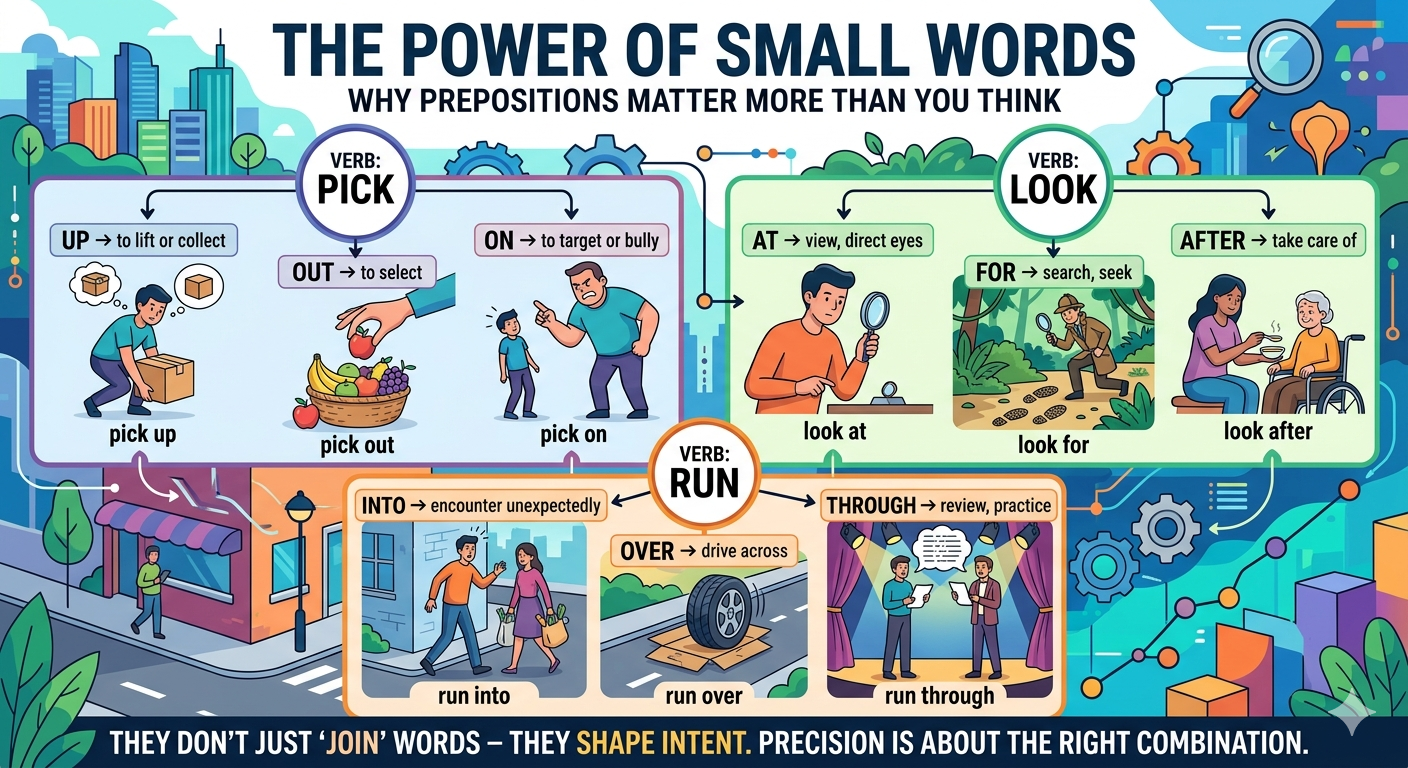
For 4 years, I was responsible for developing whole-school literacy. I had acquired this role as a result of my work developing extended writing in Humanities, over more than a decade. Throughout this time, I found myself fighting a constant battle. My ‘enemy’ was ‘keywords’. Headteachers love them. Curriculum heads love them. Teachers love them.
Why?
Because it’s an easy answer to ‘doing something about literacy’. It’s so easy to create a list of ‘topic’ words and put them on a poster. It’s much harder to teach grammar and punctuation.
First, let me slay the dragon, however. I’ve never said that vocabulary is unimportant. It’s very important, especially where technical and specialist vocabulary is critical to understanding. It’s just as important where an item of vocabulary has a particular meaning in the context of an academic subject, but a different meaning elsewhere.
BUT …
What I learned from my work with students is that an approach to literacy which is driven entirely by a focus on vocabulary can actually be counter-productive, and that many of the real problems young people experience with writing are related to grammar, not vocabulary. I discovered that a literacy policy which prioritises the teaching of grammar is far more effective in improving overall outcomes and in improving literacy generally than one which solely focuses on vocabulary.
A lightbulb moment occurred when I spent half an hour studying an essay by an A Level History student. There was absolutely nothing wrong with the argument which the student was trying to create. The facts were all correct. The concepts were all understood. But it was an absolutely horrible thing to read. I wondered why that was. After a good 30 minutes reading and re-reading the piece, I realised that the student was attempting to construct every single sentence around a noun - and I realised that these nouns were what the student regarded as the ‘keywords’ of the topic. I told the student to re-write the piece without changing a single fact or idea, but to do so by focusing on the verbs in the sentence. I demonstrated how to do this. She did it …. and the transformation was incredible. It turned a mediocre essay - which might have been Grade D standard - into something closer to a Grade A. Unbelievable! As a result, I began to apply the principle to students lower down the school and I discovered the same thing. Almost all ‘keyword’ lists were nouns. Students were being told to make sure that they used the keywords in their answers. The impact was that students were being conditioned to construct all answers around nouns, not verbs. And that caused them to mangle up the grammar, distorting the meaning and making it hard for the reader to work out what they were actually trying to say. The end result of that is that students were losing marks in examinations purely because of the way they were communicating, rather than because of their substantial knowledge and understanding. - and the root cause of that was a literacy policy which focused exclusively on vocabulary at the expense of grammar.
Another anecdotal example was an A Level Geography student. Her teacher came to me in despair. This girl was an incredibly keen Geographer. She worked hard. She understood the Geography. But … her written answers were so poor that she would be lucky to obtain a Grade E. I studied her work and I explained the problem. I told him to ask the girl to re-write her work, modelling it upon his writing style and, once again, focusing less on vocabulary and more on verb construction. She did - and, bless her, she did it consistently for 18 months. She turned that probable Grade E into an actual Grade A. She did it almost entirely by changing her writing style.
I began to look at teaching disciplinary literacy to teenagers through a completely different lens: vocabulary and grammar must be taught together.
I discovered that another way in which the quality of writing could be improved was by using prepositions correctly. So many young people, I learned, deploy the wrong preposition. In conjunction with poorly constructed verbs, this really does make a piece of writing into an unreadable mess.
Let’s take the verb ‘pick.’
Pick ‘up’ - to lift or collect
Pick ‘out’ - to select
Pick ‘on’ - to target or bully
The same verb is being deployed but the meaning are completely different, simply because of a different choice in preposition. Prepositions really do shape meaning.
Consider the following:
Look ‘at’ vs look ‘for’ vs look ‘after’.
Run ‘into’ vs run ‘over’ vs run ‘through’.
Turn ‘up’ vs turn ‘down’ vs turn ‘on’.
Thus, prepositions do some seriously heavy lifting in terms of conveying the meaning of a sentence. Good writing is as much about choosing the right combinations of words as it is about using ‘key’ words, - the specialist topic words of a subject. In short, an approach to improving literacy which is dominated by an emphasis on vocabulary at the expense of grammar is fundamentally inadequate. It’s not just about knowing words.: it’s about knowing how to use them.
Free downloadable resource available here:
If you are a student who needs an expert eye casting over your work before submission, or a teacher who needs training on how to improve the quality of your students’ writing, contact Verbatim. We can help!
Precision. Clarity. Verbatim.
The Rose

The Rose
Prologue
A rose is a lovely thing; its form and purpose designed to be a union of perfection. A budding rose holds all the potential of the flower in bloom, just waiting to be realised. One day the soft petals begin to emerge, tightly at first, like a young, prim and straight-laced governess, stepping out of the pages of some Victorian novel. Even this can bring a gasp of awe as the curve of her lips smiles like a first inviting kiss. And, yet, the real glory of the rose remains subtly hidden. Slowly and almost undetectably, the petals unfurl, revealing their soft, vibrant velvet, a unique beauty which, like the deep and secret heart of man, can so easily be bruised by the slightest touch - and, then ... when evening falls and after the rose has been embraced by the love of a summer sun, her true treasure, invisible, unforgettable and utterly indescribable, fills the air. She loiters in a corner of the garden like some ephemeral guest. She's been waiting there all day but, only now, will she reveal herself. Moving through the foliage and wafting herself gently over the dewy lawn, she is the ultimate intoxication. Go on; breathe her in ... and sigh. All is peace and contentment.
Chapter One: The Murder
One day, a sweet little girl was entranced by a rose, as all little girls are. Foolishly, all little girls greedily desire to possess the perfume of a rose and they willfully destroy her, crushing and drowning her loveliness into pungent and stagnant decay. The little girl leaned into the tender face of the rose and soaked up her glory: heaven. As she drew back, her attention was drawn to the lilies of the valley which grew beneath the rose. Only days ago, those small, white, bobbing bells had filled the garden with their fresh and uplifting fragrance. But, now, they were drooping and brown, for such loveliness, it seems, is not destined to live for long. Sadly, the little girl looked back at her rose. It, too, must die ... and death is the end of all things.
Tears filled her eyes. Hot tears, heated by the emotional love of a child for the preservation of a beautiful moment. What could she do? Like all young things, the girl could not face the thought of death and, so, in an act of perverse logic, she killed the rose. She plucked her from her stem and cut her off in her prime. What a crime! If the scream of a rose could have been heard by mortal ears, the whole world would have turned its head in terror at such anguish of soul. As it was, there was only silence and tranquility as the ruthless little horror carried her victim into the kitchen.
Carefully, she placed the dead rose onto sheets of absorbent white tissue paper. She spread the petals wide and separated each and every one: methodically detaching them and dissecting them. A budding scientific mind at work, curious but calculating and cold. Finally, she completed the shroud by laying yet more tissue paper on top. Then she buried the corpse. She hid it within the pages of a book, an old book, a heavy leather bound coffin whose contrast to the fragile delicacy of the rose could not have been more stark. The job done, the little girl took the book back into the library and, climbing to the very top of the shelves, thrust it back between its fellows. Standing, sentinel-like, this unwitting guardian soon melted into the uniformity of the whole: faceless, like a row of weatherworn headstones.
Satisfied with herself that she had done a good deed, the little girl immediately forgot the rose and, as she skipped outside, carefree, her giggling laughter could be heard echoing through the garden ...
Chapter Two: The Library
The library is a great place. Its dark oak bookshelves span the entire room, floor to ceiling. They give place to the door, the window and a carved marble fireplace topped by a predictably eighteenth century portrait, but to nothing else. It is a metaphor for human endeavour, a vast and endless circle of wisdom and of knowledge which barely a soul uses. Most visitors to the house, now just a mausoleum of frozen time, do not even acknowledge its existence. They stand behind a green rope line and gaze with blank curiosity at the carved oak cases with their over-heavy volumes filed by order, but the brass grills remain shuttered and locked, their secrets kept secretly within. The thick green damask curtains, themselves, even hide a few books behind their generous swags.
The library has not been used for many years for the books are not modern paperback novels, meant to be read, enjoyed and passed on. No: they are antiquities. Quarter bound in thick leather, they contain hand painted illustrations of tropical birds and detailed outdated maps of the counties of England. The Waverley novels rub shoulders with Dickens and the Complete Works of Shakespeare. Byron's dreary poetry is there and A History of the Tudors along with several faded copies of Wisdens. It all smacks of the 1930s and an ancient family's impoverishment through debts, indulgence, depression and a war which destroyed a generation and deprived them of an heir. Death duties. There is a slight smell of must, the inevitable result of damp air and a thin coating of dust. It's pleasant in its own way, giving one a sense of age and longevity: permanence and elegant neglect. It is this comforting illusion which pleases the snaking line of gawping bourgeois onlookers which passes through each day. It is why they come.
Epilogue
But ... if you were to take the time to search carefully, book by book, page by page, you might find something rather incredible. For if you were to find that one unique volume and gently peel back the yellowing paper to peep inside, you'd find treasure, for pressed between the sheets of some insignificant volume of verse there lies a rose. Her vivid colour still as bright; her velvet sheen as soft. Has she aged at all? True: she no longer lives and breathes but, for a moment, it is as if the oaken monstrosities vanish into nothingness as the intoxicating glory of that long dead rose once again fills the air and her shadowy phantom once more casts her spell as she walks within the garden at dusk. Go on; breathe her in ... and sigh. Though that fiendish laughter may now be silent, death, it seems, is not the end of ALL lovely things ...
For all your proofreading and editorial needs, contact Verbatim.
Precision. Clarity. Verbatim.
03 How to make learning easy: processing, memory and assessment – the power of writing
Learning shouldn’t be hard. Of course, everyone comes across something they find difficult at some point and there will always be those who struggle. But, for the vast majority of students, the process of learning things should not be hard because human beings are learning machines. We’re built to learn.
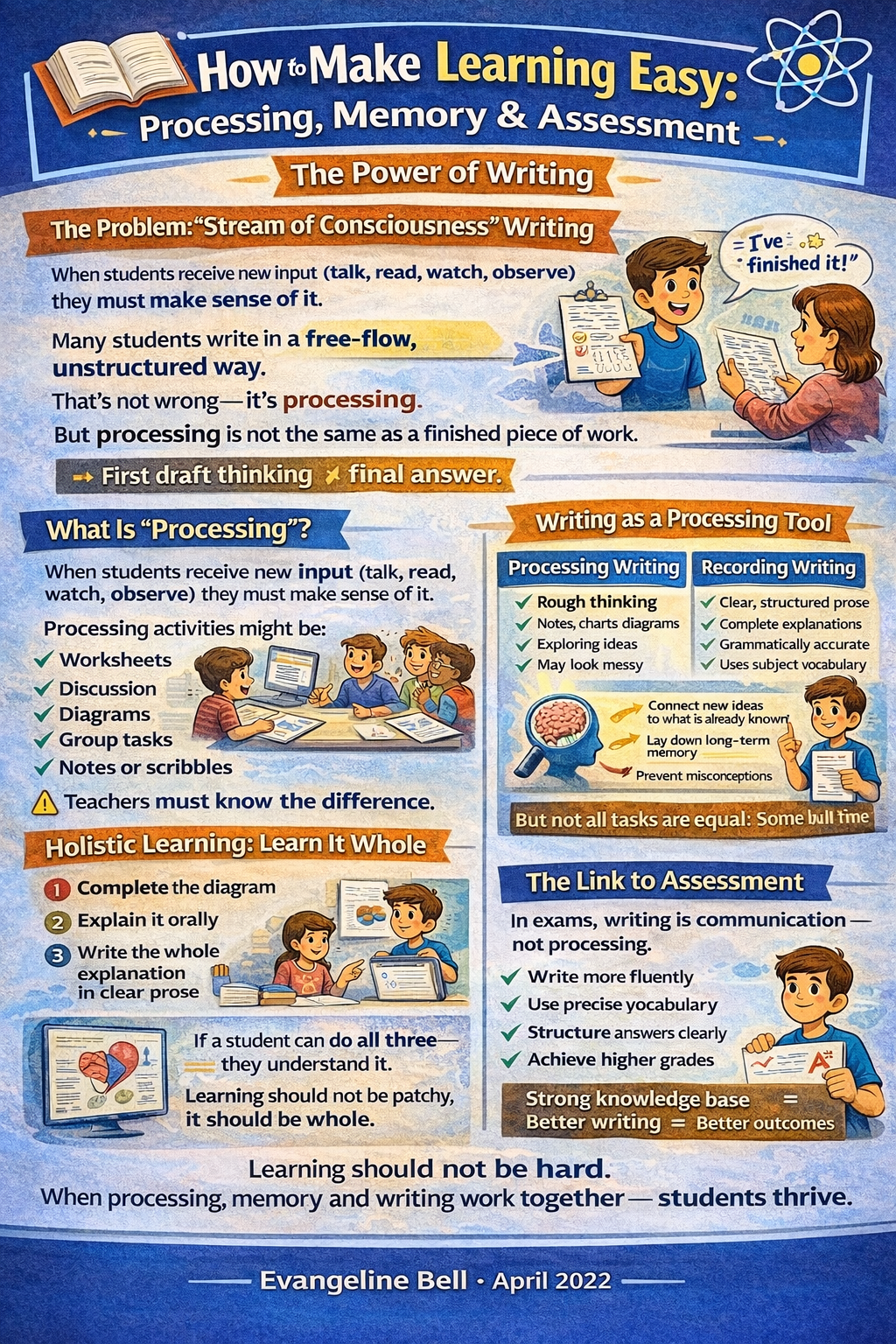
The ‘stream of consciousness’ problem
One of the most characteristic features of student writing is that it is written in a kind of ‘stream of consciousness’ style – the free association of ideas which are rammed together with little thought for structure, form, grammar, punctuation or coherence. Teachers often look at this kind of work with horror! And – no wonder. It is highly unlikely to score highly in any exam. The thing is that there is nothing ‘wrong’ about this. I do it myself. However, never in my life would I hand such a piece in to a teacher or a tutor as a finished piece of work. That’s because it would always be, for me, a form of processing: a way of sorting my thinking out. For many students, however, this is it – the first version is the final version.
Let us review the situation
So far in these blogs I have argued that the curriculum should be structured around the core thinking patterns which are inherent in every subject discipline. The logic behind that statement is that everything is learned in relation to everything else and, therefore, if the student learns the key patterns of reasoning which lay at the heart of each subject, s/he will be better able to assimilate new information than s/he would be trying to learn everything as a form of list. I have also argued that, despite what they think, students actually struggle not to remember things but to recall things and that, therefore, effective teaching should include an element of memorisation and recall at the point where something is learned for the first time. I have insisted that teaching be done in a systematic manner and that students are required to learn things holistically. The logic behind this is that if things are learned whole, they are better understood than if they are learned piecemeal or in micro-chunks. I have suggested that a school which adopted a strategy which embedded recall in the learning process would turbo-boost its outcomes because students would develop their cognitive abilities to recall across all subjects. It would pack a great punch over the long term.
The purpose of this blog is to discuss how memories may be created in the first place by the use of effective strategies of processing and how writing may play a part in that process. It is also to argue that the use of writing as a processing tool will also contribute to an improved quality of writing in the assessment part of the teaching and learning cycle.
What do we mean by ‘processing’?
Perhaps an older term for this might be ‘thinking skills’. However, what I mean by it is the array of activities which teachers set for students after they have given them some new input on something.
Typically, a teacher will give students input on some new aspect of learning. This might be by talking, reading, demonstrating or observing. The student then has to make sense of this input in some way. This is usually via some form of processing activity. It might be a worksheet to complete, a method to apply, a discussion …. It might be an individual task, a paired task or a group task.
Certainly, I sometimes thing that there are as many tasks as there are grains of sand. Some are repetitive, some are creative. Some are physical, some are mental. Some are written and some are not. The purpose of all of them, however, is that they enable the student first to make sense of the new input by understanding it in relation to that which is already known and understood, and, second, that they enable the student to lay down new memories in the long term memory.
Some of these processing activities are more effective than others – and some are more effective for some students than for others. This is an area where it is rare that one size fits all. This is a core reason why teachers should always be assessing the impact of their teaching on individual students. It is easy to assume that students have made sense of something when, in fact, they have not. I will criticise myself at this point and say that there are many times when I’ve felt in my guts that something has gone well, that a particular activity has really been effective – only to find a week or two later that it has not. Or, at least, has not been with some students and that those students have, as a result of my teaching, actually made erroneous connections.
Unfortunately, many tasks or activities in classrooms are not effective. They are merely intended to fill time. The teacher does not evaluate the effectiveness of the activity and merely assumes that learning has taken place.
For the purposes of this blog, however, let us assume that the task has been well-designed.
Writing and processing
Many of the tasks which are set in classrooms involve some form of writing. However, teachers frequently do not distinguish between processing activities and recording activities. This distinction is a topic for another time. Nevertheless, let us be clear – activities which are aimed at enabling students to make sense of new input or to memorise something are ‘processing’ activities. Activities which are intended to create materials suitable for revising from are ‘recording’ activities.
Many students like to write as part of their processing. They may like to complete a chart or a diagram. They may like to scribble notes. There are lots of forms of writing which students may like to engage in as part of this processing part of learning.
I would like to pick up, however, on one of the core principles from the last blog. Learning should be holistic. This is because things are understood better if they are understood completely. I argued then that learners should be required to articulate their learning whole. This can be done orally, of course. It should be done orally. But it should also be done in prose: in writing. This is because oral speech is not always organised as coherently as a piece of writing is, or, at least, should be. Requiring students to re-think their oral answers and compose their answers in writing – in coherent prose – is a powerful way of doubling down on this concept of totality and of holistic learning. So – to take an example from the previous blog – if a student is being asked to learn the process of photosynthesis, s/he could be asked to complete a diagram. Then s/he should be asked to explain the process orally. And, finally, s/he should be asked to explain the whole process in prose. If a student was able to do this and get it right, the teacher could be pretty sure that the student has understood the topic.
In short, writing should be a key part of the processing element of teaching. By doing this, the student would be creating a complete memory. Learning would not be patchy. It would be complete.
Quality of writing
If students were routinely asked to complete a piece of written work in order to consolidate the formation of memory and for the teacher to be able to check on the student’s level of understanding, it would be possible for that same written work to be done using short, complete sentences. It would give students practice at writing coherently. And, as a result, they would get better at it. This would be a stage beyond the initial processing activity which might be a practical activity, a creative activity, a group activity … whatever. The idea would be to make the student express the totality of their understanding of something in coherent prose. Not the stream of consciousness free association of ideas! I am talking about something which has been composed with structure and form. It is at this point that we should expect students to write well – short, clear, grammatically correct sentences. They should be deploying the subject-specific vocabulary which is required. They should be spelling correctly etc. If we did this as a whole school, we would not only improve student ability to memorise and recall, we would also improve their ability to communicate in writing. And, incidentally, we would improve their ability to articulate themselves coherently.
Assessment
Many assessment activities are also written. An assessment activity may take many forms but the most common are probably some form of assignment or some form of test. Let us assume that we are preparing our students to sit an examination. There is no doubt that the ability to write well – coherently and articulately in standard English – makes a big difference to outcomes.
If our students have internalised the content that they are being assessed on, the quality of their writing will improve. I can prove this time and again by looking at work which I know has been done after an extensive period where students have been asked to memorise information, compared to that which has not. It isn’t just that there is more substance to the work. It is that it is just generally better written. This is because a student whose knowledge base is good is not using writing as a processing activity. S/he is using it for what it should be used for – communication. If I have constantly marked and given feedback on the processing part of the work and if the student has developed the ability to recall, they will be in a position to communicate their learning clearly – and this will manifest itself in good quality writing. And this will manifest itself in higher quality grades at examination time.
Conclusion
Learning should not be hard. Yes – it often is. But, too often, this difficulty is created by teachers who are obsessed by their sequences of tasks or activities or who are determined to demonstrate their use of particular pedagogies.
In fact, if we are clear about which part of the learning process is taking place, we can be more critically aware of whether our teaching is being effective, or not. A key part of teaching and learning is the use of a multitude of activities which are basically aimed at enabling student to make sense of new material. These are ‘processing’ activities. Many (though not all) may involve some writing. Often, this may, indeed, be ‘stream of consciousness’ in form. As long as we know that this is a processing task, we do not need to worry about that. What we should not do is accept this as a finished piece of work.
What we should do is also to require students to articulate the whole of a piece of learning in both oral and written prose. This will improve the student’s ability to retain the new learning in terms of memory creation. It will also improve the student’s ability to recall information. Finally, it will improve the student’s ability to communicate in written prose. This, in turn, will help to improve student performance in written tests or exams. And – this – will improve outcomes.
If you publish books or educational materials, Verbatim is here to help, not just with proofreading but with professional expertise.
Precision. Clarity. Verbatim.
The cosmos is in motion

Aristotle said that the stars orbit the heavens on their own crystalline celestial sphere. The ancients looked to the stars for portents and omens in a world which was the centre of the universe. Everything was as it seemed in a cosmos where stasis was the natural order and a panoply of divinities inhabited an ethereal plane and ruled over men.
The monk
A monk sat, his cowl drooping over his head casting a shadow over his face and stared at the stars. He recognised the constellations: Orion, Taurus, the bull, and Leo. He knew they marked the seasons and, subject to Divine Providence, influenced the world of men. They were ancient, fixed and unchanging, part of a calm, peaceful and orderly universe.
The monk sighed deeply and rested his weary face in his hands for a brief moment. He was troubled in his spirit and anything but calm. Once, he had been so certain of his calling. Struck by lightning, he’d called upon Saint Anne to save him and vowed to become a monk. He had abandoned his secular ambitions to become a lawyer and taken the cowl. He saw himself as a young Samuel must have done when the divine voice spoke to him out of the darkness.
But something was wrong.
The church had many routes to inner peace, but he could find none. His spirit was restless and disturbed; it didn’t matter how often he availed himself of the sacraments, he never felt that God was pleased. He’d spent hours in confession. He’d tried to recall every sin he’d ever committed. He’d done penance after penance. He’d called on the assistance of every saint he could remember. He’d attended Mass after Mass. Yet, God seemed perpetually angry. As he contemplated the celestial canopy above him, all he could think of was his terror in the face of a vengeful God.
Was he truly the worst sinner that had ever lived? Each time he thought he’d confessed everything, something new would float into his mind. It never seemed to end. Did he do nothing but sin, all day, every day? Yet his life was that prescribed by the Augustinian Order. He had no possessions, barely saw a woman, could not possibly indulge in gluttony or drunkenness. He could not gamble and had never stolen so much as a piece of turnip from the soup of a fellow monk. He read. He preached. He prayed. He attended divine services and completed the offices of a monk conscientiously and diligently. He was entitled to inner peace.
A wave of rage suddenly swept over him. His skin became taut. His heart raced and he clenched his fists in frustration until his knuckles whitened. The problem was God. It had to be. God was too exacting. He always wanted more and there was just no more he could give. For a moment, he was consumed with a mixture of disgust and contempt. How dare God put him in this position. How dare God put him in a world which trapped him in sin and then threaten to consume him in hellfire when, as hard as he tried, he couldn’t stop sinning? How dare God tell him that he was all loving and forgiving when it was clearly untrue? God was lying to him: it was as simple as that. How he hated God at that moment!
And he collapsed into bitter despairing tears. He was a monk. He wasn’t supposed to hate God. Pride was the worst of all sins. He was going to hell. He was sure of it! ‘Oh Mother of God, help me.’ Surely, if God were so angry, the Blessed Virgin might help to appease him.
The monk looked up and saw the power of Taurus in the night sky. It was no good. God remained angry, implacable, unmerciful.
The monarch
A king stood on a balcony and looked to the heavens. There was Leo, giver of kingship. Over there was Orion, the warrior. And there was Taurus, the bull, giver of power. He had the blessings of all three and he knew that he had been given these blessings by his god. He smiled with genuine pleasure. Mortals may rule earthly kingdoms, but he knew that their destinies were shaped by the stars and determined by the deities who ruled the heavens.
He sighed with a deep sense of self-satisfaction. There was no monarch greater than himself and he knew that he absolutely deserved this greatness. There was no god greater than his god. All his enemies had been swept beneath his feet, and he would now pay tribute to his god for these victories. He would build temples. He would erect statues and make sacrifices. He would order all his subjects to bow before the god who had placed him in this position of supreme power and authority. His devotion to his god would be rewarded with yet more glorious conquests.
But something was wrong.
It was those Hebrew boys. There were four of them, just teenagers. But they were so stubborn and defiant. They wouldn’t accept that their god was weaker than his. They kept saying that there was only one God - and that was nonsense. The heavens were as full of gods as there were stars. And they squabbled and fought, lusted and envied, loved and hated, just like men did. So - if one was defeated, like the Hebrew god had been defeated, then his people had to bow to the victorious god. That was the natural order. Everyone knew that. And still these hard-necked Hebrew children just wouldn’t listen. It irked him for it implied that they had no respect for his own exalted position either.
And, yet there was Daniel ... When all the astrologers and magicians and priests in Babylon had failed, Daniel had not only been able to give an interpretation of the vision, but he’d known what the vision was. How had he known that? The king had always been suspicious of the mystics. You tell them of a dream and they’ll give you an interpretation, usually exactly what they think you want to hear. But he hadn’t been able to remember the dream …. and then Daniel had told him exactly what he’d seen during the darkness of a solitary night and it absolutely was not what he wanted to hear. How had he known? If the priests of his own victorious god had failed, why had the defeated worshipper of a defeated god succeeded? He found it all very perplexing; it was all so wrong.
The monarch stared up at Taurus. ‘What are you doing, oh giver of power?’
Rome
Rome: the greatest city on earth. Brother Martin thought himself to have been singularly blessed with an opportunity to visit the holy city.
Yet, Brother Martin was not really interested in the relics of antiquity or the art of the renaissance. What he wanted to do was avail himself of the multitudinous spiritual benefits which could be secured in Rome and nowhere but Rome.
In between the business of the Order, then, Brother Martin had devoted himself to religious works. He had visited every holy shrine he could. He had attended as many Masses as he could find time for. He had confessed daily, sometimes several times a day. He had visited St Peter’s basilica and was shocked to find it an ancient, somewhat decaying building, sadly in need of repair. He saw that the foundations for a new structure were being laid - but the workmen seemed indolent. He would have thought that anyone tasked with building a new home for the holy relics of St Peter would have devoted themselves to the work, night and day and thought themselves honoured with a rare privilege. This was not the case; the workmen squabbled over wages.
The lack of urgency displayed by the construction workers wasn’t the only shock. Brother Martin had been appalled to hear the irreverent way that some priests conducted Mass. Of course, it was the sacrament that mattered, not the spiritual state of the priest. But Brother Martin, who trembled every time he conducted the service, found the levity of the Italian priests astounding. Sometimes, they didn’t even use the right words. They even mocked the sacrament itself. And the decadence! If Rome was meant to be the ‘holy’ city, it left a lot to be desired. There were brothels which were frequented by clerics and Brother Martin even heard a rumour that some clerics preferred boys to girls. His simple Saxon soul shuddered at the very thought. Everyone talked of money. Funding for the new basilica may be a necessity but the naked greed on display in this city was astonishing.
Still, the church was the church and God remained God. Surely, the spiritual benefits of Rome remained valid in spite of the irreverence and degeneracy of its priests? Thus, despite his growing unease, Brother Martin had persisted in his mission to secure as many of these as he could during his time in the city.
One day, he spent the entire morning climbing the Scala Sancta, saying a prayer on each step. His reverence was deep and sincere. He knew that if he completed this penance, he could release a soul from purgatory, and he had determined that he would do this for his maternal grandfather. As he climbed the very steps which Jesus had ascended before Pontius Pilate, Brother Martin replayed the scene in his mind. He saw Christ bearing his cross. He saw the crown of thorns with blood dripping down the face of the Saviour. He saw Pilate wash his hands before the multitude and heard them choose Barabbas over the Messiah. He saw the cross atop Mount Calvary and he heard the ripping sound as the veil in the temple was torn apart.
As he breathlessly reached the summit of his climb, he raised his hand in triumph, awestruck and confident that his efforts were about to release his grandfather into paradise. As he stood, he recalled the words of Christ to the penitent thief: ‘Today, thou shalt be with me in paradise’.
He heard a deep cracking sound as the stones marking the burying places of the dead were rent in two. He thought of his grandfather. He was filled with pride at the thought of the effort he had made to release his grandfather’s soul …
‘… but who knows whether it be so!’
And Brother Martin’s certainties collapsed into a cloud of dust.
Fire
A dusty cloud hovered over the city obscuring the sun. It was impossible. King Nebuchadnezzzar’s jaw had dropped in amazement. Even at this distance, he could feel the heat. The furnace glowed red. The intense heat made the air around the entire courtyard shimmer in a blurry haze. There was an air of unreality about the whole scene. Three men had died as the huge doors had been opened and a blast of super-heated gas was expelled like a volcanic eruption. And yet the three Hebrew boys were walking around unharmed.
His Supreme Majesty had ordered them thrown into the flames because of their persistent refusal to bow the knee to Marduk. Their defiance had been more than an irritant. It had challenged all sense and reason. It was not as if the king had a problem with them continuing to worship their god. But he must be put into his proper place. Jerusalem had fallen to the Babylonian forces. Its people had been enslaved and the treasure from their temple plundered. Why wouldn’t these damned children see sense: their god was inferior to his? Marduk ruled the heavens and their god was self-evidently second-rate. But, no! They’d insisted that their God was the only God and refused point blank to participate in any worship of Marduk. They wouldn’t even eat the expensive food that had been presented to the god: they’d rather eat inedible slop, like donkeys. It was simply intolerable!
But Nebuchadnezzar was not a cruel king. He’d had the priests try to reason with them. He’d given them time to change their minds. The magicians had shown them the signs and omens in the stars. Leo had brought the blessings of sovereignty and kingship to Nebuchadnezzar. Surely, he’d thought, these clever boys with their clever minds must recognise the evidence before their own eyes. Marduk was the most-high god - and they must acknowledge that. It was Marduk who had chosen Nebuchadnezzar to be the supreme king of kings. The king’s knuckles whitened as he clenched his fist. He banged it down hard on the arm of his throne with sheer irritation. Either those boys submit to his decree …. or else! He’d make an example of them.
They hadn’t flinched. They’d repeated their defiance. They’d insisted that Nebuchadnezzar had only been able to destroy Jerusalem because their God had been angry with His people for worshipping other gods and that He could have prevented Nebuchadnezzar from taking the city if He’d wanted to - and they told him some totally absurd story about how their God had once enabled them to capture a city by making the walls simply fall down. Nebuchadnezzar sneered. The Jewish people might have won a victory eons ago but, if they did, they did it the same way that he did - by laying siege and battering the walls until they either fell or the people starved and the city surrendered. It wasn’t magic. The story had infuriated Nebuchadnezzar. Why would a god be so demanding as to refuse to recognise other gods? It made no sense. The heavens were full of divine beings.
The sheer unreasonableness of the argument caused him to order that the furnaces be stoked hotter than usual. He was kind of sorry about that now because three good men had been killed because of his rash decision. Nevertheless, if the men stoking the fires had been killed just because they were too close to the heat, how come the three intended victims were wandering about as if going for a morning stroll by the river? They were, it seemed, oblivious to the fact that they ought to be dead. Why weren’t they dead?
Nebuchadnezzar squinted. He shook his head. The heat was making him dizzy. There were three victims, right? So, who was the fourth man that he could see in there? Where had he appeared from? He blinked. He stared. He looked away and looked back again. There were definitely four human figures in there. And this last one shone. The aura which emanated from Him seemed to cast a shield over the three Hebrew boys. It was He. He was protecting them from the fires. A god in human form? A ‘live’ god in human form? This was no graven image. This man moved. He walked and he talked. Nebuchadnezzar was astounded. The three Hebrew boys were not kneeling before their God as he prostrated himself before Marduk. They were standing and he was talking to them as a man talked to his friends. This god was no warrior god. He was dressed somewhat like a peasant. This god smiled.
Gods didn’t smile. They were austere, aloof and distant. Gods were to be exalted, worshipped. They wanted sacrifices and obeisance. They were imperious, like himself. This one seemed to want conversation. He seemed astonishingly ordinary, not remotely bothered by the fact that the three boys weren’t bowing and kneeling before him. Nebuchadnezzar struggled to find the right words to describe the feeling which seemed to radiate from this unknown god. This god was some sort of protective god: a god of kindness and benevolence.
That couldn’t be right. Gods were terrifying, powerful, unreachable, inscrutable. They had to be appeased, placated … even bribed. Some gods demanded the ultimate in human sacrifice. As Nebuchadnezzar watched this god, he had the strange feeling that this god could not be placated, even by human sacrifice. And even this most powerful of all kings rather thought that he wouldn’t dare try and bribe a being who could walk about unharmed by the most ferocious of fires.
The universe swirled about Nebuchadnezzar’s head. He stared up at the stars. Orion, the warrior, stared back at him. He asked his question: how could a god who had been defeated in battle resist the power of Marduk’s flames?
St Paul
Brother Martin looked at the small crucifix which hung above his bed. It was a narrow monk’s cell, plain and barely furnished. A bed, a desk and a small wooden chest. Austere, like God. He’d been praying for so many hours that his knees were aching and sore. He simply had to sit up. He sat at a desk littered with ink-stained papers. Brother Martin might have a tidy mind, but he really was a messy worker. The papers were supposed to be his notes on his upcoming lectures on Paul’s Epistle to the Romans. He had been getting nowhere and had decided to pray for inspiration.
As usual, his prayers had rambled and circled back to the core problem: nothing satisfied an outraged and angry God. Brother Martin buried his tonsured head in his hands in utter despair. How could he lecture others on the teachings of St Paul if he had no faith of his own? And, frankly, he did not understand a word of what the Apostle was saying. His prayers had brought nothing in the way of inspiration. He was as flat and empty as he was when he first knelt down several hours ago.
He wondered if there had ever been a more miserable soul than he. He was a monk. He had devoted his life to God. His head ached. Rome had been such a disappointment. There, he had hoped to find certainty. In fact, he had only discovered doubt. What had he done that God should treat him so? Had anyone ever so despaired in God before? Had anyone ever gone through such Anfechtung?
His eyes drifted back to the crucifix. There was a silent pause …
Yes.
He had.
‘My God, my God, why hast thou forsaken me?
Was this not the cry of his own soul? Did he not feel abandoned by God? But Christ had felt it too? Had God abandoned Christ? How could God have abandoned Christ? Yet - He had.
Martin Luther looked down at his scrappy notes on the Epistle to the Romans. And he saw it. ‘That God might be just and the justifier ….’
And a realisation as sharp as a needle stabbed into his mind: Christ had experienced Anfechtung and all Brother Martin had to do was believe it. At that instant the burden he had been carrying for so many years vanished: God was no longer angry with him, and he felt an unexpected peace. His tight shoulders relaxed and he exhaled slowly.
This, he thought, was exactly as St Paul had felt when the scales had dropped from his eyes, too. Brother Martin stood. He turned to look out of his small window towards the stars. He saw that they filled the night sky. But the constellations of Orion, Leo and Taurus were nothing but imagined shapes in the heavens; they did not influence his future. They shone in the night sky and revealed the glory of a God who loved him.
The Most-High God
Babylon: the greatest city on earth. A young scribe was utterly astonished. Did his king really want him to write this? He was glad to see King Nebuchadnezzar looking so well. But it seemed incredible that this king, who had been so devoted to Marduk was now telling him to write a proclamation acknowledging the superiority of a different God entirely. The scribe paused.
King Nebuchadnezzar noticed the silence and asked the young man why he’d stopped writing. The scribe looked down, too embarrassed to say what he was thinking. The king said it for him: ‘Why am I acknowledging the supremacy of a foreign God?’
The scribe looked up. ‘You built the great temple to Marduk, sir. You were chosen by him.’
‘I did. And I have devoted many years to the service of Marduk. But … a long time ago, I threw three young men into a fiery hell for refusing to bow the knee to Marduk. I thought I’d make an example of them. Instead, I saw a vision of their God. He is a … different kind of God. They lived and they still live, here in the city.
Then, I had a vision and the man, Daniel, interpreted it for me.’
The scribe looked up again. ‘I know Daniel, sir. He lives in the blue house near the market. He buys pomegranates and figs from my grandfather. He is a great man.’
Nebuchadnezzar nodded and smiled.
‘Ah yes! You must get some of your grandfather’s figs for me, too.’
The young man smiled shyly and the king continued.
‘Daniel told me that I was proud and that his God intended to teach me humility. I was angry. I believed that my own power and might had made me ruler over the greatest city in the world: Babylon - and its empire. I saw Taurus, giver of power, shining brightly overhead and I knew that I had been destined by the gods to rule the world. At that moment, my tongue was glued to the roof of my mouth. I could not speak at all. I tried to call my servants, but I could not make myself understood. I could only grunt like a beast.
I was gripped by terror, and I ran out of the palace and into the gardens. I hid myself. I did not want anyone to see me. I crouched low and crawled to the darkest part of the garden. I saw the sun rise and I saw it fall. And, in the darkness of the night, a man came to me.
At first, I did not recognise him. But he said, ‘Nebuchadnezzar, you may not know me. But I know you.’ And then I saw that this was the same man I’d seen in the fire but, in my mind, I would not admit it. This common man in common clothes could not be a ‘god’. I tried to stand but I could not. A huge weight seemed to press me down until I knelt before him on my hands and knees. I tried to speak but I could not. He just looked at me for a long time, searching my soul, saying nothing.
A furious rage welled up inside me. I called on Marduk to throw fire from heaven on this man and destroy him. How dare he challenge my power and my majesty? How dare he defy the power of my god? And the man turned and walked slowly away.
I prayed to Marduk day and night. I watched the constellations move across the skies. I hid among the cattle. For many days, I saw no-one and no-one saw me.
My anger burned. It raged and warred against this strange god. Who was this god? Why had He let me destroy his city but would not accept defeat? How dare he upturn the celestial order? I despaired of life. I wanted to die. I tried to die. But death remained as distant as the stars. I was powerless to live and powerless to die.
Taurus shined distantly above as I lay beside a newborn bull calf. I felt the beating of his small heart and the warmth of his flesh. Life …. I realised that I wanted to live and return to the world of men. It was then that I saw the image of Marduk crack and crumble before my eyes. His dusty lifeless form was blown away in the wind and all I had left was an empty hole where a god used to be. It was a deep, cold and void place, like the entrance to an afterlife. My knees shook with fear.
I looked to the heavens. The night sky was black. I called out to the man in my mind, ‘Whoever you are, talk to me!’ And he came, slowly walking towards me; the Most-High God in the form of an ordinary man. As I looked into his eyes, I realised that no matter how hard I had pleaded with Marduk, he had remained as silent as if he were dead, but I had only asked this man to come once - a silent whisper in the darkness - and here he was, a living God. ‘Do you know me now, Nebuchadnezzar?’ Yes. I know you. You were in the fire.’ He smiled and a benevolent kindness radiated from Him. ‘Stand up … like a man, Nebuchadnezzar.’ Hope blossomed in my bosom. I stood upon my feet. I was alive and the living God was talking to me.
Stars fell, as it were from the heavens and vanished, plucked out of the night sky by a God who lived in man.
Write …’
And the scribe wrote …
The Cosmos
An old king sat on the terrace of his palace. He looked to the night sky. There was Orion, the warrior. He had been a warrior-king in his time. He had brought down enemies, destroyed cities and enslaved peoples. He saw Leo, and Taurus. But it was the strange God of the Hebrews who had brought him power and victory: a God who took the form of man and talked with men. A benevolent ‘protector-God’ who could be angry, but who did not wantonly vent that rage on a puny and ignorant man, even though he be defiant. He was a God like no other: a God who did not take life but gave it. As he stared at the familiar constellations, King Nebuchadnezzar doubted if they ever had any influence over the affairs of men.
And somewhere in late medieval Saxony an excommunicated monk called Martin Luther held the hand of his wife and looked at the same stars. What they saw was a cosmos in which nothing is what it appears to be: Rome was become Babylon, the earth orbits the sun, and space and time intersect in a fourth dimension. But Luther and Katie stared at Orion, Leo and Taurus and saw only the glory of the Creator spread out across the heavens: the same God who had humbled the arrogant pride of an ancient king had likewise destroyed the self-righteous pride of a monk, teaching him that salvation was by faith in a God whose yoke was far lighter than all the rituals of the medieval church allowed.
Above them, the heavens spun as alien worlds collided, exploded, spewed out the primordial elements and the universe hurtled through time itself, its existential violence held in check only by the power of a sovereign God whose ways and purposes remain mysterious. Aristotle’s perfect cosmos may have been broken and forgotten but, if we look to the heavens, the same stars continue to shine and God remains the same ‘yesterday, today and forever.’
For all your proofreading and editorial needs, fiction or non-fiction, contact Verbatim.
Precision. Clarity. Verbatim
Quiet Quitting

Far away, a bell tolled. Finality. It may have been a burial or the sound of an epoch closing. Its deep and sonorous sound shifted the universe at a cellular level. Motivation drifted into coma. And she found she no longer cared.
An echo lingered but the ashes were cold and the thought turned into concrete: ‘I’m almost 52 years old and I don’t want to do this anymore.’ At that instant, the walls closed in and she found herself chained and bound. Moments elongated into eons as the ticking of a clock turned into the ponderous footsteps of an assassin. She was being hunted.
The air was stale. Her words were scratches on a headstone. Her flesh crawled at the odour of decay: ‘If I have to sit through one more data meeting, I’m going to scream.’ She punched the wall until her knuckles bled. The scent of fresh blood was caught by the breeze and hyenas began to circle.
Helplessness becomes necrosis. The jungle is bleached and shrivelled dry. Survival is the only must as the sun’s scorches turn to acid: ‘I’ve been doing this for half a lifetime - and, today, I’m done.’ The whip cracked, slicing through to her bones. The hyenas tore into her raw flesh. Their teeth gleamed white in the light of a waning moon as she was eaten alive by those who’d sworn to protect.
The bells pealed to celebrate a blasphemy and the church doors slammed shut. Darkness enveloped her soul. It clung to her like moss: ‘The only way to end it is to end it.’
So - she quit.
Literary fiction writing, editing and proofreading by Verbatim.
Precision. Clarity. Verbatim.
Dashes—a 60-second masterclass
There’s a lot of talk about AI over-using em dashes. But - if you want your writing to look professional, you do need to know the difference between a hyphen, an en dash, and the mighty em dash. A lot of people use them interchangeably, but using them correctly is the ultimate "if you know, you know" for high-level communicators.
Here is the 60-second masterclass
1. The Hyphen (-)
The Connector.
• Use it for: Joining words together or separating phone numbers.
• Example: "A well-known author."
• Vibe: Keeping things tight and tidy..
2. The En Dash (–)
The Navigator. (Width of the letter 'n')
• Use it for: Ranges of time, dates, or numbers. It basically replaces the word "to."
• Example: "The 1990**–2000 era" or "9:00 AM–**5:00 PM."
• Vibe: Sophisticated logic..
3. The Em Dash (—)
The Showstopper. (Width of the letter 'm')
• Use it for: Creating a dramatic pause, adding an afterthought, or replacing commas/parentheses for emphasis.
• Example: "She finally reached the summit**—**and realized she'd forgotten the camera."
• Vibe: Bold, stylish, and impactful.
Pro-Tip: On a Mac, type Option + Shift + - for an em dash. On Windows, hold Alt and type 0151.
Small details are what separate "good" content from "expert" authority. Learning the difference between these three dashes, and when to use them, is one of the things I learned during my proofreading training. with The Publishing Training Centre.
Precision. Clarity. Verbatim.
02 How to make learning easy: memory, organisation and recall
Learning shouldn’t be hard. Of course, everyone comes across something they find difficult at some point and there will always be those who struggle. But, for the vast majority of students, the process of learning things should not be hard because human beings are learning machines. We’re built to learn.
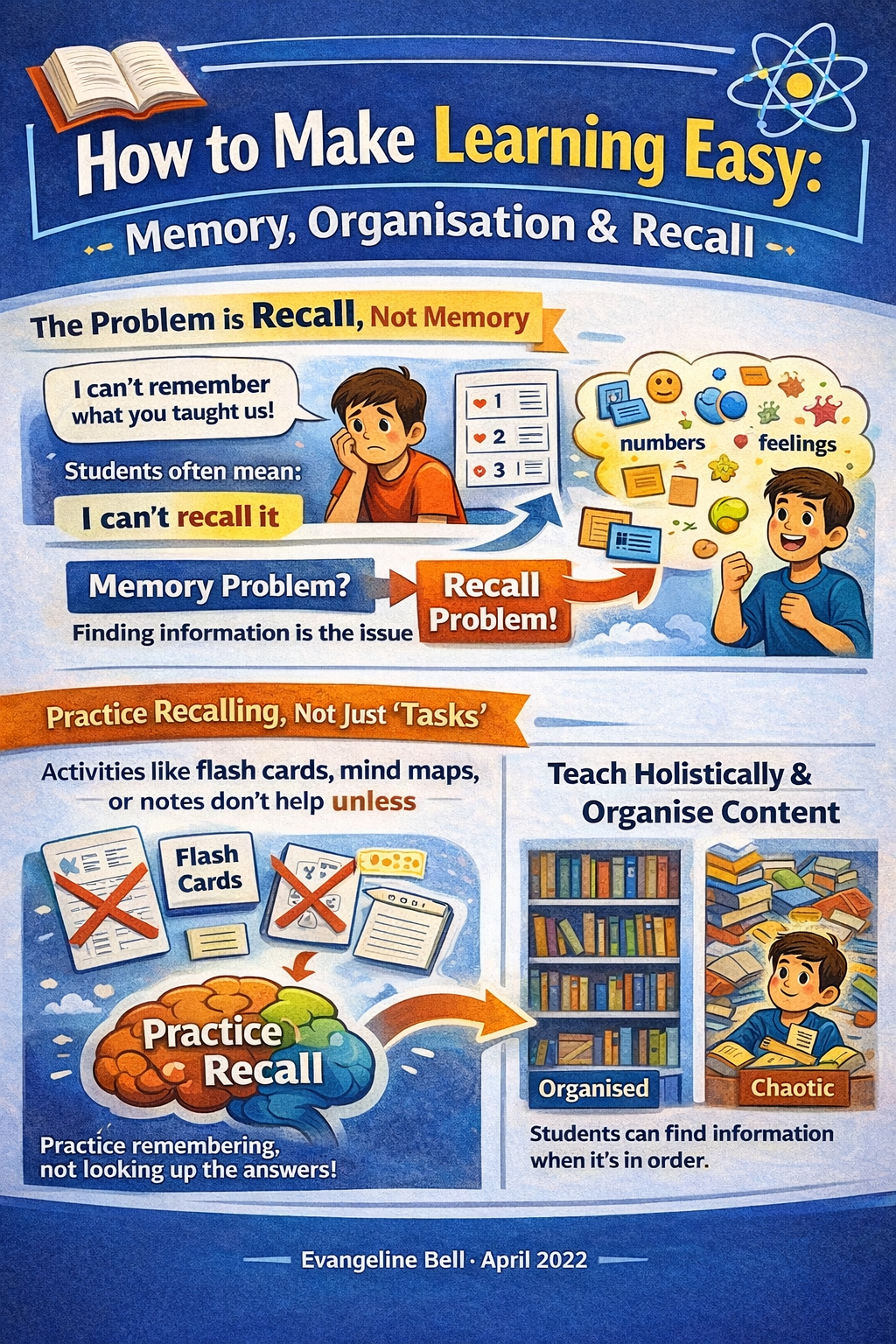
How to make learning easy; memory, organisation and recall
What students say – and what they really mean
Students often tell us that they can’t remember things that we’ve taught them. Not only is this disheartening for the student, it is also frustrating for the teacher. It also happens to be largely untrue!
Now – let me give you a caveat for a moment. Yes – students will not have remembered things that were not well-taught. They will not have remembered anything if they were not present in class or if they were not paying attention. All that is true.
But, let us assume that we have in front of us a student who attends regularly and works hard and let us flatter ourselves that we did teach them rather well. The student still tells us that they can’t remember what we’ve taught them. The chances are that they actually can – or can remember most of it. What they can’t do is recall it. How do I know this? If you give a group of students a multiple-choice test, they will do far better than if you give them recall questions on exactly the same content. What this means is that the information is in there somewhere but, when asked to find it unaided, the student cannot locate it in his/her memory. The problem, then, is not so much one of memory as one of recall. The student tells us that they cannot remember anything. What they mean is that they cannot recall it.
What this means is that solutions which focus on fixing information into the memory are largely mis-directed. The problem we need to solve isn’t memory. It’s recall. By requiring students to double-down on the process of laying down memories, we aren’t just failing to solve the problem. We are making it worse because the student may be working really hard and yet is still failing to experience success. This is bound to undermine the student’s confidence. And – a subject for another blog – confidence is vital for success.
The problem of recall
My subject has always required students to recall huge amounts of information. There is literally nothing on a GCSE History paper except a series of questions and a large amount of lines to write on. There are no prompts or aids. So, how do the students learn to do it?
First, we need to understand that when information is presented to the students, they need to actively process that information in order to make sense of it. This, they do in relation to what they already know. This is why it is important to embed the key patterns of meaning, or establish the mental schema, for your subject before expecting them to be able to recall information. They need to make sense of it and they can best do this by slotting it into those patterns of meaning I wrote about in my first blog on this topic. How students process information and do this is a theme I shall discuss in another blog. For now, let’s say that they do this via the multitude of activities which teachers give them in lesson to do.
If the activity is a well-designed activity and if the method chosen is effective, the student will transfer information from the working memory into the long-term memory. There, it will be split up into different kinds of information – numbers, words, emotions, shapes … whatever – and stored in different parts of the brain. This matters because if you ask a student a question via multiple-choice test, all the student has to do is to locate the precise bit of information which s/he has seen before and select the right answer. But – if you ask them a recall question, the chances are that they will have to find multiple bits of information which are stored in different parts of the brain, synthesise them into the whole again and spit out the complete answer. Recall isn’t just identifying. It’s synthesising. The process is very different from that of laying down, or creating, memory.
What we often do as teachers is spend a lot of time trying to get students to create memories. We rarely ask them to practice recalling – and, yet, that is the core problem.
Why flash cards and other ‘task’-based revision techniques are ineffective
Often, teachers set ‘tasks’ as revision activities. Traditionally, this has involved making flash cards or doing mind maps or summarising etc. There’s nothing amiss with any of these activities in themselves. But – if the student does them essentially by merely transferring information from point A to point B, they are not going to be able to recall much at the end of it. They are not practising recall. It’s as simple as that. Even doing past papers is of limited value if the student is always allowed to use content resources – to ‘cheat’ - when doing them.
If, however, the student makes flash cards, does a mind map – or whatever – but does it from memory, all of them may well be highly effective.
Organisation and holistic teaching
But, let’s try and make it easy for the students, shall we? Not only should we construct our curriculum around the core patterns of meaning for our subject, we should also teach in a manner which makes it easy for the students to store information away coherently.
Let us imagine for a moment that we ask our students to find a single piece of information in a library. They walk into the library and they find that everything is organised according to a system. They know where to look and where to find what they are looking for. But what if all the books were in a heap on the floor? All confused and higgledy-piggledy. How, then, would the student find that single item they needed? That’s often what we do with our students. We teach them in micro-slices, thinking that this will make the learning easier to digest. It will – in the short-term. But, if we want the student to be able to find the information and recall it at a later date, they need to put it away as part of a large whole and they need to do so systematically.
What this basically means is that we need to teach whole blocks of information and attempt to get the students to memorise it as a whole and at the time at which it is first taught. Too often, we plough our way through our schemes of work/course without checking to see if what we’ve taught has been retained. It’s what teachers used to call ‘covering the content’ – a phrase I’m recalling from my earliest teaching career. What we then do is ‘test’ them in some way. We set them to ‘revise’. But the word ‘re-vise’ means that the student is doing something for at least the second time. If they never retained it in the first place, they aren’t ‘re’ doing anything. Teachers also often expect students to retain something after only a single lesson studying it. They were told it once and they should be able to remember it… In fact, it is highly unlikely that anyone will be able to recall anything much if it is only given to them once. Therefore, we need to build opportunities for memory creation into our teaching and we need to check that students are able to recall what we’ve taught frequently. Testing is a form of sampling. It doesn’t assess the full extent of understanding or learning. As a teacher, we need to be sure that the student is learning on an ongoing basis. Again – the subject of assessment is for another blog.
The point to remember is that if something goes in as a whole, it is more likely to come out as a whole because, when the memories were laid down, the student has mentally noted where the connected bits of information were stored in that long term memory. This is known as semantic learning – learning which makes sense of disparate items of information because it is fitted into a pattern of understanding. Remember – recall entails synthesis. If the connections between things are an inherent part of the learning, it will be easier to synthesise it together again. It will be easier to recall. It will even be easier to find those single items of information needed during the sampling process – which is better known as a ‘test’.
Indeed, it may well be that your examination paper assesses student understanding by asking short questions of some kind which only tests a part of that understanding. However, it is still better to ensure that the learning is whole. For example, if a student can explain the process of photosynthesis, or the water cycle or the method of calculating the area of a geometric shape, then they really do understand it. If the examination only tests a part of this understanding or the application of something, it does not matter. The student is prepared for anything because they understand everything.
Let me give you an example of what I mean. I do this – so this is a piece of self-criticism. I ask a question to the class. A student gives me a bit of an answer. It isn’t the full answer so I ask a supplementary question. This elicits a bit more of the answer. I may continue to press the same student or I may bounce the question to another. Whatever … what is actually happening is that I am dragging information out of the students in micro-doses. Eventually, I will feel that we’ve pretty much got all the component parts to the answer and I – me – I will synthesise it all into a complete answer. The students will nod their collective heads and some of them might actually understand what I’ve just done. A lot do not. I would be teaching better if I then required the students to do the same: to synthesise all of that information into a complete answer. I would be teaching better, still, if I then asked the students to compose an answer in written prose. Again – that is a subject for another blog.
At this time, let’s say that we should always teach holistically and expect the students to learn a complete topic in its entirety. We should also expect them to be able to recall and articulate that answer in its entirety.
Another, and related, way we can make learning easy for our students is to have our curriculum organised systematically and we need to explain that system to the students. In History, for example, we may construct a programme chronologically. But, we may do it thematically. We may equally organise it conceptually. There is no fixed ‘right’ or ‘wrong’ – but what we shouldn’t do is mix up all of these approaches. We must be systematic. The same principle applies in every subject.
Making recall a part of the learning process
My contention is that we should not teach a topic by setting a sequence of activities and then assessing how much has been learned either by means of a periodic test or by an assignment. We should make recall an embedded part of the learning process.
I am suggesting that we consider these elements in the process of learning:
· Input
· Processing
· Memorising
· Recall
· Writing
· Assessment
I don’t necessarily think that there is a specific order in which these have to be done. For example, a teacher might have a recall exercise at the start of a session – or later on. A teacher might have two exercises on the same part of the process but at different phases of the learning process. What I’m suggesting is that memory and recall should become an endemic part of the process. I am also going to suggest that writing has a number of roles to play in this. Yet another topic for another blog.
What would this look like?
One year, AQA chose to focus their historical environment unit on the coffee houses of London during the Restoration Period. To teach this, I did a lot of research on the subject. I wrote three model answers focusing on different themes. I asked the students to memorise each of the themes in turn. They did this either by a process of ‘Look, Cover, Check’ or by writing notes on what I’d written and then speaking them aloud without looking at them. I then asked them to put all their processing work away and selected them at random to tell the class everything they could remember about their theme. The key concept was that students were required to recall the totality of something in some way, shape or form.
Impact
If we did this across a school, however, our students would develop an amazing ability to recall because it would be being practised day in, day out. Their cognitive ability to recall would become highly developed. My experience tells me that when students become atuned to the fact that they are going to have to recall information which they are being taught, they start to make a mental note of that. They start looking for the sort of information they need. They become faster and more efficient at it. if we combined this with a curriculum plan based on subject-specific patterns of meaning which would enable students to assimilate knowledge more easily and if we start to use writing more effectively, we could seriously turbo-boost our outcomes.
Conclusion
Learning shouldn’t be hard. Human beings are built to learn. The purpose of this blog is to argue that teachers often mis-diagnose an inability to remember when the problem is more likely to be an inability to recall. It is, therefore, to argue that we should incorporate memorisation and recall into the process of teaching and learning. It is also to argue for the concept of holistic teaching: students should be required to recall the totality of something. Learning should not be left with a topic or learning goal having been taught and learned in small chunks. It should always be synthesised back into its totality. If this is combined with a progressive curriculum plan which has been created around the inherent patterns of meaning in a subject, it will significantly improve our outcomes. A topic for another blog is the role of writing in enabling students to process their learning and how this can also facilitate better memorisation and recall. And how that creates a virtuous circle whereby better memorisation and recall can engender better writing. Better writing engenders confidence. And, both better writing and a greater sense of confidence would, I assure you, lead to better results.
If you publish books or educational materials, Verbatim is here to help, not just with proofreading but with professional expertise.
Precision. Clarity. Verbatim.
A coal miner’s son
Corporal Jack Booth watched the new POWs file into the hall. They sat in rows on hard wooden chairs and faced Major Wilkinson, the camp’s commanding officer.
As the Major politely, but firmly, outlined their current status as POWs under the provisions of the Geneva Conventions and explained how the camp operated, Jack Booth studied the faces of the men whose war was now all but over. He decided that the overwhelming mood was a mixture of relief and confusion with, perhaps, a tinge of apprehension. A lot were very young, obviously conscripts who were probably just glad to think that they might live to survive the war. Some were veterans, weary but tougher: more resilient. Some of those youngsters looked as if they might burst into tears at any moment with the sheer emotional overwhelm of it all. One or two looked wary. Their eyes shifted as they took in the details of the scene. All the prisoners would eventually be interrogated and Jack wondered if these were the ones who might actually yield useful information. It was highly unlikely that the conscripts could reveal anything but their names and units.
One man stood out. He wasn’t tall but he sat erect. He had an air of authority about him: an aura of self-confidence, even arrogance. This man looked to be in his late 30s. He wasn’t a hardened veteran but nor was he a green youth. Despite the limitations of POW status, there seemed to be something cultivated about him, as if he did not quite belong in this situation. He was clearly weighing things up. Corporal Booth decided that, despite wearing no insignia denoting officer rank, this man probably was an officer - but, for an unknown reason, was not in his right uniform.
Corporal Booth was very wrong about this. Friedrich Von Altenburg certainly carried himself like an officer. He had the archaic name and ancient lineage of an officer. But he was not an officer. He had been a very reluctant conscript. This was not because he was unpatriotic or even because he was disloyal to the Nazi regime. If he had been, he’d have ended up in Sachsenhausen. No: Von Altenburg simply thought that fighting in an army was beneath him. He thought of himself as an ultra-civilised man, cultured, learned and enlightened. He did not belong in a uniform. As a result, he had held out to remain in civilian life as long as the regime had permitted - but, eventually, he had had no choice but to reconcile himself with the inevitable. And here he was: a POW with the lowly rank of Gefreiter. He was now beginning to wish he’d shown more enthusiasm for military service; if he had, he’d probably have found himself in an officers-only camp where, protected by the Geneva Conventions, he would not be required to do manual labour. Instead - this English Major was telling him that he was going to be digging potatoes - or something equally serf-like - while these working-class British tommies stood watching. He felt the humiliation keenly.
Life at Camp 227 - or, as the local villagers called it, ‘Low Fell Camp’ - was monotonous. Major Wilkinson ran a tight ship. Everything was done according to regulation. Prisoners were treated fairly and, for the most part, they spent their days doing agricultural work on local farms. No, they were not free - but they were safe and the level of security was not excessive. On arrival, prisoners would be routinely interrogated but, after that, their days became regularised: early reveille, roll call, breakfast, work, midday meal, work, evening roll call and then a couple of hours leisure time before lights out at 9.30. Von Altenburg found the routine tedious in the extreme. And, to alleviate his boredom, he began making trouble.
He wasn’t putting his mind to devising escape plans. What was the point? Britain was an island and there would be no way back to the European mainland without crossing a water that was totally under the control of the Royal Navy. And that was assuming you could even make it to the coast at all. Britain was not occupied France or The Netherlands, where an escapee might find a sympathetic civilian population or an organised resistance movement ready to help. The first Britisher to suspect would report you straight to the authorities. Escape was an absurd idea. Besides, Von Altenburg knew that he was probably safer in Camp 227 than anywhere else.
No: Von Altenburg wasn’t intent on escape. But he resented having to kowtow to the petty authority of these peasants in khaki. So, he put his mind to finding ways to defy them and to assert his superiority over them. It helped that his English was superb. As soon as his fellow prisoners became aware of his fluency in the language, they looked to him to represent them with the English officers. It was Von Altenburg who was deputised to approach Major Wilkinson regarding matters relating to food, letters from home and work. He also asked permission to teach English classes to those prisoners who wanted to learn. The Major happily gave permission … and this gave Von Altenburg the outlet he needed. He taught English well enough but loved to do so in a way calculated to annoy the English guards.
He particularly enjoyed baiting Corporal Booth whose thick Yorkshire accent grated on his ears. The oaf could barely speak his own language so Von Altenburg didn’t bother to conceal his contempt as he taught his pupils to pronounce English words in a very clipped and precise manner. He chose sentences which were calculated and insulting for the men to practice their grammar. ‘Double negatives’ said Von Altenburg, ‘are incorrect. It is not “I didn’t do nothing wrong. It is “I have not done anything wrong.”’ He was sure that the stolid Booth knew that he was being laughed at but incapable of understanding the joke.
Von Altenburg was very wrong about that. Jack Booth was certainly Yorkshire born and bred. His father had been a coal miner and, very likely, that would have been Jack’s fate, too, had he not chosen to become a soldier in the mid-1930s. Jack was not a conscript. He had watched his father cough black sludge from his lungs while still a young man and decided that while soldiering might carry risk, it was better to be killed quickly than to die the long way. Jack had served in Palestine prior to the outbreak of war. He’d been at Dunkirk in 1940 and in Egypt by 1942. Army life had been good to him but, after contracting diphtheria in early 1943, he had ended up being posted to Camp 227 as a guard instead of returning to front line combat duties. Jack may not have had much of an education as a boy, but he was no fool. He recognised exactly what Von Altenburg was doing.
Major Wilkinson tapped his cigarette irritably on the ashtray. MI19 were causing a nuisance again. The letter which lay open on his desk informed him that owing to Camp 227’s failure to notify them of any prisoners suitable for detailed interrogation for the past three months, a Captain David Markham would be paying them a visit to assess the situation for himself. Damn! Wilkinson ran an orderly and peaceful camp. His job was to ensure that work parties were provided for the local farmers and that no prisoners escaped. That was it. He did not need some jumped-up university-educated whizz-kid coming and causing disruption to the camp by hauling off random prisoners to who-knows-where and upsetting the rest. Besides, most of his inmates were nothing more than ignorant conscripts. They’d know nothing of any military or strategic use. It was all just unreasonably annoying.
‘Corporal! Corporal!’
Booth entered his commanding officer’s room. ‘Sir?’
‘We’re going to have a visit from Intelligence. They want some prisoners to interview. Apparently … we haven’t been sending them enough recently.’
Corporal Booth looked at the Major. ‘Most of these lads are nowt but conscripts. They don’t know nothing.’
‘Yes. But we will have to give “intelligence” …’ This last was said with a suspicion of a sneer. ‘… something. Any suggestions?’
Booth thought immediately of the supercilious Von Altenburg. ‘The one who gives English lessons. He can speak our lingo.’
Wilkinson nodded. He should have thought of Von Altenburg himself. Mind you - these cocky intelligence officers liked to show off their German. Maybe Markham would prefer something he’d have to interrogate in German? He could give him that shifty-looking creature who always hung back after roll call. He might not be much but he, at least, looked vaguely suspicious. There was nothing suspicious about Von Altenburg. He kept his nose clean, worked compliantly and gave English lessons to the other men. That had proved to be invaluable. His own German was passable but basic. It’d had become a lot easier to communicate with the prisoners since Von Altenburg had been there to translate and to teach the men the meaning of basic instructions in English. The only odd thing about Von Altenburg was that he seemed too … too posh to be in a regular POW camp. He seemed more like an officer than a ranker. Wilkinson didn’t want to lose him. Still - it wouldn’t do any harm to let Markham talk to him for an hour or so.
When Captain David Markham arrived, he was respectfully saluted by Corporal Booth and promptly escorted to Major Wilkinson. Markham was much younger than seemed entirely reasonable for an intelligence officer. He was pleasant and polite with an airy charm. He wore a neat moustache and seemed anxious to make an impression. What Wilkinson and Booth did not know was that this was Markham’s first really solo mission. He’d been part of the intelligence team at Trent Park for some 12 months now, but this expedition to Camp 227 was the first time he’d been asked to carry out an operation entirely by himself. He was confident in his ability, his education and in his training, yet also slightly anxious. He wanted to do well - and that meant finding out some useful nugget of information to take back to his superiors at HQ. Wilkinson at once pigeon-holed him as an upstart with no real military experience to speak of.
‘So, Major, what have you got for me?’
‘We have a few you might be interested in. But, for the most part, these men are rank and file conscripts. Few speak any English …’ The Major’s voice tailed off.
‘Oh - that’s not a problem,’ beamed Markham, ‘my German is … “wunderbar.”’
Wilkinson’s left eyebrow shot up but he said nothing. Booth, standing quietly in front of the door, smiled to himself. ‘Excuse me, sir’ he interjected. ‘And Herr Von Altenburg.’
‘Ah! Yes. Thank you for reminding me, Booth. Yes. We do have a prisoner who is a fluent English speaker. He often translates for us. You should speak to him, too.’
‘Delighted to, I’m sure. But I won’t need a translator.’ Markham seemed very confident in his linguistic skills. And so, it was with this spirit of optimism that Captain David Markham began his interrogations - with Corporal Booth assigned to assist him.
They used one of the small rooms which opened off of the same narrow corridor which led to Major Wilkinson’s office. There wasn’t much in the way of spare accommodation in Camp 227. It was tiny and dark, with only a single, unshaded, electric light bulb hanging in mid-air. There were no windows and it felt more like a broom cupboard than an office. The corners were so dark that they disappeared entirely. Markham placed a table between himself and the prisoner and they sat facing each other. He held a notebook and pencil and scribbled copious notes as each prisoner was asked, and answered, the same list of standardised and prepared questions. Booth listened attentively. Markham’s German was, indeed, grammatically perfect.
But the information he was noting down in his tiny, cramped handwriting was utterly useless. Most of the men he interrogated knew, as he and Major Wilkinson had both anticipated, nothing of any strategic value whatsoever. And, if they did, they talked - but revealed nothing. As the days passed, Markham’s disappointment became ever more apparent. He would begin each interrogation with the same brisk tone, but the pencil would start to hover and then droop before it was discarded entirely. Instead, the ashtray would start to overflow and the tiny room fill with curls of smoke. They floated and swirled in the yellow electric light of the bulb, obscuring the prisoner from his interrogator.
After some five days of this tedious futility, Friedrich Von Altenburg walked into the room. He stared at Markham, and then at Booth. In German, he asked what this piece of scum (he was referring to Booth) was doing there. Markham replied, in perfect German, that he was there to assist and to ensure that no prisoner was maltreated during the interrogation process. That had been at Major Wilkinson’s insistence. Markham had never had any intention of maltreating a prisoner but Wilkinson was not going to trust the word of this irritating young man. He believed that it was his duty to stick to the letter of the Geneva Conventions and had posted Booth to assist Markham along with strict orders that the corporal should report any irregularities to him immediately. There were no irregularities to report. But there was no useful military information to report either.
Von Altenburg gave Booth a look of pure disdain and seated himself opposite the Captain. He switched into English. ‘And how may I be of service to you, Captain?’ Markham momentarily looked taken aback but, covering it swiftly, he began to ask the questions which Jack Booth already knew by heart. Von Altenburg responded calmly, politely, predictably - and facetiously. Markham didn’t appear to notice the asymmetrical lip lift which told Booth that he was treating the entire process with contempt. He was just delighted to have a prisoner who appeared to be giving him solid information - at last. His scribbling became more ferocious as Von Altenburg talked.
Jack Booth stood stoically in front of the door. He said nothing but, quite clearly, saw the gleam in his eye. Von Altenburg was lying. He was sure of it. He was making up a complete tissue of lies - but why? Did he have real military knowledge that he was hiding or was he just enjoying making a fool out of this eager young Captain? Booth did not know. What he did know is that Von Altenburg was lying.
And that irritated him.
Shortly after midday, Markham left to take a phone call. Booth silently watched Von Altenburg for a while. Eventually, he said, without a single trace of his broad Yorkshire accent, ‘Die Wahrheit zu sagen ist eine Pflicht, die man gegen jeden hat.’
Von Altenburg’s eyes widened in amazement. He said nothing.
Booth continued, this time in his usual broad and accented English. ‘Kant did not believe that war overrides ethics. How is it possible that the same people who produced Kant now treat Hitler as their Messiah?’
Von Altenburg shifted uneasily. Did Booth know? How could he know? As a young student, Von Altenburg had loved the works of Immanuel Kant. All educated Germans were well-versed in Kantian ethics. True: they had been sidelined during the last ten years and conveniently forgotten as the war had intensified. But, deep down, Von Altenburg remembered …
Booth continued to talk. Against his will, Von Altenburg found himself answering. To his own irritated surprise, he found himself quoting Nazi propaganda: ‘War’ he said, ‘was a law of nature. Life was all about the survival of the fittest. War determined who deserved to thrive and who deserved to be eliminated.’
‘That’s not very “German”.’ said Booth, placidly. He moved out of the shadows to sit in the seat across from Von Altenburg which had recently been vacated by Captain Markham.
‘What can you possibly know about what it is to be “German”?’ said Von Altenburg.
‘I know that Kant did not believe that violence justifies immoral actions or that you can establish what is right by force. He said, “Kein Frieden kann für einen solchen gelten, der mit dem geheimen Vorbehalt eines künftigen Krieges geschlossen worden ist.” And that’s what Hitler did at Munich in ‘38 and with the Russians in ‘39. Hitler is no “German”.’
That stung Von Altenburg.
‘Versailles was an abomination. We had a right to regain our national dignity.’
‘And how, exactly, does the kind of warfare you’ve been conducting do that?’ said Booth. ‘How does the bombing of cities full of civilians and the destruction of European civilisation itself help to restore Germany’s “national dignity”? Give me just one example of how Germany’s conduct in this war can possibly do that.’
And, at that point, Von Altenburg really began to talk. He talked rapidly and in abstract terms. Booth didn’t interrupt. He just let the incensed Von Altenburg vent. Then, slowly, he began to ask for examples. Could Von Altenburg tell him whether he ever thought that a commander remains morally responsible for the consequences of an order once it has been carried out, even when those consequences were not explicitly intended? Could he give an example from his own experience?’
Von Altenburg could … and did. And was in full flow … as Captain Markham reappeared. This could have brought an abrupt end to the conversation but neither Jack Booth nor Friedrich Von Altenburg noticed the captain as he slipped back into the room. For one moment, David Markham was on the verge of interrupting. Then, he realised what Von Altenburg was actually saying. Silently, he stepped back into the dark shadow of a corner, took out his notebook and began writing.
Corporal Booth continued the interrogation.
As the wound-up and agitated Von Altenburg tied himself into impossible philosophical knots, the self-educated son of a Yorkshire miner, who had whiled away many a tedious day in pre-war military barracks reading whatever books he could find, intuitively peppered Von Altenburg with the kind of questions which enticed him into revelations of his wartime experiences. No - as a mere Gefreiter, Von Altenburg was not privy to high-level military strategy. But he was a clever man who could interpret what he saw. He now used those experiences to illustrate what he was seeing as a philosophical debate on the justification of Germany’s war. It was not so much Nazi propaganda as his personal moral shield. He had not wanted to fight at all. Deep down, he agreed with Kant: war was a consequence of moral failure, not a matter of national pride. But he had found himself in an impossible position and, in the face of Corporal Booth’s philosophical provocation, he sought to justify his own actions to himself.
By the end of the afternoon, he was exhausted. He fell into silence. Booth smiled; he was very satisfied with his day’s work. Markham stepped forwards. ‘Sorry to interrupt you, Corporal, but I think it’s time we all had a cup of tea. What say you, Herr Von Altenburg?’ The German POW startled as he noticed Captain Markham’s presence for the first time in several hours. His eyes fell on the notebook as Markham closed it shut … and he knew exactly what he’d done. As he was escorted back to his bunk room, Von Altenburg turned to look at Corporal Booth. Their eyes met and Booth gave the German corporal a smart salute. Von Altenburg grimaced.
Major Wilkinson looked stunned as Captain Markham slid his pad of closely written notes into his briefcase. It had been an incredibly successful few days, thanks to … Corporal Booth. His afternoon with Gefreiter Von Altenburg had yielded more information about German weaponry and battle tactics, command decisions and logistics information than any interrogation which Captain Markham had ever participated in or witnessed. It wasn’t strategy at its highest level. It wasn’t top secret information. But it was useful. And just watching Booth’s technique had taught him a lesson. He had realised, almost in an instant, how sterile his standardised questions were in comparison to the dynamic dialogue adopted by this corporal - and he looked at the corporal with a new level of genuine respect.
What Wilkinson mostly wanted to know is where had the son of a Yorkshire coal miner learned German. ‘Palestine, sir’, said Corporal Booth. ‘Before the war.’ He explained that there had been a German doctor doing medical work in one of the villages and Booth had been posted there as part of a detachment sent to protect the medical facility from terrorist attack. He had got to know the doctor well and had started to pick up a bit of German. He found that he loved the words and the rhythm of the language. The doctor had been pleased with the young soldier’s talent and with his enquiring, but obviously undeveloped, mind. They’d talked - and Booth had learned both the German language and something of German history and culture. Later, to alleviate the boredom of barrack life, he had read Kant and other German works. It had been his ambition, he said, to visit Germany itself but the war, and then his illness, had put an end to that.
Captain Markham smiled warmly at Booth. ‘You’d make a fine intelligence agent, Booth. Why did you never tell anyone of your fluency in German?’
‘I’m a soldier, sir. Not a spy.’
Meanwhile, in Hut 3, Friedrich Von Altenburg ruminated. He couldn’t quite explain what had happened. At one point, he’d been amusing himself toying with the young captain and, then, that ‘Landei’ had tricked him. He twitched uncontrollably and he thought of Kant: “Der Mensch darf niemals bloß als Mittel, sondern muss jederzeit zugleich als Zweck gebraucht werden.” “A human being must never be used merely as a means, but must always be treated at the same time as an end.” To Kant, a person’s worth lay in their moral disposition, not their social position. Booth had been right: Nazism wasn’t “German” - and he wasn’t sure which was more intolerable, that Hitler had subverted German morals or that he had learned this lesson from a Yorkshire coal miner’s son.
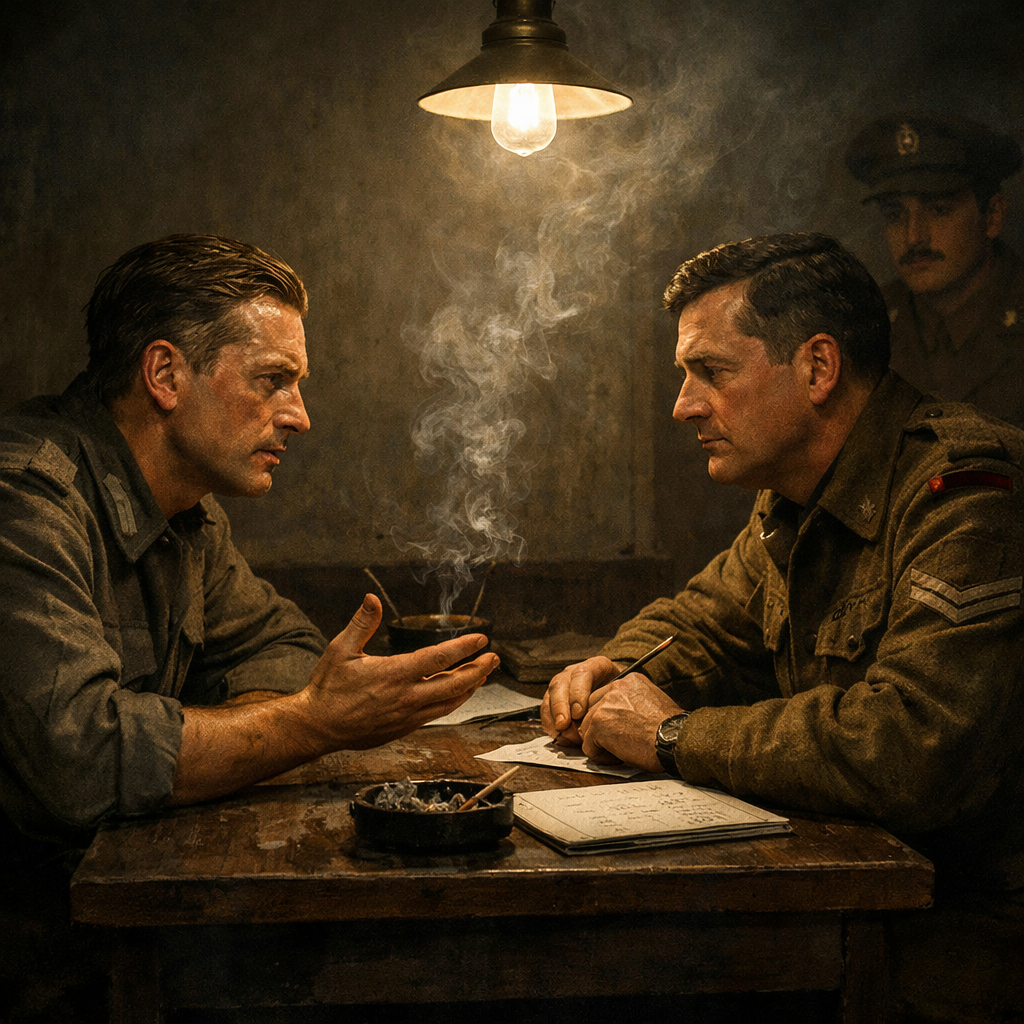
Corporal Jack Booth and Gefreiter Friedrich Von Altenburg
For proofreading and editing of fiction or non-fiction contact Verbatim.
Precision. Clarity. Verbatim.
01 How to make learning easy: patterns of meaning
I spent over 30 years in education. I did this because I passionately believe in the value of learning and that every child should have the chance to learn. Learning is the foundation of civilisation and of human progress. It is the means whereby potential is revealed, and innovation and creativity are unleashed. Without learning, neither the moon landings nor the internet: neither the 1812 overture nor Bohemian Rhapsody would have happened or exist. Monarchies would not have given way to liberal democracy, capitalism would not have replaced feudalism and we’d all be trying to scrape along at subsistence level. It matters for culture, economic development, society and government. I didn’t spend 30 years wasting my time: I worked in an incredibly important profession.
More prosaically, those little bits of paper which are the public examinations are the keys which unlock doors for individuals in the modern world. It matters a great deal that children enter adulthood with ‘grades’ simply because that is what the world looks at before it looks at anything else. Many a great candidate for a job never makes it to interview because they’re screened out for not having an appropriate qualification.
Nevertheless, the teaching profession often makes the art of teaching more obscure than need be. It loves jargon and acronyms, models and frameworks. Schools are institutions and those who run them love uniformity, systems and processes. The word ‘consistency’ is bandied about perpetually. And the result is that the basics of how learning is actually engendered is often lost in this sea of micro obsessions. This series of blog posts is aimed at stripping the art of teaching back to its basics and remembering that human beings are learning machines. It’s arguably harder to stop children from learning than it is to get them to learn. Of course, what children learn may not always align with what the teacher wants to teach - but they will learn something.
This series of blog posts, originally written between 2022 and 2025, is about how to make it easy for all children to learn - and for them to learn what it is that their teachers intend them to learn efficiently and effectively. It is about deliberately constructing a purposeful learning experience.

How to Make Learning Easy: Patterns of Meaning
Learning shouldn’t be hard. Of course, everyone comes across something they find difficult at some point and there will always be those who struggle. But, for the vast majority of students, the process of learning things should not be hard because human beings are learning machines. We’re built to learn.
It’s impossible to remember a list
In a training session I attended many years ago, we were asked to memorise a list of objects. It was after the end of the school day and, in our group, we were all tired. I remember that I was particularly bad at it. However, there was a serious point and that was that it is almost impossible to learn things if they are presented as a list of items with no form or shape. This is absolutely true. During my teaching career, I managed to raise GCSE History grades in two different schools, not just a little bit, but by 30-40 % points. When I arrived in each school, one of the problems was exactly this: teachers had been attempting to teach subject content using chronology as the only organising mechanism. Essentially, it meant that they had been trying, and largely failing, to get students to learn ‘facts’ in a very long list.
The training session then lost momentum as it went off down a rabbit-hole of a list of clichéd micro-strategies for memorising. And the most important point was missed by a country mile. First, the real problem is less one of memory than one of recall. And, second, when it does come to memory, it is necessary to recognise that everything is learned in relation to that which is already known.
Patterns of meaning
Every subject discipline has its own patterns of meaning. When we refer to ‘disciplinary language’ that’s what we are really talking about. It is that language which encodes the patterns of meaning which are intrinsic to that subject. Experts in that subject (and that means all specialist subject teachers) have an intuitive understanding of those patterns which has come from years of study and practice. It means that when teachers are presented with some new information related to their subject, they intuitively fit that knowledge into those pre-existing patterns. They absorb it easily. It is easy for them to learn.
The students we teach are not in that position. Not, that is, unless we first teach them the patterns of meaning within our subjects. This is what I’ve always done in History - and this was the hidden reason why I was able to improve GCSE outcomes so dramatically. The GCSE in History has always been content-heavy. If our students were to have even a fighting chance of retaining (let alone recalling) all that knowledge, they needed to be able to fit it into pre-existing patterns of meaning. Anything which diverted their attention from that had to be discouraged. For this reason, I’ve had very little patience with classroom micro-strategies which look and sound impressive, but are, in the end, superficial. It matters not whether min-whiteboards, hinge questions or collaborative learning techniques are favoured; what matters is whether the students internalise the core patterns of meaning which are the principal organising structures of the subjects they are attempting to learn. The technical term for this is ‘mental schema’. What I am arguing is that substantive content is more easily understood if the learner has already assimilated the mental schema which is intrinsic to the subject being learned. This is what we mean by metacognition.
One final point on this is that those students who really struggle with their learning are invariably those who struggle to identify patterns. That’s what the whole idea of the non-verbal reasoning part of a cognitive aptitude test is supposed to identify. Therefore, an important feature of any teaching programme has to be to make sure that students who are weak in terms of non-verbal reasoning internalise simple patterns. Focus less on ‘scaffolding’ tasks and more on embedding patterns. Without them, students will be lost at examination level - and those students who struggle most with identifying their own patterns will definitely struggle most under the pressure of an examination.
Early assessment should focus on patterns, not content
It is important not to confuse the concept of ‘patterns of meaning’, or mental schema, with ‘skills’. It may well be that there are patterns of meaning within your subject which are also skills but they may equally be related to concepts or knowledge. Nevertheless, whatever your patterns of meaning are, that is what you should be assessing in the early stages of your curriculum plan. Don’t waste time assessing everything you’re teaching, especially in the early years of secondary school. I never tested student knowledge of every topic we taught in Y7-9. Most of it would never form part of the sampling process of a GCSE exam and, for me, this was not the purpose of the curriculum at that point, so where was the sense in testing for it? What I assessed, in a frequent and regular way, is whether the students were retaining those essential patterns of meaning which are the core of our subject. I knew that, if they were, then it would be a whole lot easier for them to slot in the knowledge both needed for the exam later on, and for that greater purpose of understanding the world around them. Even more importantly, teaching children the importance of identifying patterns is better preparation for the adult world where problem-solving and innovation are needed far more than banks of facts. This is even more important if education is to prepare children for a future in which change is inevitable but the nature of that change unpredictable.
I want to be clear, however, that I am not denigrating the importance of ‘knowledge’. Rather, I am arguing that substantive knowledge, meaningful knowledge, knowledge which can be used and applied in a variety of contexts or to solve problems, can only really be internalised and retained if it is learned in relationship to ‘patterns of meaning’, or mental schema. This series of blog posts is about how to make the learning of that knowledge easy.
It is for this reason that a strategy of frequent knowledge testing never worked for me. Such tests are a form of knowledge sampling. The theory is that constant testing will force the students to learn how to revise. It is a sledge-hammer to crack a nut, in my view, a massive workload and a lot of wasted effort on the part of both teachers and students. It derives from a fundamentally shallow understanding of the learning process. We first need to assess the extent to which students are forming and retaining the relevant patterns of meaning for our subjects. There’s a time for knowledge sampling – and, from the point of view of student outcomes, that time is during the examination course, especially as we draw close to its conclusion. From the point of view of subject understanding, it is at the point where the learner is automatically using an embedded mental schema to make sense of new information.
Merely assessing student knowledge at the end of a topic is neither knowledge sampling, nor is it testing cumulative retention. It is only assessing recent understanding or, at best, short term retention. Its usefulness is pretty limited, actually. Far better to adopt a longitudinal approach. Begin by assessing the extent to which students are internalising the mental schema: the fundamental organising patters of meaning in your subject. By all means, use your latest topic as the vehicle but remember that it is not the topic which matters but the patterns. Then, gradually, move towards synthesising this with substantive knowledge. What we’re looking for is for students to be able to apply those patterns of meaning to ANY topic in your subject - independently. And, as the examinations draw closer, for students to be able to deploy those patterns as a mechanism for retaining substantive content. Trust me: it’s far easier to retain content if those patterns are solidly embedded in the long-term memory.
Thus, once you have identified the core patterns of meaning (and there might well be knowledge patterns in there), then that is what you should be laser-focused on assessing. It will all make it so much easier for the students to learn everything in the end.
Conclusion
Learning should not be hard work. That is not to say that hard work won’t reap rewards. It will. But - it is quite possible to work hard and achieve very little.
It is a far more efficient means of learning to build a curriculum plan which overtly teaches your students what you already know intuitively - the patterns of meaning which are an embedded part of your subject discipline. Then, later on, you can teach them new content and it will be both absorbed and understood.
If you publish books or educational materials, Verbatim is here to help, not just with proofreading but with professional expertise.
Precision. Clarity. Verbatim.
I broke
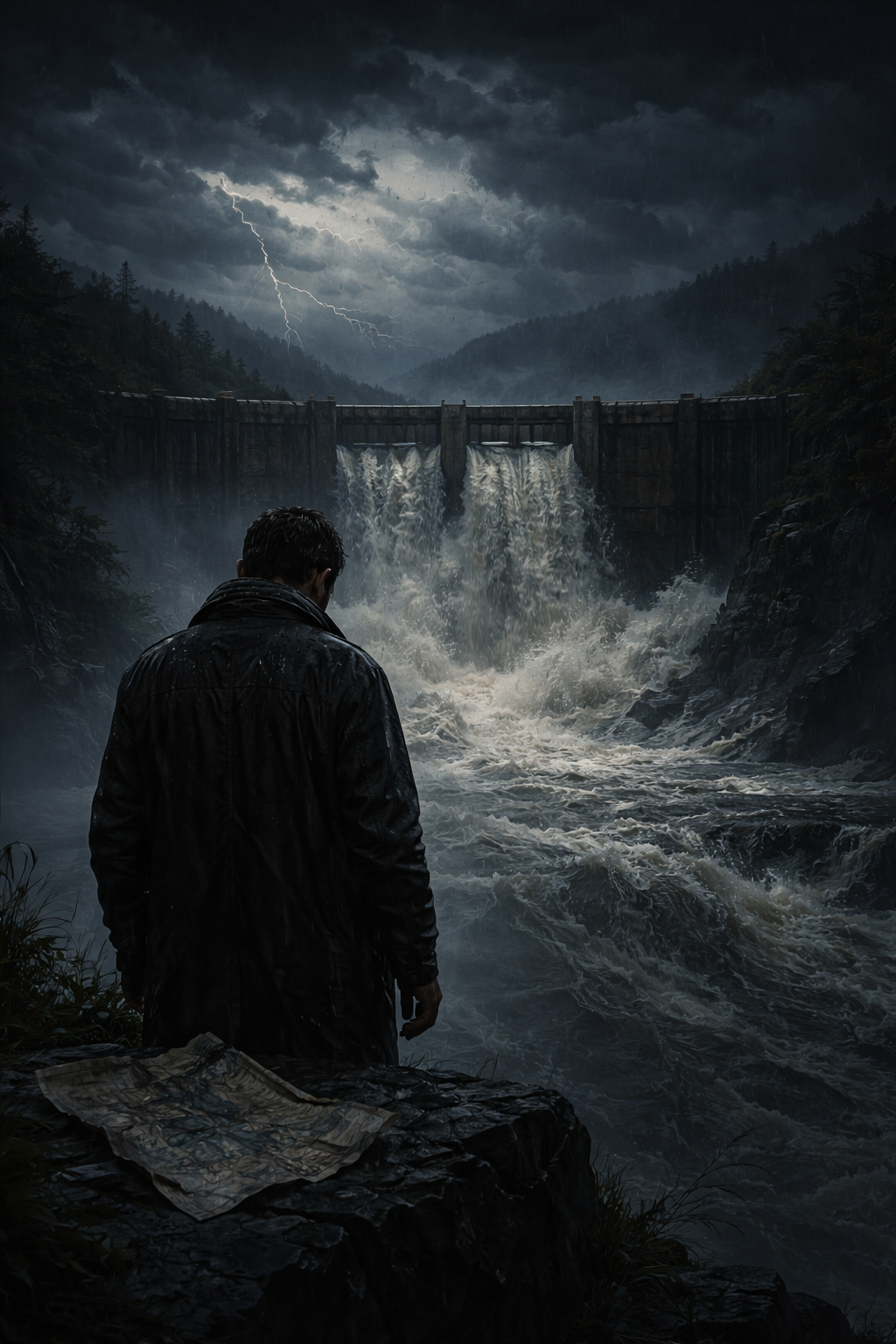
The clouds shivered;
Nature gasped in sympathy;
The ink-stained map vanished
And I was struck dumb.
I, whose words flowed,
Was as a stoppered flood.
All tense and taut in misery
I broke - and they could not come.
Think about the words chosen in this poem and what work they’re doing to create the image:
shivering clouds
An adjective-noun combination which actually gives an unnaturalness to the poem. Clouds do not ‘shiver’. They might ‘drift’ or ‘float’ or ‘race’ - a movement which conveys the idea of motion. ‘Shivering’ conveys the idea of an uncomfortable and unnatural stillness. This signposts what the poem is about - a person who is so psychologically broken that they can no longer express themselves - or behave in a way which is ‘natural’ to them. Clouds which ‘shivered’ would, similarly, be broken.
nature gasping
ink staining
words flowing
a flood stoppered
These are all combinations of nouns and verbs. Verbs are suggestive of ‘action’ but these actions don’t lead anywhere. Just as clouds do not, in reality, ‘shiver’, so nature cannot, collectively, ‘gasp’. Ink might stain but it doesn’t communicate for the map ‘vanishes’, and the flowing words are ‘stoppered’. The image of a ‘stoppered flood’ suddenly turns this unnatural stillness and the sense that things are not right into a tension - and the idea that this state of affairs cannot last. A flood cannot be held back by a tiny cork.
tense and taut - alliteration used to reinforce the meaning and double-down on the sensation of tightness and tension.
Now, look at the punctuation:
The first two lines of the first verse end in semi-colons. This has the impact of layering the three images on top of each other.
In the second verse, we have commas used to insert a subordinate clause which helps to create that tension between the ‘flow’ and the ‘stoppered flood’.
The dash after ‘broke’ then creates a physical representation of the meaning - the ‘breaking’ of the writer.
There is only one clear rhyme - ‘dumb’ and ‘come’. These are situated at the end of each verse. They are a pararhyme, rather than an exact rhyme, and slightly ugly. This matches the meaning of the poem. Situated at the end of each verse, they create a feeling of backwards pressure into the rest of the piece. They also create a feeling of closure: nothing moves, nothing arrives. Sound loops and stops. They seal the poem shut acoustically.
The poem isn’t written with a consistent meter. It’s dominant rhythm is an iambic pulse but it is really written in free verse with truncated and spondaic endings to enact psychological pressure.
All of these features illustrate prosody at work: lexical choices, punctuation, rhyme and meter.