

03 How to make learning easy: processing, memory and assessment – the power of writing
Learning shouldn’t be hard. Of course, everyone comes across something they find difficult at some point and there will always be those who struggle. But, for the vast majority of students, the process of learning things should not be hard because human beings are learning machines. We’re built to learn.
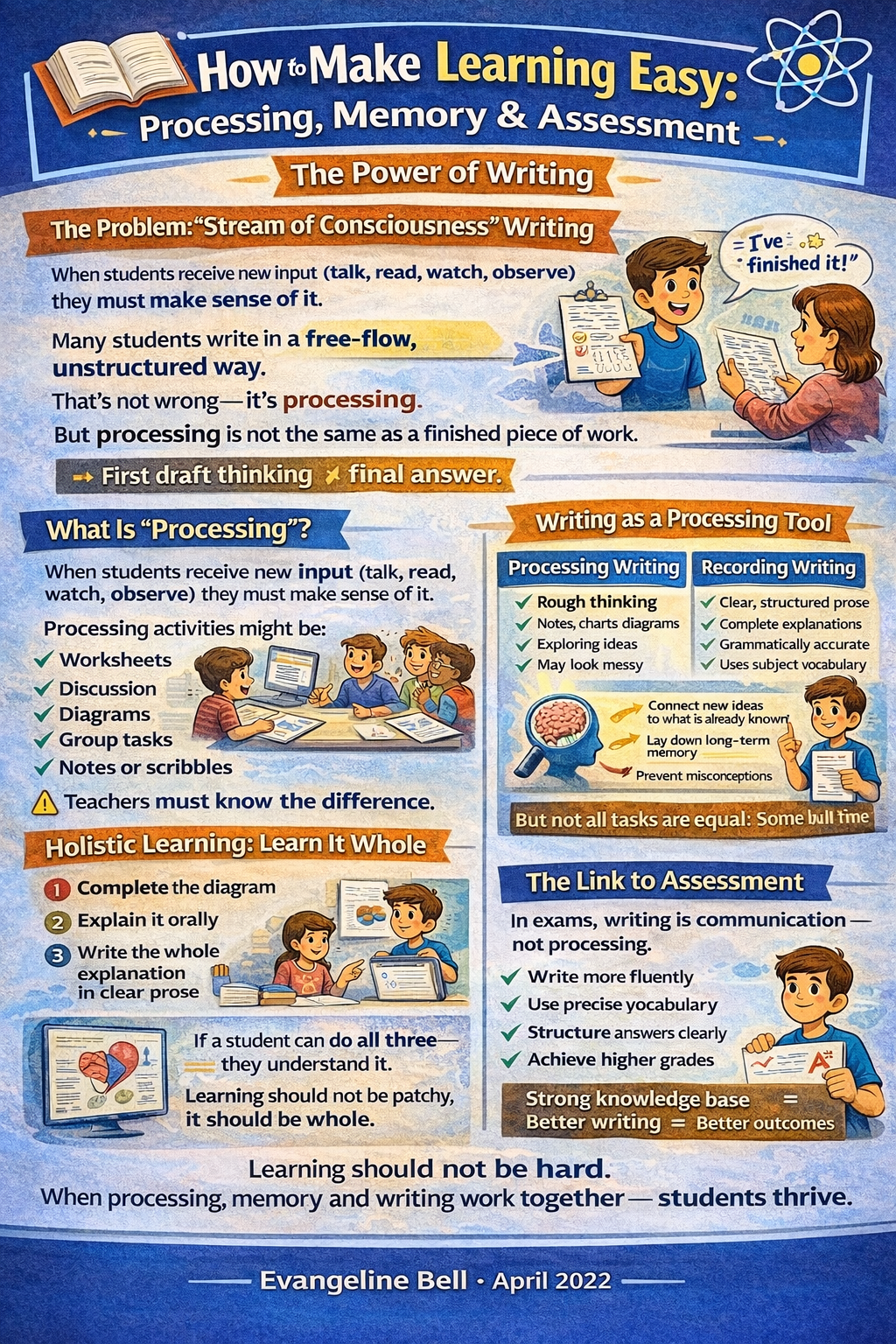
The ‘stream of consciousness’ problem
One of the most characteristic features of student writing is that it is written in a kind of ‘stream of consciousness’ style – the free association of ideas which are rammed together with little thought for structure, form, grammar, punctuation or coherence. Teachers often look at this kind of work with horror! And – no wonder. It is highly unlikely to score highly in any exam. The thing is that there is nothing ‘wrong’ about this. I do it myself. However, never in my life would I hand such a piece in to a teacher or a tutor as a finished piece of work. That’s because it would always be, for me, a form of processing: a way of sorting my thinking out. For many students, however, this is it – the first version is the final version.
Let us review the situation
So far in these blogs I have argued that the curriculum should be structured around the core thinking patterns which are inherent in every subject discipline. The logic behind that statement is that everything is learned in relation to everything else and, therefore, if the student learns the key patterns of reasoning which lay at the heart of each subject, s/he will be better able to assimilate new information than s/he would be trying to learn everything as a form of list. I have also argued that, despite what they think, students actually struggle not to remember things but to recall things and that, therefore, effective teaching should include an element of memorisation and recall at the point where something is learned for the first time. I have insisted that teaching be done in a systematic manner and that students are required to learn things holistically. The logic behind this is that if things are learned whole, they are better understood than if they are learned piecemeal or in micro-chunks. I have suggested that a school which adopted a strategy which embedded recall in the learning process would turbo-boost its outcomes because students would develop their cognitive abilities to recall across all subjects. It would pack a great punch over the long term.
The purpose of this blog is to discuss how memories may be created in the first place by the use of effective strategies of processing and how writing may play a part in that process. It is also to argue that the use of writing as a processing tool will also contribute to an improved quality of writing in the assessment part of the teaching and learning cycle.
What do we mean by ‘processing’?
Perhaps an older term for this might be ‘thinking skills’. However, what I mean by it is the array of activities which teachers set for students after they have given them some new input on something.
Typically, a teacher will give students input on some new aspect of learning. This might be by talking, reading, demonstrating or observing. The student then has to make sense of this input in some way. This is usually via some form of processing activity. It might be a worksheet to complete, a method to apply, a discussion …. It might be an individual task, a paired task or a group task.
Certainly, I sometimes thing that there are as many tasks as there are grains of sand. Some are repetitive, some are creative. Some are physical, some are mental. Some are written and some are not. The purpose of all of them, however, is that they enable the student first to make sense of the new input by understanding it in relation to that which is already known and understood, and, second, that they enable the student to lay down new memories in the long term memory.
Some of these processing activities are more effective than others – and some are more effective for some students than for others. This is an area where it is rare that one size fits all. This is a core reason why teachers should always be assessing the impact of their teaching on individual students. It is easy to assume that students have made sense of something when, in fact, they have not. I will criticise myself at this point and say that there are many times when I’ve felt in my guts that something has gone well, that a particular activity has really been effective – only to find a week or two later that it has not. Or, at least, has not been with some students and that those students have, as a result of my teaching, actually made erroneous connections.
Unfortunately, many tasks or activities in classrooms are not effective. They are merely intended to fill time. The teacher does not evaluate the effectiveness of the activity and merely assumes that learning has taken place.
For the purposes of this blog, however, let us assume that the task has been well-designed.
Writing and processing
Many of the tasks which are set in classrooms involve some form of writing. However, teachers frequently do not distinguish between processing activities and recording activities. This distinction is a topic for another time. Nevertheless, let us be clear – activities which are aimed at enabling students to make sense of new input or to memorise something are ‘processing’ activities. Activities which are intended to create materials suitable for revising from are ‘recording’ activities.
Many students like to write as part of their processing. They may like to complete a chart or a diagram. They may like to scribble notes. There are lots of forms of writing which students may like to engage in as part of this processing part of learning.
I would like to pick up, however, on one of the core principles from the last blog. Learning should be holistic. This is because things are understood better if they are understood completely. I argued then that learners should be required to articulate their learning whole. This can be done orally, of course. It should be done orally. But it should also be done in prose: in writing. This is because oral speech is not always organised as coherently as a piece of writing is, or, at least, should be. Requiring students to re-think their oral answers and compose their answers in writing – in coherent prose – is a powerful way of doubling down on this concept of totality and of holistic learning. So – to take an example from the previous blog – if a student is being asked to learn the process of photosynthesis, s/he could be asked to complete a diagram. Then s/he should be asked to explain the process orally. And, finally, s/he should be asked to explain the whole process in prose. If a student was able to do this and get it right, the teacher could be pretty sure that the student has understood the topic.
In short, writing should be a key part of the processing element of teaching. By doing this, the student would be creating a complete memory. Learning would not be patchy. It would be complete.
Quality of writing
If students were routinely asked to complete a piece of written work in order to consolidate the formation of memory and for the teacher to be able to check on the student’s level of understanding, it would be possible for that same written work to be done using short, complete sentences. It would give students practice at writing coherently. And, as a result, they would get better at it. This would be a stage beyond the initial processing activity which might be a practical activity, a creative activity, a group activity … whatever. The idea would be to make the student express the totality of their understanding of something in coherent prose. Not the stream of consciousness free association of ideas! I am talking about something which has been composed with structure and form. It is at this point that we should expect students to write well – short, clear, grammatically correct sentences. They should be deploying the subject-specific vocabulary which is required. They should be spelling correctly etc. If we did this as a whole school, we would not only improve student ability to memorise and recall, we would also improve their ability to communicate in writing. And, incidentally, we would improve their ability to articulate themselves coherently.
Assessment
Many assessment activities are also written. An assessment activity may take many forms but the most common are probably some form of assignment or some form of test. Let us assume that we are preparing our students to sit an examination. There is no doubt that the ability to write well – coherently and articulately in standard English – makes a big difference to outcomes.
If our students have internalised the content that they are being assessed on, the quality of their writing will improve. I can prove this time and again by looking at work which I know has been done after an extensive period where students have been asked to memorise information, compared to that which has not. It isn’t just that there is more substance to the work. It is that it is just generally better written. This is because a student whose knowledge base is good is not using writing as a processing activity. S/he is using it for what it should be used for – communication. If I have constantly marked and given feedback on the processing part of the work and if the student has developed the ability to recall, they will be in a position to communicate their learning clearly – and this will manifest itself in good quality writing. And this will manifest itself in higher quality grades at examination time.
Conclusion
Learning should not be hard. Yes – it often is. But, too often, this difficulty is created by teachers who are obsessed by their sequences of tasks or activities or who are determined to demonstrate their use of particular pedagogies.
In fact, if we are clear about which part of the learning process is taking place, we can be more critically aware of whether our teaching is being effective, or not. A key part of teaching and learning is the use of a multitude of activities which are basically aimed at enabling student to make sense of new material. These are ‘processing’ activities. Many (though not all) may involve some writing. Often, this may, indeed, be ‘stream of consciousness’ in form. As long as we know that this is a processing task, we do not need to worry about that. What we should not do is accept this as a finished piece of work.
What we should do is also to require students to articulate the whole of a piece of learning in both oral and written prose. This will improve the student’s ability to retain the new learning in terms of memory creation. It will also improve the student’s ability to recall information. Finally, it will improve the student’s ability to communicate in written prose. This, in turn, will help to improve student performance in written tests or exams. And – this – will improve outcomes.