

The cosmos is in motion
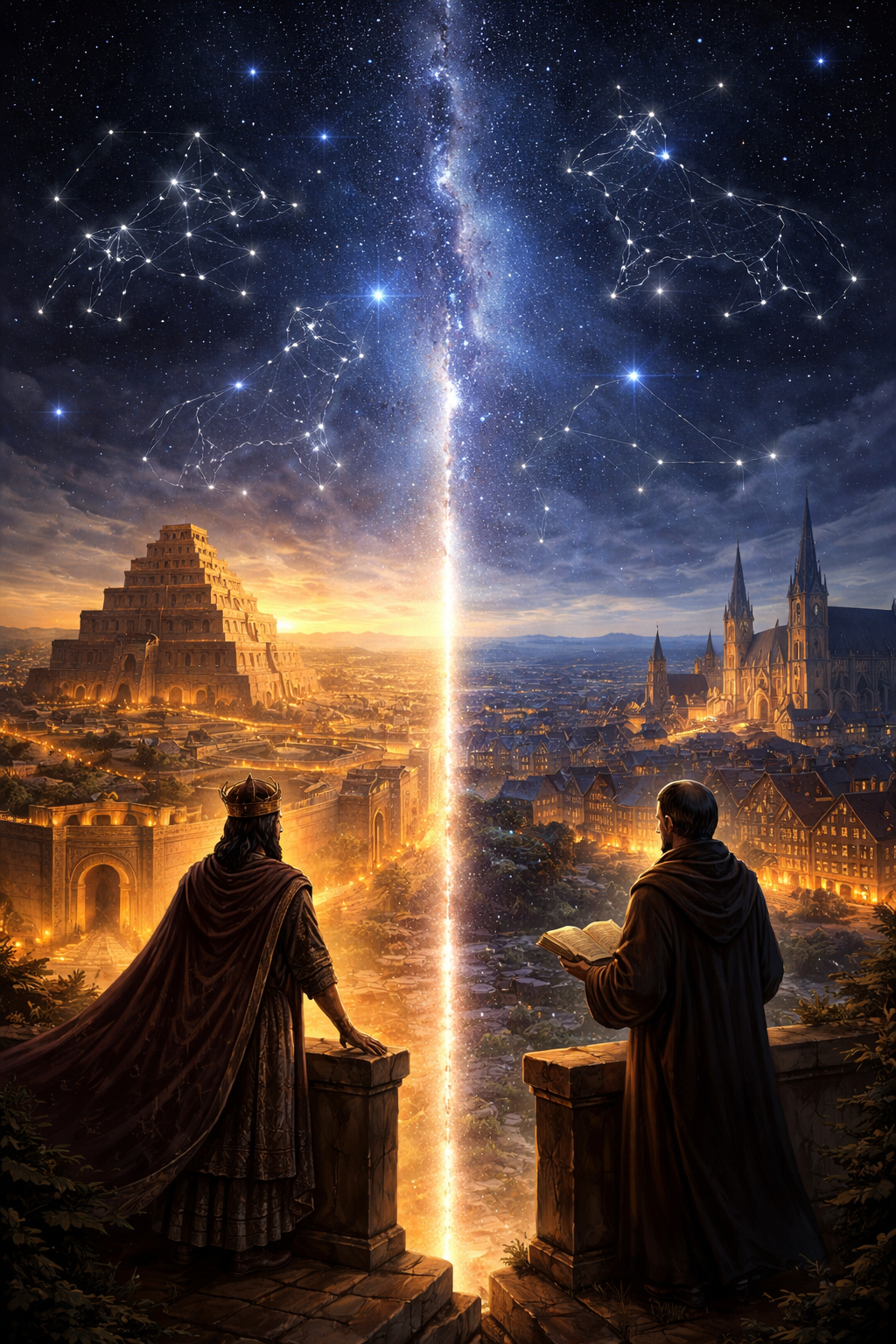
Aristotle said that the stars orbit the heavens on their own crystalline celestial sphere. The ancients looked to the stars for portents and omens in a world which was the centre of the universe. Everything was as it seemed in a cosmos where stasis was the natural order and a panoply of divinities inhabited an ethereal plane and ruled over men.
The monk
A monk sat, his cowl drooping over his head casting a shadow over his face and stared at the stars. He recognised the constellations: Orion, Taurus, the bull, and Leo. He knew they marked the seasons and, subject to Divine Providence, influenced the world of men. They were ancient, fixed and unchanging, part of a calm, peaceful and orderly universe.
The monk sighed deeply and rested his weary face in his hands for a brief moment. He was troubled in his spirit and anything but calm. Once, he had been so certain of his calling. Struck by lightning, he’d called upon Saint Anne to save him and vowed to become a monk. He had abandoned his secular ambitions to become a lawyer and taken the cowl. He saw himself as a young Samuel must have done when the divine voice spoke to him out of the darkness.
But something was wrong.
The church had many routes to inner peace, but he could find none. His spirit was restless and disturbed; it didn’t matter how often he availed himself of the sacraments, he never felt that God was pleased. He’d spent hours in confession. He’d tried to recall every sin he’d ever committed. He’d done penance after penance. He’d called on the assistance of every saint he could remember. He’d attended Mass after Mass. Yet, God seemed perpetually angry. As he contemplated the celestial canopy above him, all he could think of was his terror in the face of a vengeful God.
Was he truly the worst sinner that had ever lived? Each time he thought he’d confessed everything, something new would float into his mind. It never seemed to end. Did he do nothing but sin, all day, every day? Yet his life was that prescribed by the Augustinian Order. He had no possessions, barely saw a woman, could not possibly indulge in gluttony or drunkenness. He could not gamble and had never stolen so much as a piece of turnip from the soup of a fellow monk. He read. He preached. He prayed. He attended divine services and completed the offices of a monk conscientiously and diligently. He was entitled to inner peace.
A wave of rage suddenly swept over him. His skin became taut. His heart raced and he clenched his fists in frustration until his knuckles whitened. The problem was God. It had to be. God was too exacting. He always wanted more and there was just no more he could give. For a moment, he was consumed with a mixture of disgust and contempt. How dare God put him in this position. How dare God put him in a world which trapped him in sin and then threaten to consume him in hellfire when, as hard as he tried, he couldn’t stop sinning? How dare God tell him that he was all loving and forgiving when it was clearly untrue? God was lying to him: it was as simple as that. How he hated God at that moment!
And he collapsed into bitter despairing tears. He was a monk. He wasn’t supposed to hate God. Pride was the worst of all sins. He was going to hell. He was sure of it! ‘Oh Mother of God, help me.’ Surely, if God were so angry, the Blessed Virgin might help to appease him.
The monk looked up and saw the power of Taurus in the night sky. It was no good. God remained angry, implacable, unmerciful.
The monarch
A king stood on a balcony and looked to the heavens. There was Leo, giver of kingship. Over there was Orion, the warrior. And there was Taurus, the bull, giver of power. He had the blessings of all three and he knew that he had been given these blessings by his god. He smiled with genuine pleasure. Mortals may rule earthly kingdoms, but he knew that their destinies were shaped by the stars and determined by the deities who ruled the heavens.
He sighed with a deep sense of self-satisfaction. There was no monarch greater than himself and he knew that he absolutely deserved this greatness. There was no god greater than his god. All his enemies had been swept beneath his feet, and he would now pay tribute to his god for these victories. He would build temples. He would erect statues and make sacrifices. He would order all his subjects to bow before the god who had placed him in this position of supreme power and authority. His devotion to his god would be rewarded with yet more glorious conquests.
But something was wrong.
It was those Hebrew boys. There were four of them, just teenagers. But they were so stubborn and defiant. They wouldn’t accept that their god was weaker than his. They kept saying that there was only one God - and that was nonsense. The heavens were as full of gods as there were stars. And they squabbled and fought, lusted and envied, loved and hated, just like men did. So - if one was defeated, like the Hebrew god had been defeated, then his people had to bow to the victorious god. That was the natural order. Everyone knew that. And still these hard-necked Hebrew children just wouldn’t listen. It irked him for it implied that they had no respect for his own exalted position either.
And, yet there was Daniel ... When all the astrologers and magicians and priests in Babylon had failed, Daniel had not only been able to give an interpretation of the vision, but he’d known what the vision was. How had he known that? The king had always been suspicious of the mystics. You tell them of a dream and they’ll give you an interpretation, usually exactly what they think you want to hear. But he hadn’t been able to remember the dream …. and then Daniel had told him exactly what he’d seen during the darkness of a solitary night and it absolutely was not what he wanted to hear. How had he known? If the priests of his own victorious god had failed, why had the defeated worshipper of a defeated god succeeded? He found it all very perplexing; it was all so wrong.
The monarch stared up at Taurus. ‘What are you doing, oh giver of power?’
Rome
Rome: the greatest city on earth. Brother Martin thought himself to have been singularly blessed with an opportunity to visit the holy city.
Yet, Brother Martin was not really interested in the relics of antiquity or the art of the renaissance. What he wanted to do was avail himself of the multitudinous spiritual benefits which could be secured in Rome and nowhere but Rome.
In between the business of the Order, then, Brother Martin had devoted himself to religious works. He had visited every holy shrine he could. He had attended as many Masses as he could find time for. He had confessed daily, sometimes several times a day. He had visited St Peter’s basilica and was shocked to find it an ancient, somewhat decaying building, sadly in need of repair. He saw that the foundations for a new structure were being laid - but the workmen seemed indolent. He would have thought that anyone tasked with building a new home for the holy relics of St Peter would have devoted themselves to the work, night and day and thought themselves honoured with a rare privilege. This was not the case; the workmen squabbled over wages.
The lack of urgency displayed by the construction workers wasn’t the only shock. Brother Martin had been appalled to hear the irreverent way that some priests conducted Mass. Of course, it was the sacrament that mattered, not the spiritual state of the priest. But Brother Martin, who trembled every time he conducted the service, found the levity of the Italian priests astounding. Sometimes, they didn’t even use the right words. They even mocked the sacrament itself. And the decadence! If Rome was meant to be the ‘holy’ city, it left a lot to be desired. There were brothels which were frequented by clerics and Brother Martin even heard a rumour that some clerics preferred boys to girls. His simple Saxon soul shuddered at the very thought. Everyone talked of money. Funding for the new basilica may be a necessity but the naked greed on display in this city was astonishing.
Still, the church was the church and God remained God. Surely, the spiritual benefits of Rome remained valid in spite of the irreverence and degeneracy of its priests? Thus, despite his growing unease, Brother Martin had persisted in his mission to secure as many of these as he could during his time in the city.
One day, he spent the entire morning climbing the Scala Sancta, saying a prayer on each step. His reverence was deep and sincere. He knew that if he completed this penance, he could release a soul from purgatory, and he had determined that he would do this for his maternal grandfather. As he climbed the very steps which Jesus had ascended before Pontius Pilate, Brother Martin replayed the scene in his mind. He saw Christ bearing his cross. He saw the crown of thorns with blood dripping down the face of the Saviour. He saw Pilate wash his hands before the multitude and heard them choose Barabbas over the Messiah. He saw the cross atop Mount Calvary and he heard the ripping sound as the veil in the temple was torn apart.
As he breathlessly reached the summit of his climb, he raised his hand in triumph, awestruck and confident that his efforts were about to release his grandfather into paradise. As he stood, he recalled the words of Christ to the penitent thief: ‘Today, thou shalt be with me in paradise’.
He heard a deep cracking sound as the stones marking the burying places of the dead were rent in two. He thought of his grandfather. He was filled with pride at the thought of the effort he had made to release his grandfather’s soul …
‘… but who knows whether it be so!’
And Brother Martin’s certainties collapsed into a cloud of dust.
Fire
A dusty cloud hovered over the city obscuring the sun. It was impossible. King Nebuchadnezzzar’s jaw had dropped in amazement. Even at this distance, he could feel the heat. The furnace glowed red. The intense heat made the air around the entire courtyard shimmer in a blurry haze. There was an air of unreality about the whole scene. Three men had died as the huge doors had been opened and a blast of super-heated gas was expelled like a volcanic eruption. And yet the three Hebrew boys were walking around unharmed.
His Supreme Majesty had ordered them thrown into the flames because of their persistent refusal to bow the knee to Marduk. Their defiance had been more than an irritant. It had challenged all sense and reason. It was not as if the king had a problem with them continuing to worship their god. But he must be put into his proper place. Jerusalem had fallen to the Babylonian forces. Its people had been enslaved and the treasure from their temple plundered. Why wouldn’t these damned children see sense: their god was inferior to his? Marduk ruled the heavens and their god was self-evidently second-rate. But, no! They’d insisted that their God was the only God and refused point blank to participate in any worship of Marduk. They wouldn’t even eat the expensive food that had been presented to the god: they’d rather eat inedible slop, like donkeys. It was simply intolerable!
But Nebuchadnezzar was not a cruel king. He’d had the priests try to reason with them. He’d given them time to change their minds. The magicians had shown them the signs and omens in the stars. Leo had brought the blessings of sovereignty and kingship to Nebuchadnezzar. Surely, he’d thought, these clever boys with their clever minds must recognise the evidence before their own eyes. Marduk was the most-high god - and they must acknowledge that. It was Marduk who had chosen Nebuchadnezzar to be the supreme king of kings. The king’s knuckles whitened as he clenched his fist. He banged it down hard on the arm of his throne with sheer irritation. Either those boys submit to his decree …. or else! He’d make an example of them.
They hadn’t flinched. They’d repeated their defiance. They’d insisted that Nebuchadnezzar had only been able to destroy Jerusalem because their God had been angry with His people for worshipping other gods and that He could have prevented Nebuchadnezzar from taking the city if He’d wanted to - and they told him some totally absurd story about how their God had once enabled them to capture a city by making the walls simply fall down. Nebuchadnezzar sneered. The Jewish people might have won a victory eons ago but, if they did, they did it the same way that he did - by laying siege and battering the walls until they either fell or the people starved and the city surrendered. It wasn’t magic. The story had infuriated Nebuchadnezzar. Why would a god be so demanding as to refuse to recognise other gods? It made no sense. The heavens were full of divine beings.
The sheer unreasonableness of the argument caused him to order that the furnaces be stoked hotter than usual. He was kind of sorry about that now because three good men had been killed because of his rash decision. Nevertheless, if the men stoking the fires had been killed just because they were too close to the heat, how come the three intended victims were wandering about as if going for a morning stroll by the river? They were, it seemed, oblivious to the fact that they ought to be dead. Why weren’t they dead?
Nebuchadnezzar squinted. He shook his head. The heat was making him dizzy. There were three victims, right? So, who was the fourth man that he could see in there? Where had he appeared from? He blinked. He stared. He looked away and looked back again. There were definitely four human figures in there. And this last one shone. The aura which emanated from Him seemed to cast a shield over the three Hebrew boys. It was He. He was protecting them from the fires. A god in human form? A ‘live’ god in human form? This was no graven image. This man moved. He walked and he talked. Nebuchadnezzar was astounded. The three Hebrew boys were not kneeling before their God as he prostrated himself before Marduk. They were standing and he was talking to them as a man talked to his friends. This god was no warrior god. He was dressed somewhat like a peasant. This god smiled.
Gods didn’t smile. They were austere, aloof and distant. Gods were to be exalted, worshipped. They wanted sacrifices and obeisance. They were imperious, like himself. This one seemed to want conversation. He seemed astonishingly ordinary, not remotely bothered by the fact that the three boys weren’t bowing and kneeling before him. Nebuchadnezzar struggled to find the right words to describe the feeling which seemed to radiate from this unknown god. This god was some sort of protective god: a god of kindness and benevolence.
That couldn’t be right. Gods were terrifying, powerful, unreachable, inscrutable. They had to be appeased, placated … even bribed. Some gods demanded the ultimate in human sacrifice. As Nebuchadnezzar watched this god, he had the strange feeling that this god could not be placated, even by human sacrifice. And even this most powerful of all kings rather thought that he wouldn’t dare try and bribe a being who could walk about unharmed by the most ferocious of fires.
The universe swirled about Nebuchadnezzar’s head. He stared up at the stars. Orion, the warrior, stared back at him. He asked his question: how could a god who had been defeated in battle resist the power of Marduk’s flames?
St Paul
Brother Martin looked at the small crucifix which hung above his bed. It was a narrow monk’s cell, plain and barely furnished. A bed, a desk and a small wooden chest. Austere, like God. He’d been praying for so many hours that his knees were aching and sore. He simply had to sit up. He sat at a desk littered with ink-stained papers. Brother Martin might have a tidy mind, but he really was a messy worker. The papers were supposed to be his notes on his upcoming lectures on Paul’s Epistle to the Romans. He had been getting nowhere and had decided to pray for inspiration.
As usual, his prayers had rambled and circled back to the core problem: nothing satisfied an outraged and angry God. Brother Martin buried his tonsured head in his hands in utter despair. How could he lecture others on the teachings of St Paul if he had no faith of his own? And, frankly, he did not understand a word of what the Apostle was saying. His prayers had brought nothing in the way of inspiration. He was as flat and empty as he was when he first knelt down several hours ago.
He wondered if there had ever been a more miserable soul than he. He was a monk. He had devoted his life to God. His head ached. Rome had been such a disappointment. There, he had hoped to find certainty. In fact, he had only discovered doubt. What had he done that God should treat him so? Had anyone ever so despaired in God before? Had anyone ever gone through such Anfechtung?
His eyes drifted back to the crucifix. There was a silent pause …
Yes.
He had.
‘My God, my God, why hast thou forsaken me?
Was this not the cry of his own soul? Did he not feel abandoned by God? But Christ had felt it too? Had God abandoned Christ? How could God have abandoned Christ? Yet - He had.
Martin Luther looked down at his scrappy notes on the Epistle to the Romans. And he saw it. ‘That God might be just and the justifier ….’
And a realisation as sharp as a needle stabbed into his mind: Christ had experienced Anfechtung and all Brother Martin had to do was believe it. At that instant the burden he had been carrying for so many years vanished: God was no longer angry with him, and he felt an unexpected peace. His tight shoulders relaxed and he exhaled slowly.
This, he thought, was exactly as St Paul had felt when the scales had dropped from his eyes, too. Brother Martin stood. He turned to look out of his small window towards the stars. He saw that they filled the night sky. But the constellations of Orion, Leo and Taurus were nothing but imagined shapes in the heavens; they did not influence his future. They shone in the night sky and revealed the glory of a God who loved him.
The Most-High God
Babylon: the greatest city on earth. A young scribe was utterly astonished. Did his king really want him to write this? He was glad to see King Nebuchadnezzar looking so well. But it seemed incredible that this king, who had been so devoted to Marduk was now telling him to write a proclamation acknowledging the superiority of a different God entirely. The scribe paused.
King Nebuchadnezzar noticed the silence and asked the young man why he’d stopped writing. The scribe looked down, too embarrassed to say what he was thinking. The king said it for him: ‘Why am I acknowledging the supremacy of a foreign God?’
The scribe looked up. ‘You built the great temple to Marduk, sir. You were chosen by him.’
‘I did. And I have devoted many years to the service of Marduk. But … a long time ago, I threw three young men into a fiery hell for refusing to bow the knee to Marduk. I thought I’d make an example of them. Instead, I saw a vision of their God. He is a … different kind of God. They lived and they still live, here in the city.
Then, I had a vision and the man, Daniel, interpreted it for me.’
The scribe looked up again. ‘I know Daniel, sir. He lives in the blue house near the market. He buys pomegranates and figs from my grandfather. He is a great man.’
Nebuchadnezzar nodded and smiled.
‘Ah yes! You must get some of your grandfather’s figs for me, too.’
The young man smiled shyly and the king continued.
‘Daniel told me that I was proud and that his God intended to teach me humility. I was angry. I believed that my own power and might had made me ruler over the greatest city in the world: Babylon - and its empire. I saw Taurus, giver of power, shining brightly overhead and I knew that I had been destined by the gods to rule the world. At that moment, my tongue was glued to the roof of my mouth. I could not speak at all. I tried to call my servants, but I could not make myself understood. I could only grunt like a beast.
I was gripped by terror, and I ran out of the palace and into the gardens. I hid myself. I did not want anyone to see me. I crouched low and crawled to the darkest part of the garden. I saw the sun rise and I saw it fall. And, in the darkness of the night, a man came to me.
At first, I did not recognise him. But he said, ‘Nebuchadnezzar, you may not know me. But I know you.’ And then I saw that this was the same man I’d seen in the fire but, in my mind, I would not admit it. This common man in common clothes could not be a ‘god’. I tried to stand but I could not. A huge weight seemed to press me down until I knelt before him on my hands and knees. I tried to speak but I could not. He just looked at me for a long time, searching my soul, saying nothing.
A furious rage welled up inside me. I called on Marduk to throw fire from heaven on this man and destroy him. How dare he challenge my power and my majesty? How dare he defy the power of my god? And the man turned and walked slowly away.
I prayed to Marduk day and night. I watched the constellations move across the skies. I hid among the cattle. For many days, I saw no-one and no-one saw me.
My anger burned. It raged and warred against this strange god. Who was this god? Why had He let me destroy his city but would not accept defeat? How dare he upturn the celestial order? I despaired of life. I wanted to die. I tried to die. But death remained as distant as the stars. I was powerless to live and powerless to die.
Taurus shined distantly above as I lay beside a newborn bull calf. I felt the beating of his small heart and the warmth of his flesh. Life …. I realised that I wanted to live and return to the world of men. It was then that I saw the image of Marduk crack and crumble before my eyes. His dusty lifeless form was blown away in the wind and all I had left was an empty hole where a god used to be. It was a deep, cold and void place, like the entrance to an afterlife. My knees shook with fear.
I looked to the heavens. The night sky was black. I called out to the man in my mind, ‘Whoever you are, talk to me!’ And he came, slowly walking towards me; the Most-High God in the form of an ordinary man. As I looked into his eyes, I realised that no matter how hard I had pleaded with Marduk, he had remained as silent as if he were dead, but I had only asked this man to come once - a silent whisper in the darkness - and here he was, a living God. ‘Do you know me now, Nebuchadnezzar?’ Yes. I know you. You were in the fire.’ He smiled and a benevolent kindness radiated from Him. ‘Stand up … like a man, Nebuchadnezzar.’ Hope blossomed in my bosom. I stood upon my feet. I was alive and the living God was talking to me.
Stars fell, as it were from the heavens and vanished, plucked out of the night sky by a God who lived in man.
Write …’
And the scribe wrote …
The Cosmos
An old king sat on the terrace of his palace. He looked to the night sky. There was Orion, the warrior. He had been a warrior-king in his time. He had brought down enemies, destroyed cities and enslaved peoples. He saw Leo, and Taurus. But it was the strange God of the Hebrews who had brought him power and victory: a God who took the form of man and talked with men. A benevolent ‘protector-God’ who could be angry, but who did not wantonly vent that rage on a puny and ignorant man, even though he be defiant. He was a God like no other: a God who did not take life but gave it. As he stared at the familiar constellations, King Nebuchadnezzar doubted if they ever had any influence over the affairs of men.
And somewhere in late medieval Saxony an excommunicated monk called Martin Luther held the hand of his wife and looked at the same stars. What they saw was a cosmos in which nothing is what it appears to be: Rome was become Babylon, the earth orbits the sun, and space and time intersect in a fourth dimension. But Luther and Katie stared at Orion, Leo and Taurus and saw only the glory of the Creator spread out across the heavens: the same God who had humbled the arrogant pride of an ancient king had likewise destroyed the self-righteous pride of a monk, teaching him that salvation was by faith in a God whose yoke was far lighter than all the rituals of the medieval church allowed.
Above them, the heavens spun as alien worlds collided, exploded, spewed out the primordial elements and the universe hurtled through time itself, its existential violence held in check only by the power of a sovereign God whose ways and purposes remain mysterious. Aristotle’s perfect cosmos may have been broken and forgotten but, if we look to the heavens, the same stars continue to shine and God remains the same ‘yesterday, today and forever.’