01 How to make learning easy: patterns of meaning
I spent over 30 years in education. I did this because I passionately believe in the value of learning and that every child should have the chance to learn. Learning is the foundation of civilisation and of human progress. It is the means whereby potential is revealed, and innovation and creativity are unleashed. Without learning, neither the moon landings nor the internet: neither the 1812 overture nor Bohemian Rhapsody would have happened or exist. Monarchies would not have given way to liberal democracy, capitalism would not have replaced feudalism and we’d all be trying to scrape along at subsistence level. It matters for culture, economic development, society and government. I didn’t spend 30 years wasting my time: I worked in an incredibly important profession.
More prosaically, those little bits of paper which are the public examinations are the keys which unlock doors for individuals in the modern world. It matters a great deal that children enter adulthood with ‘grades’ simply because that is what the world looks at before it looks at anything else. Many a great candidate for a job never makes it to interview because they’re screened out for not having an appropriate qualification.
Nevertheless, the teaching profession often makes the art of teaching more obscure than need be. It loves jargon and acronyms, models and frameworks. Schools are institutions and those who run them love uniformity, systems and processes. The word ‘consistency’ is bandied about perpetually. And the result is that the basics of how learning is actually engendered is often lost in this sea of micro obsessions. This series of blog posts is aimed at stripping the art of teaching back to its basics and remembering that human beings are learning machines. It’s arguably harder to stop children from learning than it is to get them to learn. Of course, what children learn may not always align with what the teacher wants to teach - but they will learn something.
This series of blog posts, originally written between 2022 and 2025, is about how to make it easy for all children to learn - and for them to learn what it is that their teachers intend them to learn efficiently and effectively. It is about deliberately constructing a purposeful learning experience.
How to Make Learning Easy: Patterns of Meaning
Learning shouldn’t be hard. Of course, everyone comes across something they find difficult at some point and there will always be those who struggle. But, for the vast majority of students, the process of learning things should not be hard because human beings are learning machines. We’re built to learn.
It’s impossible to remember a list
In a training session I attended many years ago, we were asked to memorise a list of objects. It was after the end of the school day and, in our group, we were all tired. I remember that I was particularly bad at it. However, there was a serious point and that was that it is almost impossible to learn things if they are presented as a list of items with no form or shape. This is absolutely true. During my teaching career, I managed to raise GCSE History grades in two different schools, not just a little bit, but by 30-40 % points. When I arrived in each school, one of the problems was exactly this: teachers had been attempting to teach subject content using chronology as the only organising mechanism. Essentially, it meant that they had been trying, and largely failing, to get students to learn ‘facts’ in a very long list.
The training session then lost momentum as it went off down a rabbit-hole of a list of clichéd micro-strategies for memorising. And the most important point was missed by a country mile. First, the real problem is less one of memory than one of recall. And, second, when it does come to memory, it is necessary to recognise that everything is learned in relation to that which is already known.
Patterns of meaning
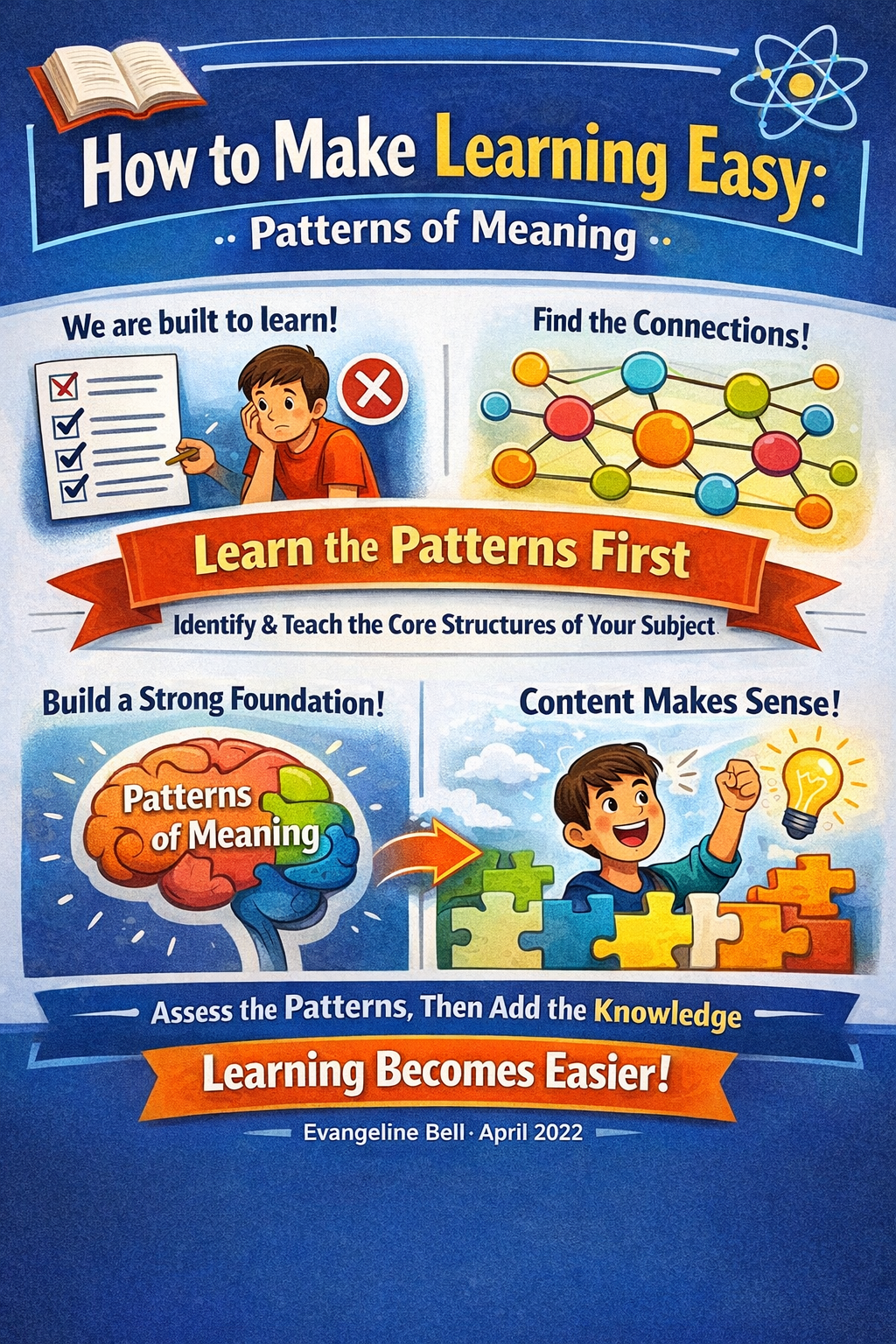
Every subject discipline has its own patterns of meaning. When we refer to ‘disciplinary language’ that’s what we are really talking about. It is that language which encodes the patterns of meaning which are intrinsic to that subject. Experts in that subject (and that means all specialist subject teachers) have an intuitive understanding of those patterns which has come from years of study and practice. It means that when teachers are presented with some new information related to their subject, they intuitively fit that knowledge into those pre-existing patterns. They absorb it easily. It is easy for them to learn.
The students we teach are not in that position. Not, that is, unless we first teach them the patterns of meaning within our subjects. This is what I’ve always done in History - and this was the hidden reason why I was able to improve GCSE outcomes so dramatically. The GCSE in History has always been content-heavy. If our students were to have even a fighting chance of retaining (let alone recalling) all that knowledge, they needed to be able to fit it into pre-existing patterns of meaning. Anything which diverted their attention from that had to be discouraged. For this reason, I’ve had very little patience with classroom micro-strategies which look and sound impressive, but are, in the end, superficial. It matters not whether min-whiteboards, hinge questions or collaborative learning techniques are favoured; what matters is whether the students internalise the core patterns of meaning which are the principal organising structures of the subjects they are attempting to learn. The technical term for this is ‘mental schema’. What I am arguing is that substantive content is more easily understood if the learner has already assimilated the mental schema which is intrinsic to the subject being learned. This is what we mean by metacognition.
One final point on this is that those students who really struggle with their learning are invariably those who struggle to identify patterns. That’s what the whole idea of the non-verbal reasoning part of a cognitive aptitude test is supposed to identify. Therefore, an important feature of any teaching programme has to be to make sure that students who are weak in terms of non-verbal reasoning internalise simple patterns. Focus less on ‘scaffolding’ tasks and more on embedding patterns. Without them, students will be lost at examination level - and those students who struggle most with identifying their own patterns will definitely struggle most under the pressure of an examination.
Early assessment should focus on patterns, not content
It is important not to confuse the concept of ‘patterns of meaning’, or mental schema, with ‘skills’. It may well be that there are patterns of meaning within your subject which are also skills but they may equally be related to concepts or knowledge. Nevertheless, whatever your patterns of meaning are, that is what you should be assessing in the early stages of your curriculum plan. Don’t waste time assessing everything you’re teaching, especially in the early years of secondary school. I never tested student knowledge of every topic we taught in Y7-9. Most of it would never form part of the sampling process of a GCSE exam and, for me, this was not the purpose of the curriculum at that point, so where was the sense in testing for it? What I assessed, in a frequent and regular way, is whether the students were retaining those essential patterns of meaning which are the core of our subject. I knew that, if they were, then it would be a whole lot easier for them to slot in the knowledge both needed for the exam later on, and for that greater purpose of understanding the world around them. Even more importantly, teaching children the importance of identifying patterns is better preparation for the adult world where problem-solving and innovation are needed far more than banks of facts. This is even more important if education is to prepare children for a future in which change is inevitable but the nature of that change unpredictable.
I want to be clear, however, that I am not denigrating the importance of ‘knowledge’. Rather, I am arguing that substantive knowledge, meaningful knowledge, knowledge which can be used and applied in a variety of contexts or to solve problems, can only really be internalised and retained if it is learned in relationship to ‘patterns of meaning’, or mental schema. This series of blog posts is about how to make the learning of that knowledge easy.
It is for this reason that a strategy of frequent knowledge testing never worked for me. Such tests are a form of knowledge sampling. The theory is that constant testing will force the students to learn how to revise. It is a sledge-hammer to crack a nut, in my view, a massive workload and a lot of wasted effort on the part of both teachers and students. It derives from a fundamentally shallow understanding of the learning process. We first need to assess the extent to which students are forming and retaining the relevant patterns of meaning for our subjects. There’s a time for knowledge sampling – and, from the point of view of student outcomes, that time is during the examination course, especially as we draw close to its conclusion. From the point of view of subject understanding, it is at the point where the learner is automatically using an embedded mental schema to make sense of new information.
Merely assessing student knowledge at the end of a topic is neither knowledge sampling, nor is it testing cumulative retention. It is only assessing recent understanding or, at best, short term retention. Its usefulness is pretty limited, actually. Far better to adopt a longitudinal approach. Begin by assessing the extent to which students are internalising the mental schema: the fundamental organising patters of meaning in your subject. By all means, use your latest topic as the vehicle but remember that it is not the topic which matters but the patterns. Then, gradually, move towards synthesising this with substantive knowledge. What we’re looking for is for students to be able to apply those patterns of meaning to ANY topic in your subject - independently. And, as the examinations draw closer, for students to be able to deploy those patterns as a mechanism for retaining substantive content. Trust me: it’s far easier to retain content if those patterns are solidly embedded in the long-term memory.
Thus, once you have identified the core patterns of meaning (and there might well be knowledge patterns in there), then that is what you should be laser-focused on assessing. It will all make it so much easier for the students to learn everything in the end.
Conclusion
Learning should not be hard work. That is not to say that hard work won’t reap rewards. It will. But - it is quite possible to work hard and achieve very little.
It is a far more efficient means of learning to build a curriculum plan which overtly teaches your students what you already know intuitively - the patterns of meaning which are an embedded part of your subject discipline. Then, later on, you can teach them new content and it will be both absorbed and understood.