

A coal miner’s son
Corporal Jack Booth watched the new POWs file into the hall. They sat in rows on hard wooden chairs and faced Major Wilkinson, the camp’s commanding officer.
As the Major politely, but firmly, outlined their current status as POWs under the provisions of the Geneva Conventions and explained how the camp operated, Jack Booth studied the faces of the men whose war was now all but over. He decided that the overwhelming mood was a mixture of relief and confusion with, perhaps, a tinge of apprehension. A lot were very young, obviously conscripts who were probably just glad to think that they might live to survive the war. Some were veterans, weary but tougher: more resilient. Some of those youngsters looked as if they might burst into tears at any moment with the sheer emotional overwhelm of it all. One or two looked wary. Their eyes shifted as they took in the details of the scene. All the prisoners would eventually be interrogated and Jack wondered if these were the ones who might actually yield useful information. It was highly unlikely that the conscripts could reveal anything but their names and units.
One man stood out. He wasn’t tall but he sat erect. He had an air of authority about him: an aura of self-confidence, even arrogance. This man looked to be in his late 30s. He wasn’t a hardened veteran but nor was he a green youth. Despite the limitations of POW status, there seemed to be something cultivated about him, as if he did not quite belong in this situation. He was clearly weighing things up. Corporal Booth decided that, despite wearing no insignia denoting officer rank, this man probably was an officer - but, for an unknown reason, was not in his right uniform.
Corporal Booth was very wrong about this. Friedrich Von Altenburg certainly carried himself like an officer. He had the archaic name and ancient lineage of an officer. But he was not an officer. He had been a very reluctant conscript. This was not because he was unpatriotic or even because he was disloyal to the Nazi regime. If he had been, he’d have ended up in Sachsenhausen. No: Von Altenburg simply thought that fighting in an army was beneath him. He thought of himself as an ultra-civilised man, cultured, learned and enlightened. He did not belong in a uniform. As a result, he had held out to remain in civilian life as long as the regime had permitted - but, eventually, he had had no choice but to reconcile himself with the inevitable. And here he was: a POW with the lowly rank of Gefreiter. He was now beginning to wish he’d shown more enthusiasm for military service; if he had, he’d probably have found himself in an officers-only camp where, protected by the Geneva Conventions, he would not be required to do manual labour. Instead - this English Major was telling him that he was going to be digging potatoes - or something equally serf-like - while these working-class British tommies stood watching. He felt the humiliation keenly.
Life at Camp 227 - or, as the local villagers called it, ‘Low Fell Camp’ - was monotonous. Major Wilkinson ran a tight ship. Everything was done according to regulation. Prisoners were treated fairly and, for the most part, they spent their days doing agricultural work on local farms. No, they were not free - but they were safe and the level of security was not excessive. On arrival, prisoners would be routinely interrogated but, after that, their days became regularised: early reveille, roll call, breakfast, work, midday meal, work, evening roll call and then a couple of hours leisure time before lights out at 9.30. Von Altenburg found the routine tedious in the extreme. And, to alleviate his boredom, he began making trouble.
He wasn’t putting his mind to devising escape plans. What was the point? Britain was an island and there would be no way back to the European mainland without crossing a water that was totally under the control of the Royal Navy. And that was assuming you could even make it to the coast at all. Britain was not occupied France or The Netherlands, where an escapee might find a sympathetic civilian population or an organised resistance movement ready to help. The first Britisher to suspect would report you straight to the authorities. Escape was an absurd idea. Besides, Von Altenburg knew that he was probably safer in Camp 227 than anywhere else.
No: Von Altenburg wasn’t intent on escape. But he resented having to kowtow to the petty authority of these peasants in khaki. So, he put his mind to finding ways to defy them and to assert his superiority over them. It helped that his English was superb. As soon as his fellow prisoners became aware of his fluency in the language, they looked to him to represent them with the English officers. It was Von Altenburg who was deputised to approach Major Wilkinson regarding matters relating to food, letters from home and work. He also asked permission to teach English classes to those prisoners who wanted to learn. The Major happily gave permission … and this gave Von Altenburg the outlet he needed. He taught English well enough but loved to do so in a way calculated to annoy the English guards.
He particularly enjoyed baiting Corporal Booth whose thick Yorkshire accent grated on his ears. The oaf could barely speak his own language so Von Altenburg didn’t bother to conceal his contempt as he taught his pupils to pronounce English words in a very clipped and precise manner. He chose sentences which were calculated and insulting for the men to practice their grammar. ‘Double negatives’ said Von Altenburg, ‘are incorrect. It is not “I didn’t do nothing wrong. It is “I have not done anything wrong.”’ He was sure that the stolid Booth knew that he was being laughed at but incapable of understanding the joke.
Von Altenburg was very wrong about that. Jack Booth was certainly Yorkshire born and bred. His father had been a coal miner and, very likely, that would have been Jack’s fate, too, had he not chosen to become a soldier in the mid-1930s. Jack was not a conscript. He had watched his father cough black sludge from his lungs while still a young man and decided that while soldiering might carry risk, it was better to be killed quickly than to die the long way. Jack had served in Palestine prior to the outbreak of war. He’d been at Dunkirk in 1940 and in Egypt by 1942. Army life had been good to him but, after contracting diphtheria in early 1943, he had ended up being posted to Camp 227 as a guard instead of returning to front line combat duties. Jack may not have had much of an education as a boy, but he was no fool. He recognised exactly what Von Altenburg was doing.
Major Wilkinson tapped his cigarette irritably on the ashtray. MI19 were causing a nuisance again. The letter which lay open on his desk informed him that owing to Camp 227’s failure to notify them of any prisoners suitable for detailed interrogation for the past three months, a Captain David Markham would be paying them a visit to assess the situation for himself. Damn! Wilkinson ran an orderly and peaceful camp. His job was to ensure that work parties were provided for the local farmers and that no prisoners escaped. That was it. He did not need some jumped-up university-educated whizz-kid coming and causing disruption to the camp by hauling off random prisoners to who-knows-where and upsetting the rest. Besides, most of his inmates were nothing more than ignorant conscripts. They’d know nothing of any military or strategic use. It was all just unreasonably annoying.
‘Corporal! Corporal!’
Booth entered his commanding officer’s room. ‘Sir?’
‘We’re going to have a visit from Intelligence. They want some prisoners to interview. Apparently … we haven’t been sending them enough recently.’
Corporal Booth looked at the Major. ‘Most of these lads are nowt but conscripts. They don’t know nothing.’
‘Yes. But we will have to give “intelligence” …’ This last was said with a suspicion of a sneer. ‘… something. Any suggestions?’
Booth thought immediately of the supercilious Von Altenburg. ‘The one who gives English lessons. He can speak our lingo.’
Wilkinson nodded. He should have thought of Von Altenburg himself. Mind you - these cocky intelligence officers liked to show off their German. Maybe Markham would prefer something he’d have to interrogate in German? He could give him that shifty-looking creature who always hung back after roll call. He might not be much but he, at least, looked vaguely suspicious. There was nothing suspicious about Von Altenburg. He kept his nose clean, worked compliantly and gave English lessons to the other men. That had proved to be invaluable. His own German was passable but basic. It’d had become a lot easier to communicate with the prisoners since Von Altenburg had been there to translate and to teach the men the meaning of basic instructions in English. The only odd thing about Von Altenburg was that he seemed too … too posh to be in a regular POW camp. He seemed more like an officer than a ranker. Wilkinson didn’t want to lose him. Still - it wouldn’t do any harm to let Markham talk to him for an hour or so.
When Captain David Markham arrived, he was respectfully saluted by Corporal Booth and promptly escorted to Major Wilkinson. Markham was much younger than seemed entirely reasonable for an intelligence officer. He was pleasant and polite with an airy charm. He wore a neat moustache and seemed anxious to make an impression. What Wilkinson and Booth did not know was that this was Markham’s first really solo mission. He’d been part of the intelligence team at Trent Park for some 12 months now, but this expedition to Camp 227 was the first time he’d been asked to carry out an operation entirely by himself. He was confident in his ability, his education and in his training, yet also slightly anxious. He wanted to do well - and that meant finding out some useful nugget of information to take back to his superiors at HQ. Wilkinson at once pigeon-holed him as an upstart with no real military experience to speak of.
‘So, Major, what have you got for me?’
‘We have a few you might be interested in. But, for the most part, these men are rank and file conscripts. Few speak any English …’ The Major’s voice tailed off.
‘Oh - that’s not a problem,’ beamed Markham, ‘my German is … “wunderbar.”’
Wilkinson’s left eyebrow shot up but he said nothing. Booth, standing quietly in front of the door, smiled to himself. ‘Excuse me, sir’ he interjected. ‘And Herr Von Altenburg.’
‘Ah! Yes. Thank you for reminding me, Booth. Yes. We do have a prisoner who is a fluent English speaker. He often translates for us. You should speak to him, too.’
‘Delighted to, I’m sure. But I won’t need a translator.’ Markham seemed very confident in his linguistic skills. And so, it was with this spirit of optimism that Captain David Markham began his interrogations - with Corporal Booth assigned to assist him.
They used one of the small rooms which opened off of the same narrow corridor which led to Major Wilkinson’s office. There wasn’t much in the way of spare accommodation in Camp 227. It was tiny and dark, with only a single, unshaded, electric light bulb hanging in mid-air. There were no windows and it felt more like a broom cupboard than an office. The corners were so dark that they disappeared entirely. Markham placed a table between himself and the prisoner and they sat facing each other. He held a notebook and pencil and scribbled copious notes as each prisoner was asked, and answered, the same list of standardised and prepared questions. Booth listened attentively. Markham’s German was, indeed, grammatically perfect.
But the information he was noting down in his tiny, cramped handwriting was utterly useless. Most of the men he interrogated knew, as he and Major Wilkinson had both anticipated, nothing of any strategic value whatsoever. And, if they did, they talked - but revealed nothing. As the days passed, Markham’s disappointment became ever more apparent. He would begin each interrogation with the same brisk tone, but the pencil would start to hover and then droop before it was discarded entirely. Instead, the ashtray would start to overflow and the tiny room fill with curls of smoke. They floated and swirled in the yellow electric light of the bulb, obscuring the prisoner from his interrogator.
After some five days of this tedious futility, Friedrich Von Altenburg walked into the room. He stared at Markham, and then at Booth. In German, he asked what this piece of scum (he was referring to Booth) was doing there. Markham replied, in perfect German, that he was there to assist and to ensure that no prisoner was maltreated during the interrogation process. That had been at Major Wilkinson’s insistence. Markham had never had any intention of maltreating a prisoner but Wilkinson was not going to trust the word of this irritating young man. He believed that it was his duty to stick to the letter of the Geneva Conventions and had posted Booth to assist Markham along with strict orders that the corporal should report any irregularities to him immediately. There were no irregularities to report. But there was no useful military information to report either.
Von Altenburg gave Booth a look of pure disdain and seated himself opposite the Captain. He switched into English. ‘And how may I be of service to you, Captain?’ Markham momentarily looked taken aback but, covering it swiftly, he began to ask the questions which Jack Booth already knew by heart. Von Altenburg responded calmly, politely, predictably - and facetiously. Markham didn’t appear to notice the asymmetrical lip lift which told Booth that he was treating the entire process with contempt. He was just delighted to have a prisoner who appeared to be giving him solid information - at last. His scribbling became more ferocious as Von Altenburg talked.
Jack Booth stood stoically in front of the door. He said nothing but, quite clearly, saw the gleam in his eye. Von Altenburg was lying. He was sure of it. He was making up a complete tissue of lies - but why? Did he have real military knowledge that he was hiding or was he just enjoying making a fool out of this eager young Captain? Booth did not know. What he did know is that Von Altenburg was lying.
And that irritated him.
Shortly after midday, Markham left to take a phone call. Booth silently watched Von Altenburg for a while. Eventually, he said, without a single trace of his broad Yorkshire accent, ‘Die Wahrheit zu sagen ist eine Pflicht, die man gegen jeden hat.’
Von Altenburg’s eyes widened in amazement. He said nothing.
Booth continued, this time in his usual broad and accented English. ‘Kant did not believe that war overrides ethics. How is it possible that the same people who produced Kant now treat Hitler as their Messiah?’
Von Altenburg shifted uneasily. Did Booth know? How could he know? As a young student, Von Altenburg had loved the works of Immanuel Kant. All educated Germans were well-versed in Kantian ethics. True: they had been sidelined during the last ten years and conveniently forgotten as the war had intensified. But, deep down, Von Altenburg remembered …
Booth continued to talk. Against his will, Von Altenburg found himself answering. To his own irritated surprise, he found himself quoting Nazi propaganda: ‘War’ he said, ‘was a law of nature. Life was all about the survival of the fittest. War determined who deserved to thrive and who deserved to be eliminated.’
‘That’s not very “German”.’ said Booth, placidly. He moved out of the shadows to sit in the seat across from Von Altenburg which had recently been vacated by Captain Markham.
‘What can you possibly know about what it is to be “German”?’ said Von Altenburg.
‘I know that Kant did not believe that violence justifies immoral actions or that you can establish what is right by force. He said, “Kein Frieden kann für einen solchen gelten, der mit dem geheimen Vorbehalt eines künftigen Krieges geschlossen worden ist.” And that’s what Hitler did at Munich in ‘38 and with the Russians in ‘39. Hitler is no “German”.’
That stung Von Altenburg.
‘Versailles was an abomination. We had a right to regain our national dignity.’
‘And how, exactly, does the kind of warfare you’ve been conducting do that?’ said Booth. ‘How does the bombing of cities full of civilians and the destruction of European civilisation itself help to restore Germany’s “national dignity”? Give me just one example of how Germany’s conduct in this war can possibly do that.’
And, at that point, Von Altenburg really began to talk. He talked rapidly and in abstract terms. Booth didn’t interrupt. He just let the incensed Von Altenburg vent. Then, slowly, he began to ask for examples. Could Von Altenburg tell him whether he ever thought that a commander remains morally responsible for the consequences of an order once it has been carried out, even when those consequences were not explicitly intended? Could he give an example from his own experience?’
Von Altenburg could … and did. And was in full flow … as Captain Markham reappeared. This could have brought an abrupt end to the conversation but neither Jack Booth nor Friedrich Von Altenburg noticed the captain as he slipped back into the room. For one moment, David Markham was on the verge of interrupting. Then, he realised what Von Altenburg was actually saying. Silently, he stepped back into the dark shadow of a corner, took out his notebook and began writing.
Corporal Booth continued the interrogation.
As the wound-up and agitated Von Altenburg tied himself into impossible philosophical knots, the self-educated son of a Yorkshire miner, who had whiled away many a tedious day in pre-war military barracks reading whatever books he could find, intuitively peppered Von Altenburg with the kind of questions which enticed him into revelations of his wartime experiences. No - as a mere Gefreiter, Von Altenburg was not privy to high-level military strategy. But he was a clever man who could interpret what he saw. He now used those experiences to illustrate what he was seeing as a philosophical debate on the justification of Germany’s war. It was not so much Nazi propaganda as his personal moral shield. He had not wanted to fight at all. Deep down, he agreed with Kant: war was a consequence of moral failure, not a matter of national pride. But he had found himself in an impossible position and, in the face of Corporal Booth’s philosophical provocation, he sought to justify his own actions to himself.
By the end of the afternoon, he was exhausted. He fell into silence. Booth smiled; he was very satisfied with his day’s work. Markham stepped forwards. ‘Sorry to interrupt you, Corporal, but I think it’s time we all had a cup of tea. What say you, Herr Von Altenburg?’ The German POW startled as he noticed Captain Markham’s presence for the first time in several hours. His eyes fell on the notebook as Markham closed it shut … and he knew exactly what he’d done. As he was escorted back to his bunk room, Von Altenburg turned to look at Corporal Booth. Their eyes met and Booth gave the German corporal a smart salute. Von Altenburg grimaced.
Major Wilkinson looked stunned as Captain Markham slid his pad of closely written notes into his briefcase. It had been an incredibly successful few days, thanks to … Corporal Booth. His afternoon with Gefreiter Von Altenburg had yielded more information about German weaponry and battle tactics, command decisions and logistics information than any interrogation which Captain Markham had ever participated in or witnessed. It wasn’t strategy at its highest level. It wasn’t top secret information. But it was useful. And just watching Booth’s technique had taught him a lesson. He had realised, almost in an instant, how sterile his standardised questions were in comparison to the dynamic dialogue adopted by this corporal - and he looked at the corporal with a new level of genuine respect.
What Wilkinson mostly wanted to know is where had the son of a Yorkshire coal miner learned German. ‘Palestine, sir’, said Corporal Booth. ‘Before the war.’ He explained that there had been a German doctor doing medical work in one of the villages and Booth had been posted there as part of a detachment sent to protect the medical facility from terrorist attack. He had got to know the doctor well and had started to pick up a bit of German. He found that he loved the words and the rhythm of the language. The doctor had been pleased with the young soldier’s talent and with his enquiring, but obviously undeveloped, mind. They’d talked - and Booth had learned both the German language and something of German history and culture. Later, to alleviate the boredom of barrack life, he had read Kant and other German works. It had been his ambition, he said, to visit Germany itself but the war, and then his illness, had put an end to that.
Captain Markham smiled warmly at Booth. ‘You’d make a fine intelligence agent, Booth. Why did you never tell anyone of your fluency in German?’
‘I’m a soldier, sir. Not a spy.’
Meanwhile, in Hut 3, Friedrich Von Altenburg ruminated. He couldn’t quite explain what had happened. At one point, he’d been amusing himself toying with the young captain and, then, that ‘Landei’ had tricked him. He twitched uncontrollably and he thought of Kant: “Der Mensch darf niemals bloß als Mittel, sondern muss jederzeit zugleich als Zweck gebraucht werden.” “A human being must never be used merely as a means, but must always be treated at the same time as an end.” To Kant, a person’s worth lay in their moral disposition, not their social position. Booth had been right: Nazism wasn’t “German” - and he wasn’t sure which was more intolerable, that Hitler had subverted German morals or that he had learned this lesson from a Yorkshire coal miner’s son.
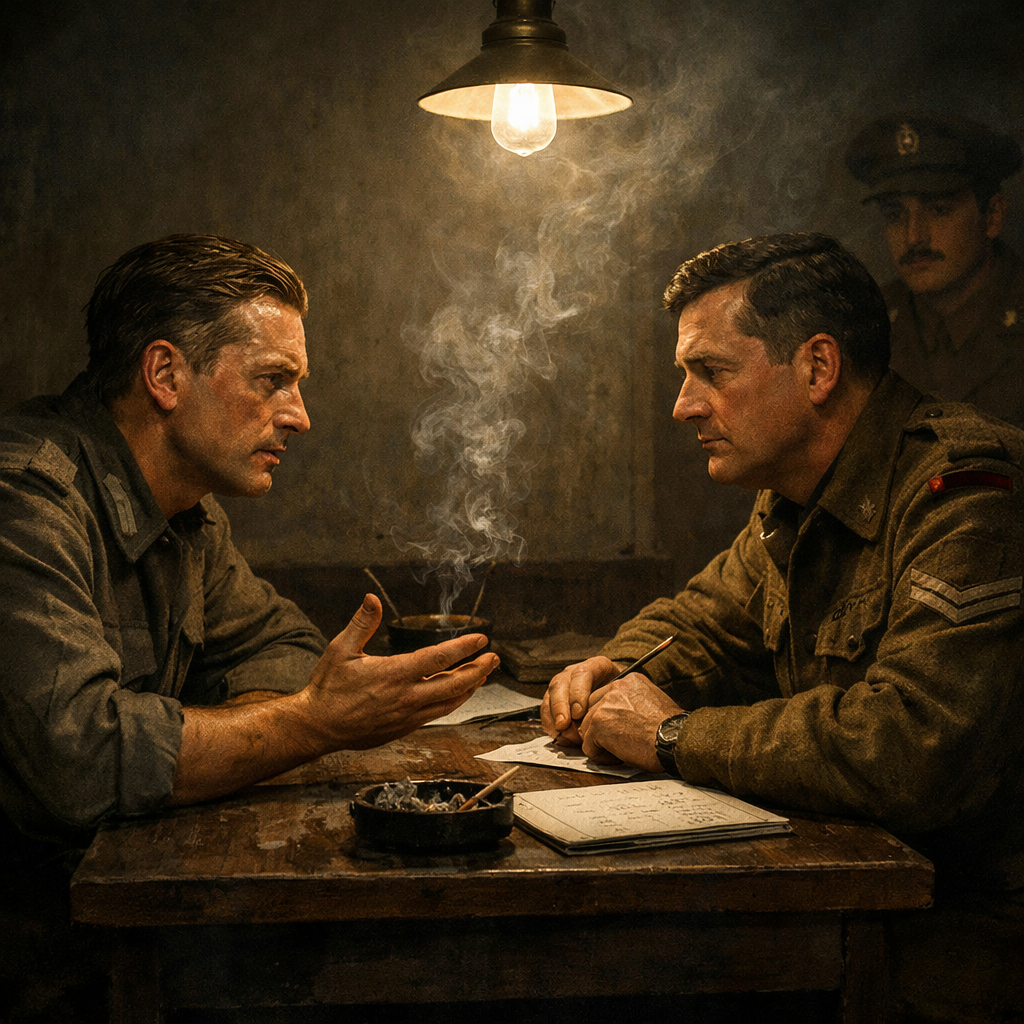
Corporal Jack Booth and Gefreiter Friedrich Von Altenburg