

02 How to make learning easy: memory, organisation and recall
Learning shouldn’t be hard. Of course, everyone comes across something they find difficult at some point and there will always be those who struggle. But, for the vast majority of students, the process of learning things should not be hard because human beings are learning machines. We’re built to learn.
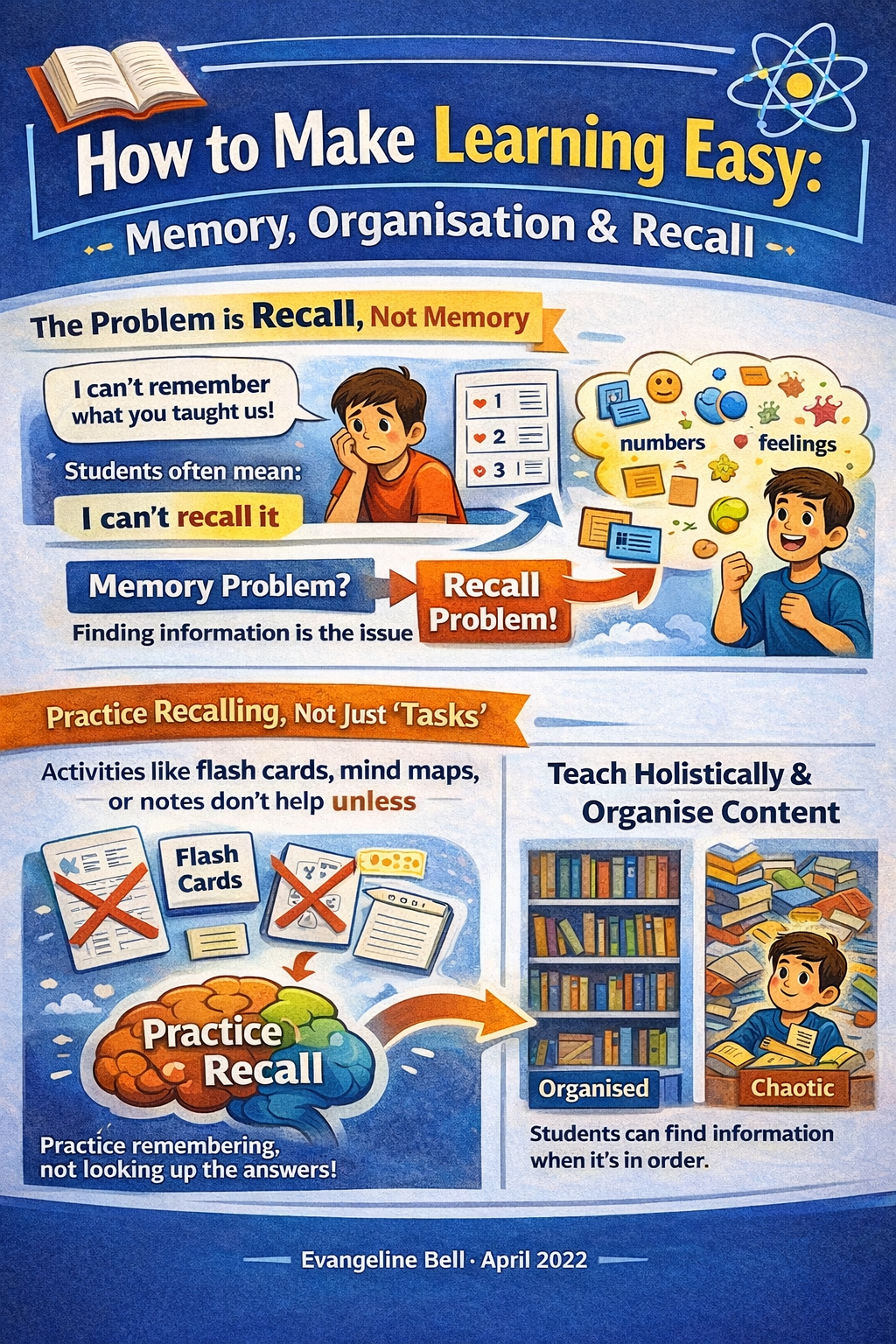
How to make learning easy; memory, organisation and recall
What students say – and what they really mean
Students often tell us that they can’t remember things that we’ve taught them. Not only is this disheartening for the student, it is also frustrating for the teacher. It also happens to be largely untrue!
Now – let me give you a caveat for a moment. Yes – students will not have remembered things that were not well-taught. They will not have remembered anything if they were not present in class or if they were not paying attention. All that is true.
But, let us assume that we have in front of us a student who attends regularly and works hard and let us flatter ourselves that we did teach them rather well. The student still tells us that they can’t remember what we’ve taught them. The chances are that they actually can – or can remember most of it. What they can’t do is recall it. How do I know this? If you give a group of students a multiple-choice test, they will do far better than if you give them recall questions on exactly the same content. What this means is that the information is in there somewhere but, when asked to find it unaided, the student cannot locate it in his/her memory. The problem, then, is not so much one of memory as one of recall. The student tells us that they cannot remember anything. What they mean is that they cannot recall it.
What this means is that solutions which focus on fixing information into the memory are largely mis-directed. The problem we need to solve isn’t memory. It’s recall. By requiring students to double-down on the process of laying down memories, we aren’t just failing to solve the problem. We are making it worse because the student may be working really hard and yet is still failing to experience success. This is bound to undermine the student’s confidence. And – a subject for another blog – confidence is vital for success.
The problem of recall
My subject has always required students to recall huge amounts of information. There is literally nothing on a GCSE History paper except a series of questions and a large amount of lines to write on. There are no prompts or aids. So, how do the students learn to do it?
First, we need to understand that when information is presented to the students, they need to actively process that information in order to make sense of it. This, they do in relation to what they already know. This is why it is important to embed the key patterns of meaning, or establish the mental schema, for your subject before expecting them to be able to recall information. They need to make sense of it and they can best do this by slotting it into those patterns of meaning I wrote about in my first blog on this topic. How students process information and do this is a theme I shall discuss in another blog. For now, let’s say that they do this via the multitude of activities which teachers give them in lesson to do.
If the activity is a well-designed activity and if the method chosen is effective, the student will transfer information from the working memory into the long-term memory. There, it will be split up into different kinds of information – numbers, words, emotions, shapes … whatever – and stored in different parts of the brain. This matters because if you ask a student a question via multiple-choice test, all the student has to do is to locate the precise bit of information which s/he has seen before and select the right answer. But – if you ask them a recall question, the chances are that they will have to find multiple bits of information which are stored in different parts of the brain, synthesise them into the whole again and spit out the complete answer. Recall isn’t just identifying. It’s synthesising. The process is very different from that of laying down, or creating, memory.
What we often do as teachers is spend a lot of time trying to get students to create memories. We rarely ask them to practice recalling – and, yet, that is the core problem.
Why flash cards and other ‘task’-based revision techniques are ineffective
Often, teachers set ‘tasks’ as revision activities. Traditionally, this has involved making flash cards or doing mind maps or summarising etc. There’s nothing amiss with any of these activities in themselves. But – if the student does them essentially by merely transferring information from point A to point B, they are not going to be able to recall much at the end of it. They are not practising recall. It’s as simple as that. Even doing past papers is of limited value if the student is always allowed to use content resources – to ‘cheat’ - when doing them.
If, however, the student makes flash cards, does a mind map – or whatever – but does it from memory, all of them may well be highly effective.
Organisation and holistic teaching
But, let’s try and make it easy for the students, shall we? Not only should we construct our curriculum around the core patterns of meaning for our subject, we should also teach in a manner which makes it easy for the students to store information away coherently.
Let us imagine for a moment that we ask our students to find a single piece of information in a library. They walk into the library and they find that everything is organised according to a system. They know where to look and where to find what they are looking for. But what if all the books were in a heap on the floor? All confused and higgledy-piggledy. How, then, would the student find that single item they needed? That’s often what we do with our students. We teach them in micro-slices, thinking that this will make the learning easier to digest. It will – in the short-term. But, if we want the student to be able to find the information and recall it at a later date, they need to put it away as part of a large whole and they need to do so systematically.
What this basically means is that we need to teach whole blocks of information and attempt to get the students to memorise it as a whole and at the time at which it is first taught. Too often, we plough our way through our schemes of work/course without checking to see if what we’ve taught has been retained. It’s what teachers used to call ‘covering the content’ – a phrase I’m recalling from my earliest teaching career. What we then do is ‘test’ them in some way. We set them to ‘revise’. But the word ‘re-vise’ means that the student is doing something for at least the second time. If they never retained it in the first place, they aren’t ‘re’ doing anything. Teachers also often expect students to retain something after only a single lesson studying it. They were told it once and they should be able to remember it… In fact, it is highly unlikely that anyone will be able to recall anything much if it is only given to them once. Therefore, we need to build opportunities for memory creation into our teaching and we need to check that students are able to recall what we’ve taught frequently. Testing is a form of sampling. It doesn’t assess the full extent of understanding or learning. As a teacher, we need to be sure that the student is learning on an ongoing basis. Again – the subject of assessment is for another blog.
The point to remember is that if something goes in as a whole, it is more likely to come out as a whole because, when the memories were laid down, the student has mentally noted where the connected bits of information were stored in that long term memory. This is known as semantic learning – learning which makes sense of disparate items of information because it is fitted into a pattern of understanding. Remember – recall entails synthesis. If the connections between things are an inherent part of the learning, it will be easier to synthesise it together again. It will be easier to recall. It will even be easier to find those single items of information needed during the sampling process – which is better known as a ‘test’.
Indeed, it may well be that your examination paper assesses student understanding by asking short questions of some kind which only tests a part of that understanding. However, it is still better to ensure that the learning is whole. For example, if a student can explain the process of photosynthesis, or the water cycle or the method of calculating the area of a geometric shape, then they really do understand it. If the examination only tests a part of this understanding or the application of something, it does not matter. The student is prepared for anything because they understand everything.
Let me give you an example of what I mean. I do this – so this is a piece of self-criticism. I ask a question to the class. A student gives me a bit of an answer. It isn’t the full answer so I ask a supplementary question. This elicits a bit more of the answer. I may continue to press the same student or I may bounce the question to another. Whatever … what is actually happening is that I am dragging information out of the students in micro-doses. Eventually, I will feel that we’ve pretty much got all the component parts to the answer and I – me – I will synthesise it all into a complete answer. The students will nod their collective heads and some of them might actually understand what I’ve just done. A lot do not. I would be teaching better if I then required the students to do the same: to synthesise all of that information into a complete answer. I would be teaching better, still, if I then asked the students to compose an answer in written prose. Again – that is a subject for another blog.
At this time, let’s say that we should always teach holistically and expect the students to learn a complete topic in its entirety. We should also expect them to be able to recall and articulate that answer in its entirety.
Another, and related, way we can make learning easy for our students is to have our curriculum organised systematically and we need to explain that system to the students. In History, for example, we may construct a programme chronologically. But, we may do it thematically. We may equally organise it conceptually. There is no fixed ‘right’ or ‘wrong’ – but what we shouldn’t do is mix up all of these approaches. We must be systematic. The same principle applies in every subject.
Making recall a part of the learning process
My contention is that we should not teach a topic by setting a sequence of activities and then assessing how much has been learned either by means of a periodic test or by an assignment. We should make recall an embedded part of the learning process.
I am suggesting that we consider these elements in the process of learning:
· Input
· Processing
· Memorising
· Recall
· Writing
· Assessment
I don’t necessarily think that there is a specific order in which these have to be done. For example, a teacher might have a recall exercise at the start of a session – or later on. A teacher might have two exercises on the same part of the process but at different phases of the learning process. What I’m suggesting is that memory and recall should become an endemic part of the process. I am also going to suggest that writing has a number of roles to play in this. Yet another topic for another blog.
What would this look like?
One year, AQA chose to focus their historical environment unit on the coffee houses of London during the Restoration Period. To teach this, I did a lot of research on the subject. I wrote three model answers focusing on different themes. I asked the students to memorise each of the themes in turn. They did this either by a process of ‘Look, Cover, Check’ or by writing notes on what I’d written and then speaking them aloud without looking at them. I then asked them to put all their processing work away and selected them at random to tell the class everything they could remember about their theme. The key concept was that students were required to recall the totality of something in some way, shape or form.
Impact
If we did this across a school, however, our students would develop an amazing ability to recall because it would be being practised day in, day out. Their cognitive ability to recall would become highly developed. My experience tells me that when students become atuned to the fact that they are going to have to recall information which they are being taught, they start to make a mental note of that. They start looking for the sort of information they need. They become faster and more efficient at it. if we combined this with a curriculum plan based on subject-specific patterns of meaning which would enable students to assimilate knowledge more easily and if we start to use writing more effectively, we could seriously turbo-boost our outcomes.
Conclusion
Learning shouldn’t be hard. Human beings are built to learn. The purpose of this blog is to argue that teachers often mis-diagnose an inability to remember when the problem is more likely to be an inability to recall. It is, therefore, to argue that we should incorporate memorisation and recall into the process of teaching and learning. It is also to argue for the concept of holistic teaching: students should be required to recall the totality of something. Learning should not be left with a topic or learning goal having been taught and learned in small chunks. It should always be synthesised back into its totality. If this is combined with a progressive curriculum plan which has been created around the inherent patterns of meaning in a subject, it will significantly improve our outcomes. A topic for another blog is the role of writing in enabling students to process their learning and how this can also facilitate better memorisation and recall. And how that creates a virtuous circle whereby better memorisation and recall can engender better writing. Better writing engenders confidence. And, both better writing and a greater sense of confidence would, I assure you, lead to better results.