

A New Social Contract
This is is an opinion piece which I first wrote in November 2016 - shortly after the Brexit referendum in the UK and the first election of Donald Trump to the US Presidency. I’m including it in this Blog to showcase a different genre of writing. However, it strikes me on re-reading the piece, how very pertinent the themes are a decade after it was originally written. After a brief hiatus, Donald Trump is back in the White House and populism is on the rise in many parts of the world. This piece isn’t intended to promote or denigrate any particular poltical figure or party. It was originally intended to stimulate readers to think. Here - it is merely being used as an exemplar of opinion writing, as opposed to a story, a poem or an academic essay.
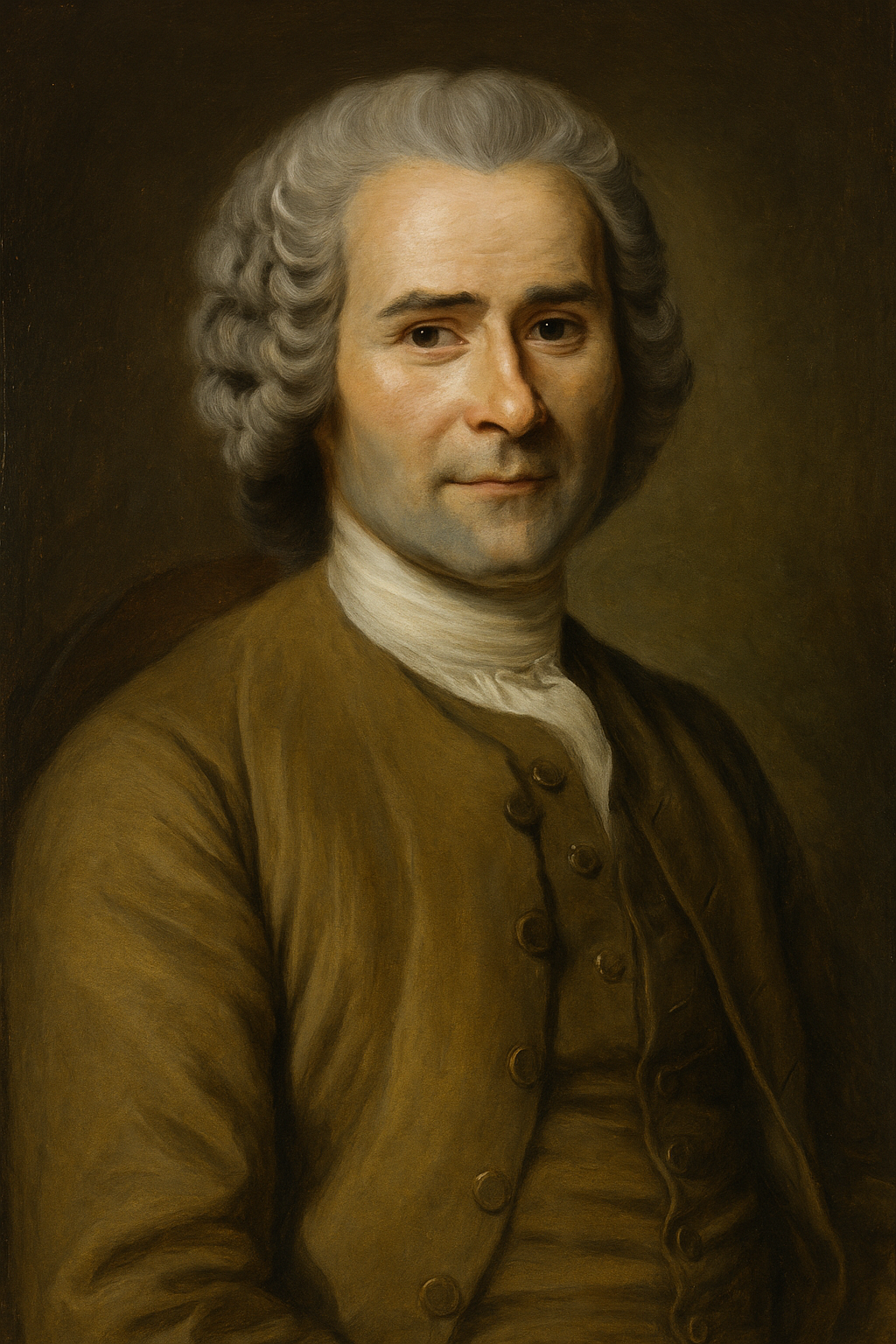
Jean-Jacques Rousseau 1712-1778 (image generated by AI)
When Jean Jacques Rousseau wrote "The Social Contract" in 1762, it was during a period of profound social, economic and political change which ushered in the greatest expansion of human prosperity and personal liberty ever known. It is the thesis of this article that the time has come to reconsider the terms of this contract in order that we do not lose the benefits we have gained in the last 250 years.
It has been 87 years since the Wall Street Crash triggered the banking crisis which facilitated the Great Depression and much has been learned as a result. It didn't matter much whether your political philosophy was fascist, communist or liberal democratic, all states affected by the Depression pretty much pursued the same solutions. In the end, vast amounts of government expenditure kick-started the global economy into activity by creating demand where there was none. Of course, most of this expenditure was justified by World War Two. Even people who violently object to public spending on welfare have no problem justifying precisely the same expenditure when directed to national defence. In economic terms, however, it matters very little what one spends taxpayers' money on; the point is that it was spent.
In the aftermath of the Second World War there was a de facto recognition that unfettered capitalism has flaws. Admittedly, there are those whose belief in perfect markets has a religious fervor to it but, in practice, all stable states have practiced
policies of economic management. Furthermore, all states in the western world have, to a greater or lesser extent - and often whilst making public declarations to the contrary - actually pursued policies of a redistributive nature. Here in the UK, for instance, every state employee, every old age pensioner, every business working on a government contract and many organizations whose independence is little more than a superficial facade for the expenditure of a government grant - and every small business whose income is dependent upon state employees spending their money on their goods and services is, in fact the recipient of government policies which are inherently redistributive. Just take a walk down any typical small town high street, but especially in areas of deindustrialisation, and consider how many of those nail salons and sandwich shops only exist because they have a regular clientele whose income is derived directly, and more commonly, indirectly from the state and it will soon start to sink in that we are a nation whose economic wellbeing is utterly dependent on the fact that the state shifts vast amounts of wealth from those who have to those who have not. To argue otherwise is quite to delude oneself in the face of the facts. In other words, the very survival of capitalism, as we know it, has been the result of state nurture.
And, let's be honest. It's been a good thing. It is utterly undeniable that capitalism - the free movement of capital, goods, service and labour - within a framework managed by the state has led to a greater collective wealth and well-being than ever before. The thought of returning to a pre-capitalist world of labour service and personal bondage is ridiculous. Economic freedom, a polity based on the social contract between ruler and ruled and the personal liberty of the individual are all manifestations of the same post-Enlightenment world. We, in the modern world, may disagree about many things but we are all beneficiaries of a world built, in part, by capitalism.
And, yet, it happened again. Indeed, that the 2008 banking crisis did not lead to another Great Depression is thanks entirely to the lessons learned in the 1930s. This time, states did not wait until the banking system collapsed before taking pre-emptive action: they bailed out the banks. The result has been an inevitable increase in sovereign debt and, in some quarters, the cry that this necessitates a reduction in the redistributive role played by the state over the past 87 years. Basically, the individual citizen must shift for themselves. If a person will not work, they shouldn't eat - and there is a moral repugnance at the idea that those who are industrious should pay the bills for the indolent. It's time to recognise that there are finite resources within a state and they should be shared on a basis of individual moral worth, rather than on a basis of universal equity.
OK. I see the logic. And, if that is the logic, then we should indeed look after our own first. We should limit immigration. We should protect our industries. We should "take back control". We should "put America first" etc etc. We should defend our interests, howsoever they be defined, against "the other", the outsider, the alien. Even if we are one of those who have lost our livelihoods and lack economic security - who rely, in short, upon the redistributive hand of the state (although we'd really like to pretend that that isn't the case) - we can all rally behind the call of a charismatic personality who promises to put 'us' first. What we want is a Messiah!
But, what, exactly does this mean? The millions of UK citizens who voted for Brexit and the millions of US citizens who voted for Donald Trump are an inchoate group with no discernible philosophical unity - except for one thing. They want the state to take action to increase their economic security. This isn't a rebellion against the concept of government. If that were so, voters would not have turned out to vote at all. Voter apathy is indicative of a population which wants less government or who isn't interested in who governs them. No: this might be characterised as some very angry people who want their government to listen to them and "do something" about their very real problems. The logic of this is an increase in state activity, not a decrease.
But, what can these governments, in practice, actually do? It is an unfortunate truth that most governments in western states govern for the short term. Election cycles dominate thinking and there are often swinging reversals in government policy as opponents replace incumbents within historically minute periods of time. Right now, and despite all the noisy disputation, there is a consistent call for an increase in government spending. Central banks have slashed interest rates to zero, or nearly to zero. They have printed money, albeit electronically. They are out of ideas - and still the level of demand in the global economy remains sluggish. Politicians, financiers and businessmen talk up the prospect of future prosperity - but we all know that such recovery as exists in the aftermath of the 2008 crisis is incredibly fragile. So-called 'Project Fear' was driven by very real fears that cutting the UK off from its most lucrative market is economic suicide, even though it will take years before the reality of this begins to hit home. UK Chancellor Philip Hammond's pledge to abandon the objective of achieving a budget surplus by 2020 is a shadowy reflection of President-elect Trump's pledge to orchestrate a construction-driven boom. At heart, we are watching these states come to terms with a reality which few are willing to admit: state expenditure is a necessity because there are a lot of very angry citizens out there. They want jobs, they want security - and YOU, rulers of the world, had better provide it. You can do so by stimulating private enterprise or you can do so by employing us directly: we don't mind.
At this point, we reach the crux of the argument. Can the rulers who have been brought to power on this wave of popular discontent actually make good on their promises? I fear not. Why? Because not one of them is facing up to the long term and underlying problem which has plagued capitalism for the past 87 years. It is a fundamental flaw in the theory. Capitalism is driven by the profit motive. It works on the principle that every enlightened being pursuing his or her own rational interests will inevitably result in change which is of benefit to the whole. This is fine and dandy in theory but, in practice, it not only results in the unprincipled members of society taking every opportunity to exploit their fellow man but, more benignly, it results in the owners of capital taking every opportunity to dispense with human labour entirely. The industrial revolution is predicated upon the replacement of human labour by machine. The thing is that machines may produce; they do not consume. When capitalism functions in accordance with the theory, there is an equitable balance between production and consumption. The workers who labour in the factory proceed to spend their earnings on the very product they have laboured to produce.
But, what if there were no workers? Let us, Jules Verne-like, imagine a future in which all production was to be accomplished by robotics. Who, then, would buy the products thus produced? Can we not, reductio ad absurdium, fantasise of a bottomless pit into which the mechanized production line teems a vast array of wonderful products whilst a poverty-stricken population sits and watches? Of course, the global economy is vastly more complex and some things will inevitably be done by mankind alone. It merely serves to illustrate the flaw: the advancement of technology has made labour cheap. Low wages may serve to increase company profits but they do nothing to increase demand. The angry citizens are real people who face job insecurity and low wages. Right now, they are blaming "the other". Without a great deal of empirical evidence to support the conclusion, they are convinced that the blame lies at the door of the immigrant who is "stealing their job" or undercutting local wages. If it isn't the immigrant at home, it's the foreigner abroad: the Chinese mostly. Or, here in the UK, the fault lies, obviously, in "Brussels"....
In fact, none of this is true. Human migration is driven by many factors, chief among which is the belief that life is better somewhere else. It is very likely to be true that migrants are seeking work. But that pre-supposes that there was insufficient work at their place of origin. It is true that businesses seek out the cheapest source of raw material, human labour included. But, were workers to be in short supply on a global basis, labour would be more costly. Employers would be competing for workers wherever they might be found. It was the demand for workers after the Black Death which helped to undermine the medieval feudal system, after all. And, for all its inefficiencies and absurdities, the single market is a phenomenally good idea, extending the positive benefits of capitalism to its logical conclusion. To work efficiently, a single market requires a stable political and legal framework which reduces uncertainty. What is caricatured as "Brussels" is, in fact, a sensible means of creating the context in which capitalism can flourish in Western Europe. The angry citizen is blaming the wrong causes. For this reason, their Messiahs, spouting slogans which pithily express an underlying emotion, will not provide long term solutions.
There's nothing inherently wrong with using machines in the place of human labour. There's nothing inherently wrong with the acquisition of wealth. The question is: what is it all for? Surely, the morality of capitalism lies in the use of whatever humankind produces for the benefit of all humankind? That those who are industrious view themselves as more virtuous than those who are indolent might have merit if indolence was a voluntary choice. Yes: we can all cite examples of lazy scoundrels. But, the millions of voters who voted for Brexit and Trump are not primarily lazy scoundrels. They're angry because they want to work - and they want to receive both financial and moral recognition that their labour is valuable - but can't find it, or enough of it, to be able to enjoy life. Equally, I'm not suggesting that the solution is for the state to appropriate the proceeds of society and redistribute it in some form of totalitarian concept of the equality of man. I am suggesting that those who would compete for power in a democratic polity in which the benign benefits of capitalism can be realised need to recognise that there is an underlying flaw in capitalism. It's been growing for 87 years and it isn't going away.
We need to create an economy and society in which everybody's labour counts. Yes: everybody needs to work, in one way or another, but not all the time and not in the same way. And, however one contributes to society - provided one does contribute - one should be able to reap the reward of a 'good life'. I want those who read this article to think about the implications of this, for they are profound. Societal contribution does not just mean a fixed number of hours spent grafting in a factory or an office. It might mean many different things. We need to decide what it is that we value in our society and how we should distribute resources in order to reflect that. Right now, what we're actually saying is that we don't value people just because they're people. In essence, that makes our civilisation little better than those who based their economy on slavery or whose rulers used them as cannon fodder in the pursuit of personal glory. I think we're better than that. We ought to be better than that. And, if liberal democracy is to survive in the long term, we had better be better than that. People are active agents and they don't do "nothing". Eventually, if their faith in their leaders is destroyed completely, this mass of angry citizens will do something - and who knows what? What I fear is that whatever they do will destroy all that the post-Enlightenment world of capitalism and liberal democracy has gained.
So, in this article, I am talking about the need for a new social contract - and I want to see and hear people debating what that might look like.