

05 How to make learning easy: Recording and Revising
Learning shouldn’t be hard. Of course, everyone comes across something they find difficult at some point and there will always be those who struggle. But, for the vast majority of students, the process of learning things should not be hard because human beings are learning machines. We’re built to learn.
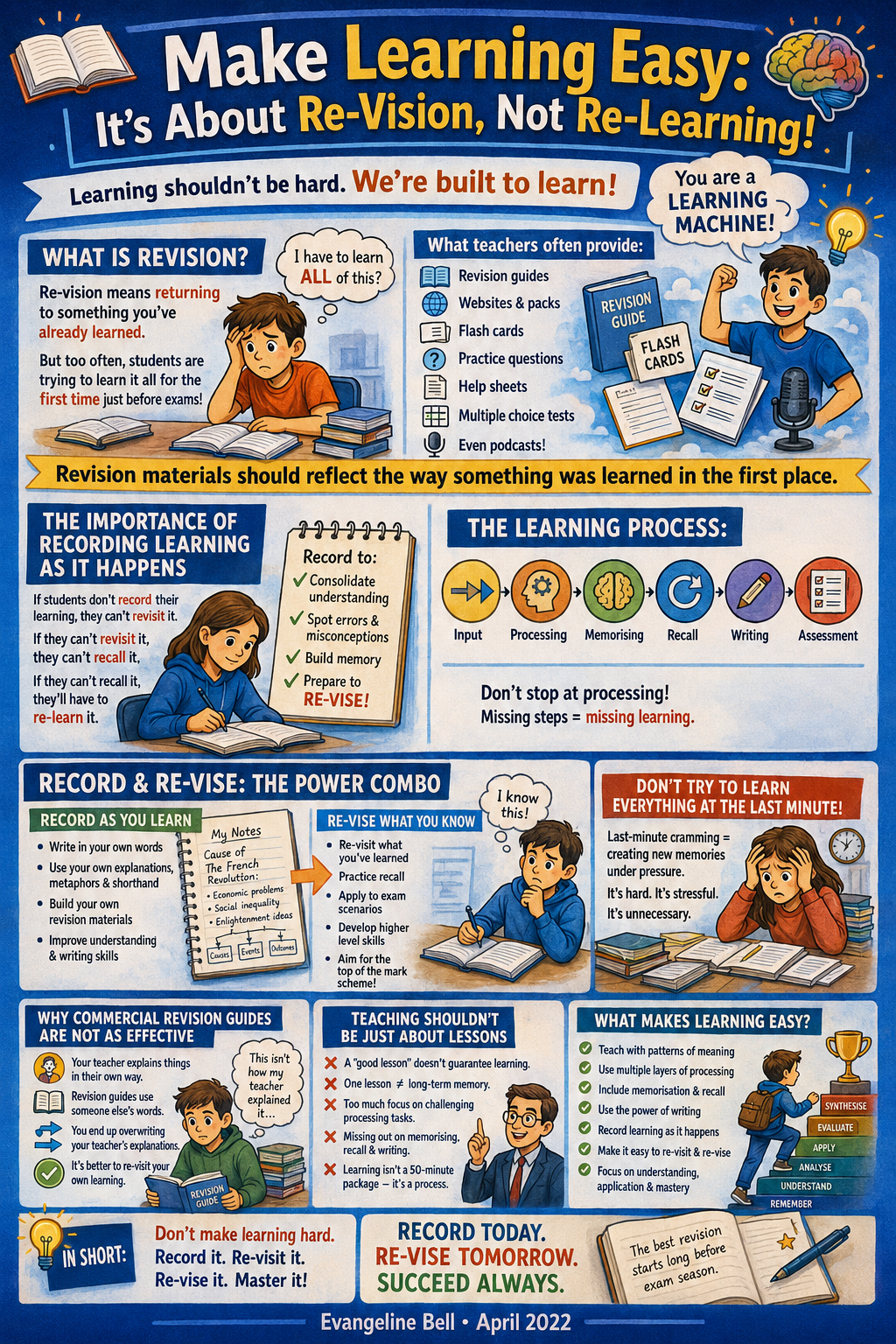
What is revision?
How many teachers have I seen provide ‘revision’ materials for students? They point students to a published revision guide, a website, a pack of teacher-prepared resources, commercially produced ‘flash cards’ …. etc. They provide practice questions and help sheets. Multiple choice tests on content. Even podcasts!
I want to argue in this paper that ‘re-vision’ implies a returning to something and, yet, too often, what actually happens in the lead up to examinations is that students are attempting to learn everything for the first time, as if they’d never really learned it in the first place. I also want to argue that, to make it easy for students to ‘re-vise’, revision materials need to reflect the way something was learned in the first place.
The importance of recording learning as it happens
Many years ago, a colleague asked me a question: why is it that I can teach ‘good’ lessons and, yet, the students don’t get good results? What he meant by ‘good’ lessons were lessons which had been graded ‘good’ by observers, using the then criteria used by OFSTED. The answer is that, too often, OFSTED spend their time looking at what teachers are doing and insufficient time looking at what learners are learning. A more important issue is that the concept of the ‘lesson’ leads to a poor way of engendering learning.
Let us consider what we mean by a ‘lesson’. For over 20 years, the ‘lesson’ has been the key focus in teacher training, inspections, quality assurance and most CPD. Essentially, it means ‘the package of activities which teachers and students engage in during a fixed period of, typically, 50-60 mins’. There are variations on a theme and different opinions about what elements ought to be in these ‘lessons’. Some schools have a very rigid approach. Some are more flexible. However, the basic idea is that it is engagement in these activities which drives learning. There is much talk about making these activities ‘challenging’ – the inference being that the harder students have to think, the more effective the learning will be.
That is partly true. Clearly, it does matter what students do when they are face-to-face with their teacher. Clearly, it matters what teachers do when they are face-to-face with their students. And, as I argued in my paper on processing, there is a kernel of sense in the idea that thinking aids memory. In this series of papers, I have argued that there are, indeed, various elements to the process of learning:
· Input
· Processing
· Memorising
· Recall
· Writing
· Assessment
But, I have been very careful not to use the term ‘lesson’. This is because I believe that the idea of forcing individuals into a position where they have to imbibe information, learn to do something, make conceptual leaps etc within a succession of equally fixed time periods is ludicrous. We all know that different things take different lengths of time to learn. So, a teacher who stands there and tells his/her class that the ‘learning outcome’ for the session is X and expects that this one session is going to achieve that may be well-meaning but is likely to be only ever partly successful, at best. It may be that a critical mass of students understands something during that session that they did not know before. It may be that they are exposed to some new information that they have never seen before. It may be that they have a go at a new skill or think about something in a new way. Yes – there are lots of things done in lessons which are a necessary and valuable step on the road to learning. Indeed, if the curriculum plan is constructed in accordance with the core patterns of meaning inherent in a subject, if teaching is organised and holistic, if multiple layers of processing are required, if the power of writing is harnessed and if the acts of memorisation and recall are an intrinsic part of the teaching and learning process, it is quite likely that the impact of what happens in lessons is very effective.
But the experiences of a single ‘lesson’ alone are hardly likely to engender long-term learning. This is especially true when the default structure of any ‘lesson’ is a sequence of processing tasks. Now – I’m not criticising the concept of processing. Indeed, my last paper was arguing that multiple layers of processing are critically important in engendering long-term learning. I am arguing that teachers have been conditioned to think that EVERY lesson should require learners to engage in a sequence of processing activities and that the more challenging they are, the better. The subject of creating appropriate challenge is a topic for another time. In this paper, I want to argue that teaching which is constructed solely around a sequence of ‘lessons’ consisting of challenging processing activities is misguided. Even if these activities are intrinsically good – and let’s assume that they are – what they are asking the students to do is use their active working memories in the belief that this will transfer information into their long-term memories. As I argued in an earlier paper, there are as many such activities as there are grains of sand BUT they are not all equally effective, and they are not all equally effective for all learners. I argued that there are many times when I’ve felt that something has worked, only to find weeks later that it has not. For this reason, learners require time to consolidate their learning: to reflect on their thinking, to make the relationship between new input and those core patterns of meaning secure - and the act of recording their learning helps to do that. It also helps teachers to spot errors, misconceptions, missing items and erroneous connections and conclusions.
Let us return to my colleague’s question. It is quite possible to teach a sequence of ostensibly ‘good lessons’ without the learners retaining very much at all. This is because the assumption is that it is these challenging processing ‘tasks’ themselves which powers the learning. Now, as I shall show in another paper, this is not true. Processing tasks are necessary in teaching and learning, as is appropriate challenge, but no matter how effective the immediate in-class experience appears to be for learners, it is inevitable that they are going to go away and that much of what they temporarily learned in that session is forgotten in the hurly burly of daily life. This is absolutely true if the process of learning is merely a sequence of input, processing and assessment and without the elements of memorising, recalling and writing. If the end point of a course is an examination, and if that examination contains a significant written element, then, there is going to come a point where the learner has to re-visit prior learning and revise it.
For this reason, it is important that learners record their learning as it occurs. When they need to revise, they need to re-visit what they have already learned. Re-visit! The general idea is that, thanks to the well-designed processing activities and, if done well, the embedded elements of memorisation and recall, they have already stored the critical mass of the required learning in their long-term memories. Re-vision is all about practising recall and bringing what has already been learned back into the working memory. It is about applying learning to potential examination scenarios, honing techniques and pushing on to the higher levels required in whatever mark scheme is going to be used, usually by synthesising various elements of learning into a whole. What they do not need is to be put into the position where they are being asked to learn the entirety of a course within the few weeks prior to an exam. What we are doing to students under these circumstances is asking them to create new memories in a very short period of time. And, quite frankly, this is exactly what many teachers actually do! This is to make learning a lot harder than it need be.
I cannot count the number of occasions when I hear teachers talking about giving students ‘revision materials’ – and so many of them are summaries of what the student should have already learned. Why? The answer to this question is that the students have basically not learned it. Why? They were not required to record their learning as it happened and, so, did not consolidate that which they did understand at the time their first encountered it. Why? The answer to this question is that teachers were more obsessed by structuring a sequence of activities which met the criteria for a ‘good lesson’ – typically a sequence of challenging processing activities - than they were about ensuring that the students were in a good position to revisit their learning at a later stage. They also did not include memorisation, recall and writing in their teaching and learning cycle. They just assumed that input, processing and assessment alone would engender learning.
Commercially produced revision materials are not as effective as recording learning as it happens
If a student engages in a course of learning – for those of us in secondary education, this largely refers to our GCSE, A Level and Btec courses – the way they learn something matters. If I – as the teacher – explain something, I use my own choice of vocabulary. I use my own metaphors as illustrators. I use my own short-hand aids to memory. I explain important concepts the way I understand them. What I am hoping is that the student will end up seeing whatever it is in the same way that I do. After all, I’m the expert. But, if the student does not make an ongoing record of their learning – the way they’ve understood these things – and, at the end of the course goes and buys a revision guide, it is highly unlikely that the person who wrote the revision guide used exactly the same explanations as I did when I taught them originally. Under these circumstances, the student is, effectively, choosing to listen to an instructor who was not the person who originally taught them. They are attempting to overwrite whatever it is that they can recall from their own teacher with that written down in the revision guide.
Now – I’m not saying that students cannot learn from revision guides or ‘knowledge organisers’. Of course they can. Indeed, you might choose to make such a resource the default resource for your course and, if you do, then it will double as the default revision resource as well. Moreover, I’ve contributed to the production of a commercial revision guide and, when I was 16 myself, used one to pass my Chemistry exam. Indeed, it is having had to do that which tells me that attempting to learn an entire course from scratch between February and June of Year 11 is a foolish idea – and much less effective than being in a situation where I had an ongoing record of my learning done in the way that I learned it at the time. Why? In effect, I was discarding everything that I had done in Chemistry class in favour of memorising the content of my revision guide. I may point out that it worked and I got a very good grade in Chemistry. But it did mean that pretty much the entirety of the 2 years I had spent in Chemistry class were a waste of time. And I could not have done that for every one of my courses simultaneously.
Recording and revising
My contention is that one way of interpreting the sequence of elements in the learning process which is listed above in this paper and, again, in my paper on ‘memory, organisation and recall’, is to make recording an embedded part of classroom practice. What I mean by that is that students should be required to write in prose – in clear, accurate and well-constructed written English – their total, complete and holistic understanding of what they have learned. We might call this the ongoing construction of their own revision materials. If we do this, not only would it enable the learner to consolidate their understanding of what they’ve learned by having to compose a piece of text to explain it, it would also give them the opportunity to practice their writing skills and give them materials to revise from which match the way they learned whatever it is at the time they learned it. This would, in turn, mean that when students come to re-vise, they are actually revisiting prior learning and not trying to learn everything from scratch in the weeks leading up to an exam.
Under these circumstances, a commercially produced revision guide or a ‘knowledge organiser’ may become a supplement during revision. But, too often, it is the only source of material for revision because students have not made an on-going record of their learning as they learned. This is to make learning unnecessarily hard for the student.
Conclusion
The core theme of these papers is that learning should be easy. Yet, too often, teachers make it overly difficult. In this paper, I have argued that the nature of revision means that students should be ‘re-visiting’ things which they have already learned. They should not be trying to learn an entire course in the weeks leading up to an examination.
I am arguing that on top of all the other things I’ve talked about in this series – patterns of meaning, memory, metacognition, systematic teaching, holistic learning, multiple processing, writing – requiring students to record their learning as they learn is an important aid to making learning easy. Not only should students be using a process of recording to consolidate their understanding as they encounter learning for the first time, not only should teachers be using this as a diagnostic tool to evaluate the quality of that learning, but students should be producing materials which will enable them to re-visit their learning in the way that they originally learned it. The memories laid down at that time should be located, retrieved and re-worked in preparation for an examination. Moreover, instead of spending time creating new memories, students preparing for examination should be spending that time practising application and developing advanced skills which will enable them to reach the higher levels of whatever scheme of assessment is being used in the exam.
Finally, I have also argued that a core reason why teachers make learning overly hard is because of the default position that teaching is all about the construction of a ‘lesson’. It isn’t and it shouldn’t be. It should be about finding every possible route to making it easy for students to understand, memorise, recall and apply.