

Scaramouche and Harlequin
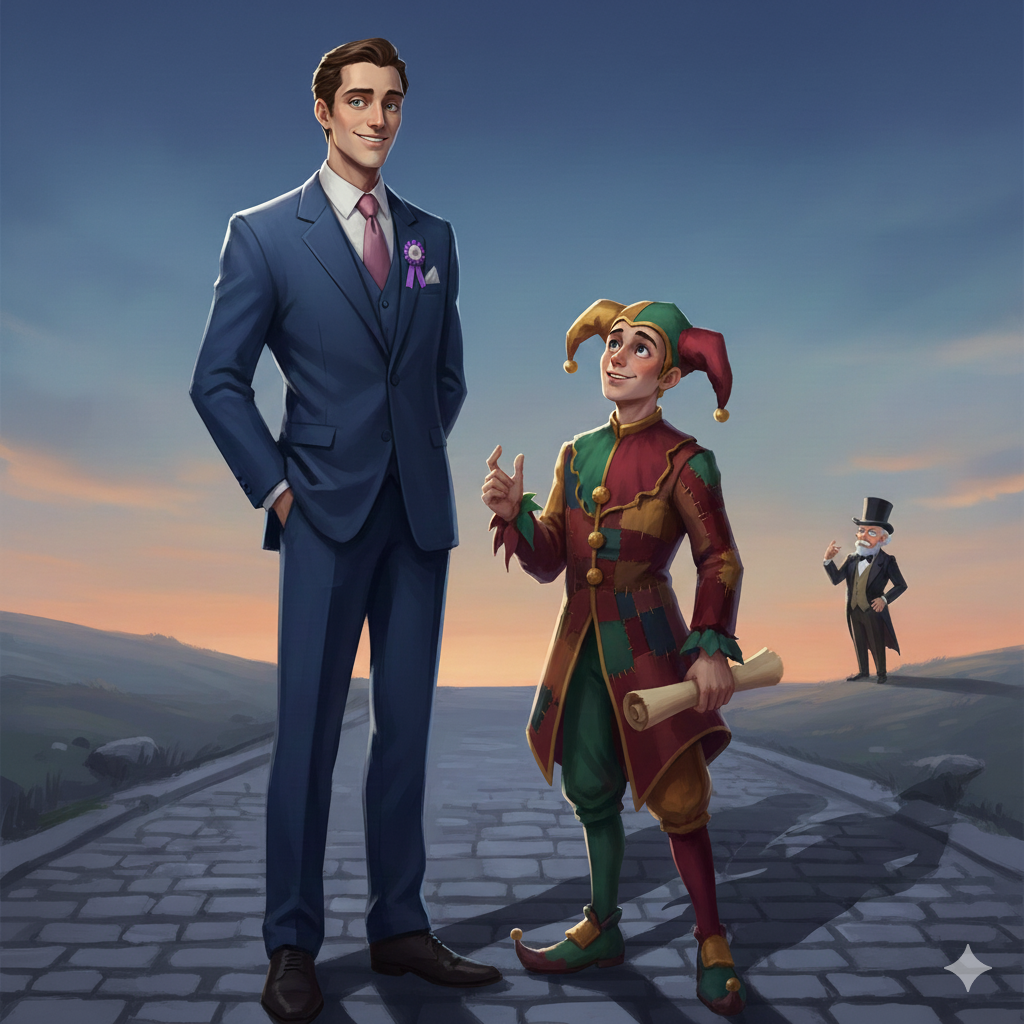
Scaramouche is a liar. He does not look like a liar - but what liar does? Only a really bad liar looks like he would deceive you. Scaramouche wears a smart blue suit, bright white shirt, a dusky pink tie and a kerchief of matching hue pokes out of his top pocket. He is impeccable. On special days he wears an appropriate lapel badge: breast cancer, Holocaust memorial, Remembrance or mental health awareness … whatever. The cause matters not for the cause is to be seen to be sending the right message. Scaramouche smiles a lot: it is a warm smile, inviting confidences, often accompanied by a flash of the eyes suggestive of an intimacy which can never exist. It is easy to be caught in his net, enticed by flattery and unspoken promises. You are sure he would not betray your trust. But Scaramouche is wearing a mask. He likes to play the ‘man of integrity’ but he glances at you obliquely, hiding his soul behind his lashes. You will notice that he says little and listens a lot: the manipulator’s ‘tell’. You think he is in accord with you but … is he? While you are with him you are sure that he agrees with every word you say but, afterwards … you are not quite so certain. Did you ever hear him say, ‘Yes’? No: you did not. You assumed. That’s how Scaramouche likes it. Everyone assumes that he agrees with them when, in fact, we - none of us - know what was playing in his mind. We only discover what he was thinking when he turns his thoughts into deeds. Then, we are shocked because it turns out that Scaramouche is a liar.
Harlequin is naive. He feels things but doesn’t always think them through. Harlequin cries easily, too empathetic to be cynical. He wears his coat of many colours with modesty. It is hand-made, rustic and stitched with the boldness of sincerity. Harlequin would never make it into the lobby of a posh hotel. He would be directed to the charity shelter in a back street instead … and he would go, even if he were supposed to be the honoured guest at dinner for Harlequin would not suppose that he was being despised or mocked. Harlequin admires Scaramouche for Harlequin sees only the glib and shiny exterior of ‘the leader’ Scaramouche is pretending to be. He does not see that Scaramouche is a liar.
One day, Scaramouche and Harlequin walked together down a lonely road: an odd couple. Ah! We forget: Scaramouche is too well-mannered to show open disdain for the likes of Harlequin. His contempt is disguised beneath that mask. Harlequin is overjoyed to have been noticed by a real-life hero, not so much a bronzed Hercules but a 21st century Scarlet Pimpernel.
Scaramouche asks Harlequin how things have been. He is utterly disinterested but it is courteous to ask. Harlequin is flattered into divulging that things have been ‘OK’ - a stunning revelation indeed. Scaramouche nods and compresses his lips, once more forcing the disdain to remain concealed. Taking this for a signal to continue, Harlequin talks. This is how Scaramouche learns of useful secrets. Harlequin asks Scaramouche where he is going. Scaramouche does not reply. He never replies to a direct question: he distracts Harlequin with a question of his own. Harlequin is looking for Merlin for he has heard that Merlin knows the location of a priceless diamond. Now Scaramouche’s ears are pricked: a diamond? Yes - in an old book, Harlequin learned of the existence of this treasure and that the only person who knows of its location is the legendary magician, Merlin. So - he is off to find Merlin.
Scaramouche secretly scoffs; Harlequin is a fool. There are no magicians and no priceless diamonds. The world is run by people like himself: suave players who cynically exploit the naivety of others. It is an exclusive club, an unassailable elite who rise … on the back of their own merit, of course. God forbid that there might be so much as a whiff of institutionalised privilege or the gaming of a system designed by other Scaramouches. After all, what is all that education for but to prepare you to be a great leader? It entitles you to be condescending. For an instant, Scaramouche’s lip almost curled. But Scaramouche has spent a lifetime learning to discipline his features. He restrains himself and presses his lips together.
In the split second that Scaramouche was thinking these thoughts, Harlequin had pulled out an old piece of yellowing parchment. Its very thickness and strange dark text spoke of ancient wisdom. Gothic script with bizarre diagrams and occult symbols. Harlequin began to translate the words and ideas as alien as kindness began to form in Scaramouche’s mind. Yes - there was a diamond. And a desire, more burning than the fires of Hell, more obsessive than addiction, more intoxicating than lust, arose inside him. He absolutely must possess this treasure.
‘Let us join forces and find Merlin together,’ suggested Scaramouche to Harlequin. Harlequin beamed, for he did not see the greed lurking in the eyes which Scaramouche kept behind the veil of his lashes.
The moment the pact was made, an old gentleman suddenly appeared before them. He was dapper in his top hat, tail coat and spats. A trim little beard and a walking cane completed the look: Mr Monopoly himself, no less. ‘Good morning, sirs. And how do you do?’ said the old gentleman. ‘I hear you are looking for Merlin.’ Harlequin blushed but Scaramouche confidently asserted that they were. ‘Ah!’ said Mr Monopoly, ‘… then you must be seeking the diamond.’ ‘You know of this diamond,’ said Scaramouche. ‘I do,’ he replied. ‘It is the greatest of all treasures but, I’m sorry, it cannot be divided. Were you intending to split it between you?’ ‘Two are always better than one,’ said Scaramouche, carefully avoiding a direct answer to the question. ‘Harlequin is my friend.’ Harlequin beamed. Mr Monopoly winked at Harlequin.
‘Then you must play my games,’ said the gentleman. ‘These games will test you to the utmost. They will see if your friendship is strong enough. If it is, perhaps you can find the diamond together. Will you play?’
Scaramouche looked at Harlequin. There he was in his multi-coloured, hand-made garb and smiling peaceably. What an irritating and deplorable sight! But - he was also still clutching that parchment …
Harlequin looked at Scaramouche. Tall, smart, sophisticated. Oh! To be like him.
‘Yes!’ they said, in unison.
Now this is a fairy-tale and that means there must be three. Aladdin and Portia would be disappointed if there were not. A fairy godmother should not short-change her audience and even Macbeth would be disgusted if we fell short at this point in our story. Thus, Scaramouche and Harlequin must chance their fortunes thrice. However, as we sophisticates look on, we are astonished that our protagonists do not see the obvious moral tale being woven by our narrator; that Portia’s suitors did not spot that the real treasure lay inside the lead casket or a mythical king did not immediately realise that salt is more valuable than gold. In this case, it is self-evident that Merlin wishes to teach Scaramouche that the friendship of Harlequin is worth more than the lump of carbon which has inflamed his greedy heart.
But this is a 21st century fairy-tale and it is nearly a century since Walt Disney punctured all the naive charm from Snow White and Cinderella. We expect more from our stories than a twee happy ending where a girl is overwhelmed with joy to have found her Prince. Beauty marries the Beast and the end credits roll with no thought of tomorrow and tomorrow and tomorrow …
So, we will not infuriate our readers with lame puzzles and beige-coloured riddles. We will pick up our narrative at the point where Scaramouche recognises that the friendship of Harlequin is worth more than all the diamonds in the world.
Merlin beamed; his top hat wobbled on his head as he waved his cane in glee. Scaramouche and Harlequin had just broken free from their embrace. Harlequin smiled sweetly as Scaramouche wiped the tears from his eyes. ‘My friend!’ said Scaramouche, his face shining with a pinkish glow, almost, indeed, the same hue as his natty tie and kerchief - and his heart warmed with the unassailable knowledge of complete and utter trust. ‘And, so, you’ve found your diamond…’ said Merlin. ‘My job is done.’ And, with that, he vanished.
Harlequin and Scaramouche walked back along the lonely road, wending their way home. An odd couple, still, but, this time, deep in talk: intimate. They share a joke and spontaneously laugh at the same time: kindred spirits. Harlequin links his arm with Scaramouche and Scaramouche does not flinch; it’s been a long time since Scaramouche walked in step with anyone for the Scaramouches of this world do not truly have friends – they have contacts: they network and none of their acquaintances are indispensable. They are tools in their toolbox. They may lay untouched for years in their contacts list but you never know when a number never yet dialled might suddenly come in handy and become useful. It’s a nice feeling, this feeling of camaraderie, of comradeship, of companionship. Were we to see a feeling rather than sense it, we would be able to see a sunny warmth enveloping these friends, radiating from them, and illuminating the world around them, turning all that is grey and mundane into bright technicolour as they walk the yellow brick road.
But, eventually, they must part, these two, for all roads have an end. In this case, Scaramouche must return to his mansion and Harlequin to his bedsit. They embrace one last time and promise that they will speak shortly. Scaramouche has something he would like to give to Harlequin, benevolence oozing from every pore. Harlequin is overwhelmed and tries to think of some way to reciprocate. What can he possibly give to Scaramouche to match this generosity? Scaramouche smiles, that warm and intimate smile, inviting confidences. His eyes flash. ‘No need. No need at all,’ he says. Harlequin watches Scaramouche as he turns, waves and heads home.
…………………………………………………………………
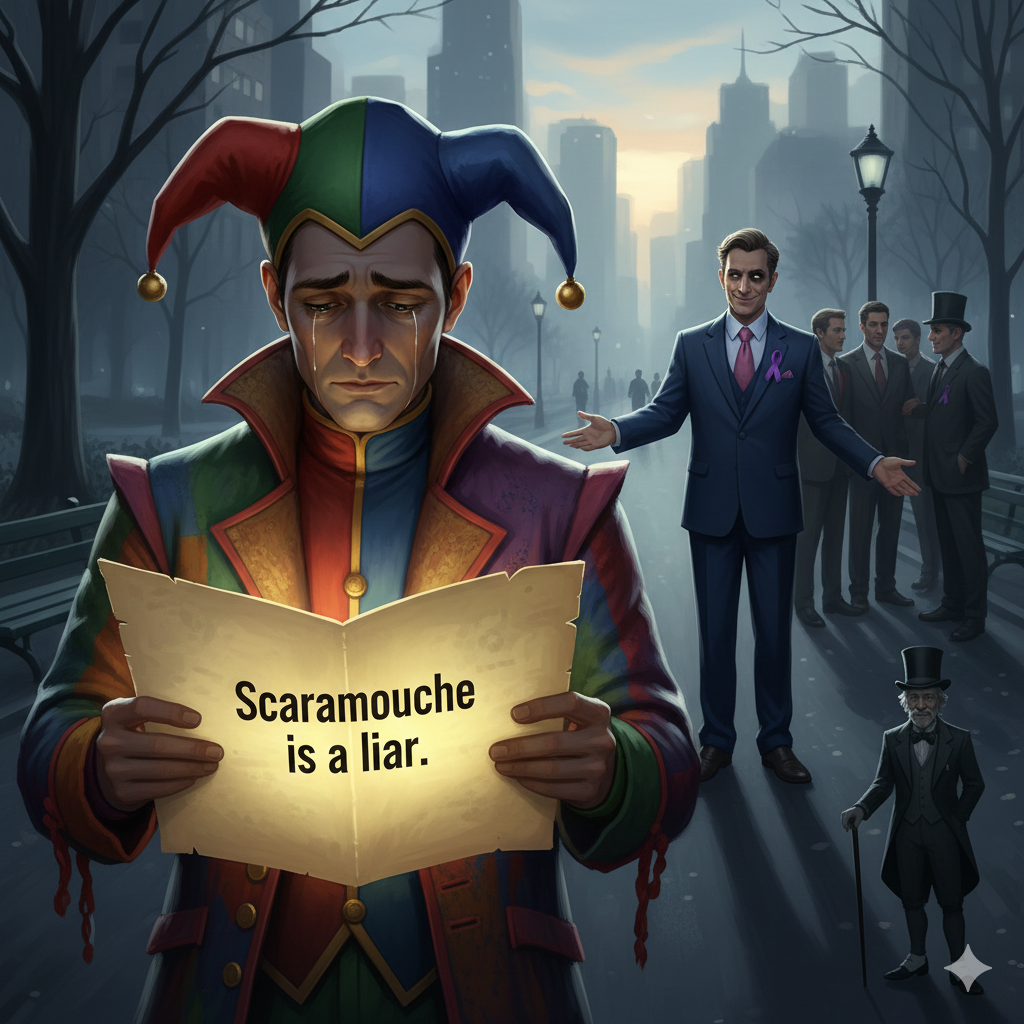
It is many days later before Harlequin sees Scaramouche again. It is at a distance. Scaramouche is with a group of business associates. He is dressed, as always, in a smart blue suit, bright white shirt, a dusky pink tie and a kerchief of matching hue pokes out of his top pocket. He is quite impeccable. He has a ribbon pinned to his lapel. It is to raise awareness of the dangers of testicular cancer in the young: a worthy cause, indeed. Harlequin, too, looks just as we first saw him in his hand-made, rustic coat of many colours. For a moment, Harlequin watches Scaramouche but Scaramouche is not aware that he is being observed. Scaramouche’s smile is warm and inviting. His eyes flash. He is glancing obliquely to left and right, saying little and listening intently to his companions as he mimes his habitual role as the ‘man of integrity’. His lashes are lowered and there is an asymmetry to his smile. It is clear to Harlequin that Scaramouche has a secret.
Suddenly, Scaramouche looks up. His eyes meet those of Harlequin. For an instant, there is panic. His eyes widen and his cheeks flush for, as soon as he had left Harlequin at the parting of the ways, his sincerity had become a miasma. But this resurrection is only for a fraction of a moment and the others in Scaramouche’s group are not even aware that Scaramouche’s mask has slipped. As his eyes dart back behind those concealing lashes, it is Harlequin whose gaze remains steady. As he stares, Scaramouche’s appearance seems to change before his eyes. The clothes remain as pristine as ever but the man inhabiting them seems to wither. Somehow, he is smaller and more frail. His flesh seems pinched. His smile is frozen. His eyes are black. As he nods his head in apparent agreement with something someone else says, Harlequin can see Scaramouche’s face contort into a smirk. He does not agree but the other thinks that he does. Harlequin shudders; Scaramouche is a liar.
As he turns away, Harlequin sighs. What he has seen does not please him. He takes no satisfaction in learning that Scaramouches do not change their natures. He cries, not so much for the loss of a friend he never truly had but for Scaramouche, who once did. As the tears slip down his cheeks, Harlequin pulls an old piece of yellowing parchment out of his pocket. Its very thickness and strange dark text speaks of ancient wisdom. He unfolds it to find, written in bold arial font, ‘Scaramouche is a liar.’
At that very moment, Harlequin could have sworn on oath that, out of the corner of his eye, an old gentleman, with a trim little beard, in top hat, tails and spats and carrying a walking cane, winked at him.