

The Power of Small Words: Why Prepositions Matter
For 4 years, I was responsible for developing whole-school literacy. I had acquired this role as a result of my work developing extended writing in Humanities, over more than a decade. Throughout this time, I found myself fighting a constant battle. My ‘enemy’ was ‘keywords’. Headteachers love them. Curriculum heads love them. Teachers love them.
Why?
Because it’s an easy answer to ‘doing something about literacy’. It’s so easy to create a list of ‘topic’ words and put them on a poster. It’s much harder to teach grammar and punctuation.
First, let me slay the dragon, however. I’ve never said that vocabulary is unimportant. It’s very important, especially where technical and specialist vocabulary is critical to understanding. It’s just as important where an item of vocabulary has a particular meaning in the context of an academic subject, but a different meaning elsewhere.
BUT …
What I learned from my work with students is that an approach to literacy which is driven entirely by a focus on vocabulary can actually be counter-productive, and that many of the real problems young people experience with writing are related to grammar, not vocabulary. I discovered that a literacy policy which prioritises the teaching of grammar is far more effective in improving overall outcomes and in improving literacy generally than one which solely focuses on vocabulary.
A lightbulb moment occurred when I spent half an hour studying an essay by an A Level History student. There was absolutely nothing wrong with the argument which the student was trying to create. The facts were all correct. The concepts were all understood. But it was an absolutely horrible thing to read. I wondered why that was. After a good 30 minutes reading and re-reading the piece, I realised that the student was attempting to construct every single sentence around a noun - and I realised that these nouns were what the student regarded as the ‘keywords’ of the topic. I told the student to re-write the piece without changing a single fact or idea, but to do so by focusing on the verbs in the sentence. I demonstrated how to do this. She did it …. and the transformation was incredible. It turned a mediocre essay - which might have been Grade D standard - into something closer to a Grade A. Unbelievable! As a result, I began to apply the principle to students lower down the school and I discovered the same thing. Almost all ‘keyword’ lists were nouns. Students were being told to make sure that they used the keywords in their answers. The impact was that students were being conditioned to construct all answers around nouns, not verbs. And that caused them to mangle up the grammar, distorting the meaning and making it hard for the reader to work out what they were actually trying to say. The end result of that is that students were losing marks in examinations purely because of the way they were communicating, rather than because of their substantial knowledge and understanding. - and the root cause of that was a literacy policy which focused exclusively on vocabulary at the expense of grammar.
Another anecdotal example was an A Level Geography student. Her teacher came to me in despair. This girl was an incredibly keen Geographer. She worked hard. She understood the Geography. But … her written answers were so poor that she would be lucky to obtain a Grade E. I studied her work and I explained the problem. I told him to ask the girl to re-write her work, modelling it upon his writing style and, once again, focusing less on vocabulary and more on verb construction. She did - and, bless her, she did it consistently for 18 months. She turned that probable Grade E into an actual Grade A. She did it almost entirely by changing her writing style.
I began to look at teaching disciplinary literacy to teenagers through a completely different lens: vocabulary and grammar must be taught together.
I discovered that another way in which the quality of writing could be improved was by using prepositions correctly. So many young people, I learned, deploy the wrong preposition. In conjunction with poorly constructed verbs, this really does make a piece of writing into an unreadable mess.
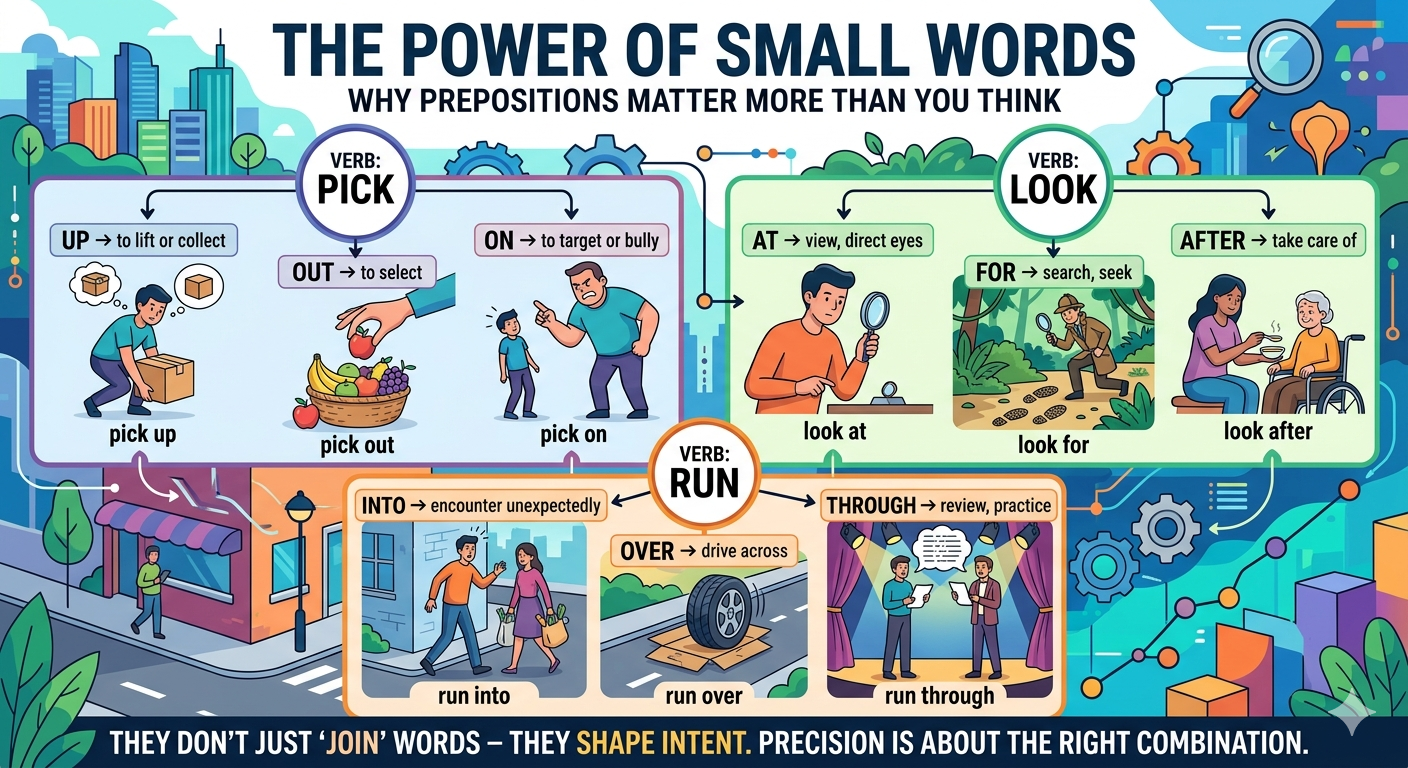
Let’s take the verb ‘pick.’
Pick ‘up’ - to lift or collect
Pick ‘out’ - to select
Pick ‘on’ - to target or bully
The same verb is being deployed but the meaning are completely different, simply because of a different choice in preposition. Prepositions really do shape meaning.
Consider the following:
Look ‘at’ vs look ‘for’ vs look ‘after’.
Run ‘into’ vs run ‘over’ vs run ‘through’.
Turn ‘up’ vs turn ‘down’ vs turn ‘on’.
Thus, prepositions do some seriously heavy lifting in terms of conveying the meaning of a sentence. Good writing is as much about choosing the right combinations of words as it is about using ‘key’ words, - the specialist topic words of a subject. In short, an approach to improving literacy which is dominated by an emphasis on vocabulary at the expense of grammar is fundamentally inadequate. It’s not just about knowing words.: it’s about knowing how to use them.