

The Problem with ‘due to’
‘Why have you spoiled a really good essay by pooing all over it with “due to”s?’
This was me, being very brutally honest with an A Level student some years ago. I wasn’t being unkind and the student went on to achieve an A* in her A Level History exam. It was, however, a common problem. Many of my students would litter their writing with ‘due to’, and the impact was that it reduced the quality of their writing and, consequently, their grades. Indeed, I have spent many hours crossing out ‘due to’ and replacing it with ‘because’ or ‘as a consequence’.
And it isn’t just students. I’ve proofread whole books where experts in a particular field have also repeatedly used ‘due to’. When this happens, it leaves the reader in the position of having to fill in an explanation for themselves and, in effect, guess what the writer was alluding to and what relationships he or she wanted the reader to understand.
Now, it isn’t that the phrase ‘due to’ should never be used nor that it is intrinsically wrong grammatically. It isn’t. But …. too many writers use it as a form of shorthand to evade explanation, and this is the very last thing that any writer should do. In effect, they are asking the reader (or the examiner) to infer understanding from text which doesn’t explain it.
Take the following example:
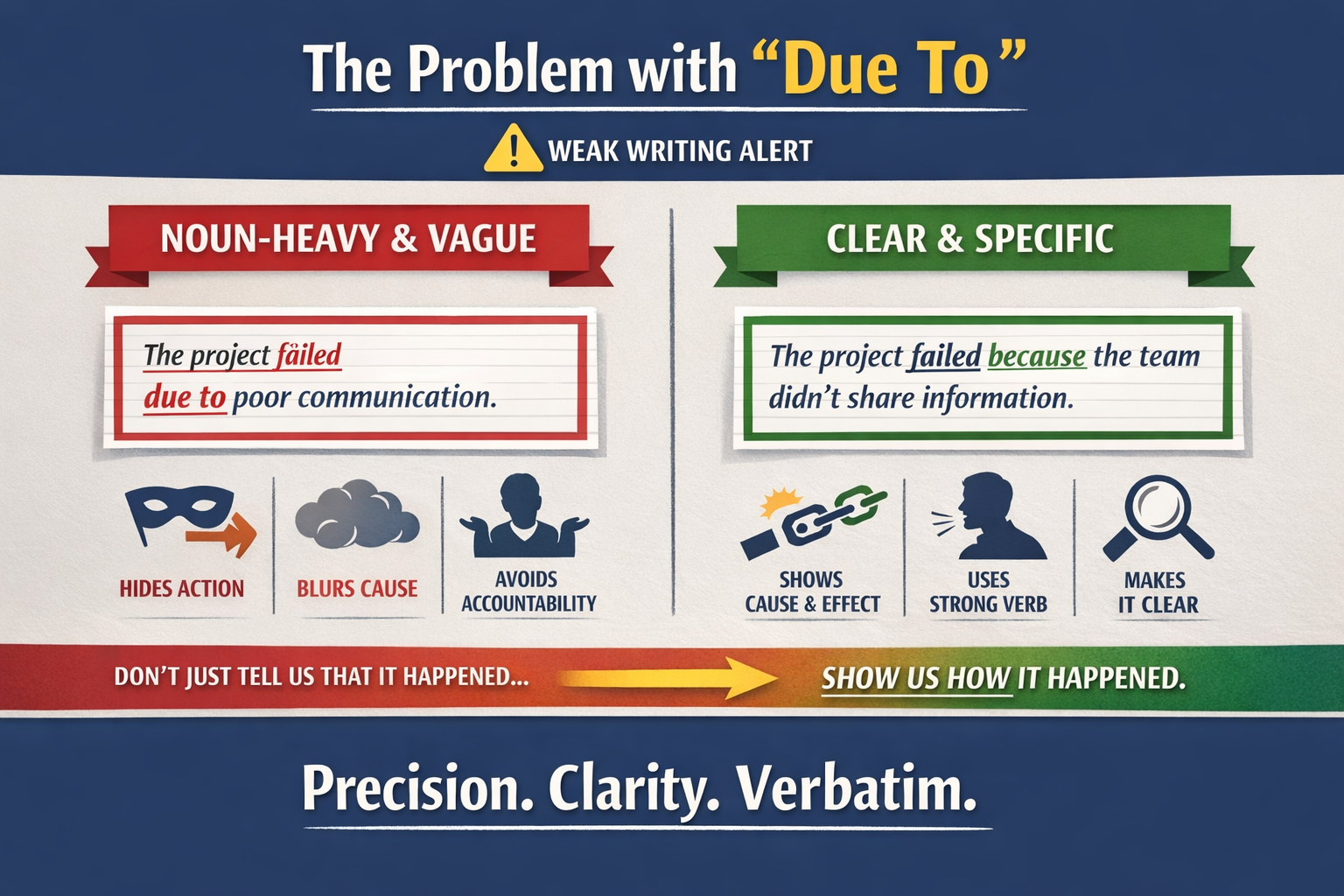
The project failed due to poor communication.
vs
The project failed because the team didn’t share critical information.
The first simply states a reason. The second explains a reason. The grammatical point behind this is that ‘due to’ frequently leads writers to focus on a noun whereas ‘because’ leads writers to focus on a verb. The former is static whereas the latter demonstrates cause and effect.
Here’s a second example:
The delay was due to a signalling fault.
vs
The train was delayed because the signalling system failed.
In both cases, the phrase ‘due to’ is followed by a noun - ‘poor communication’ and ‘signalling fault’, whereas ‘because’ is followed by a verb ‘didn’t share’ and ‘failed’. This habit of deploying ‘due to’ is very much one of those unintended consequences which happen when a school’s literacy policy emphasises ‘keywords’ rather than precision in grammar. The student is subliminally conscious of the need to use the ‘keywords’ (and these are invariably dominated by nouns) so their mind is focused on structuring a sentence based on a noun. ‘Due to’ fits that model precisely. Thus, instead of creating a sentence based around a verb and creating an explanation, the student reaches for the keyword noun and writes: ‘The decrease in reaction rather was due to catalyst degradation.’ rather than ‘The reaction rate decreased because the catalyst’s active sites were blocked by impurities.’
So - a good rule is this: use ‘due to’ when describing a state but avoid it when explaining an action. Above all, do not expect a reader to infer a causal relationship between two phenomena unless the writing makes that relationship clear.
The purpose of writing is to communicate. It is never up to the reader to guess what the writer intended. It is always up to the writer to make their meaning clear to a reader. Clarity should always come before complexity. Punctuation and grammar are tools writers use to convey meaning, so recognising when it is appropriate to use a phrase like ‘due to’ and when it is not is an aid to good writing.